
Google Patents a Text-Only Image Editor That Fine-Tunes Itself on Your Photo
Most AI image editors make you draw a mask, provide a sketch, or carefully crop the area you want changed. Google's UniTune patent describes a system that skips all of that — you hand it a photo and a sentence, and it figures out the rest.
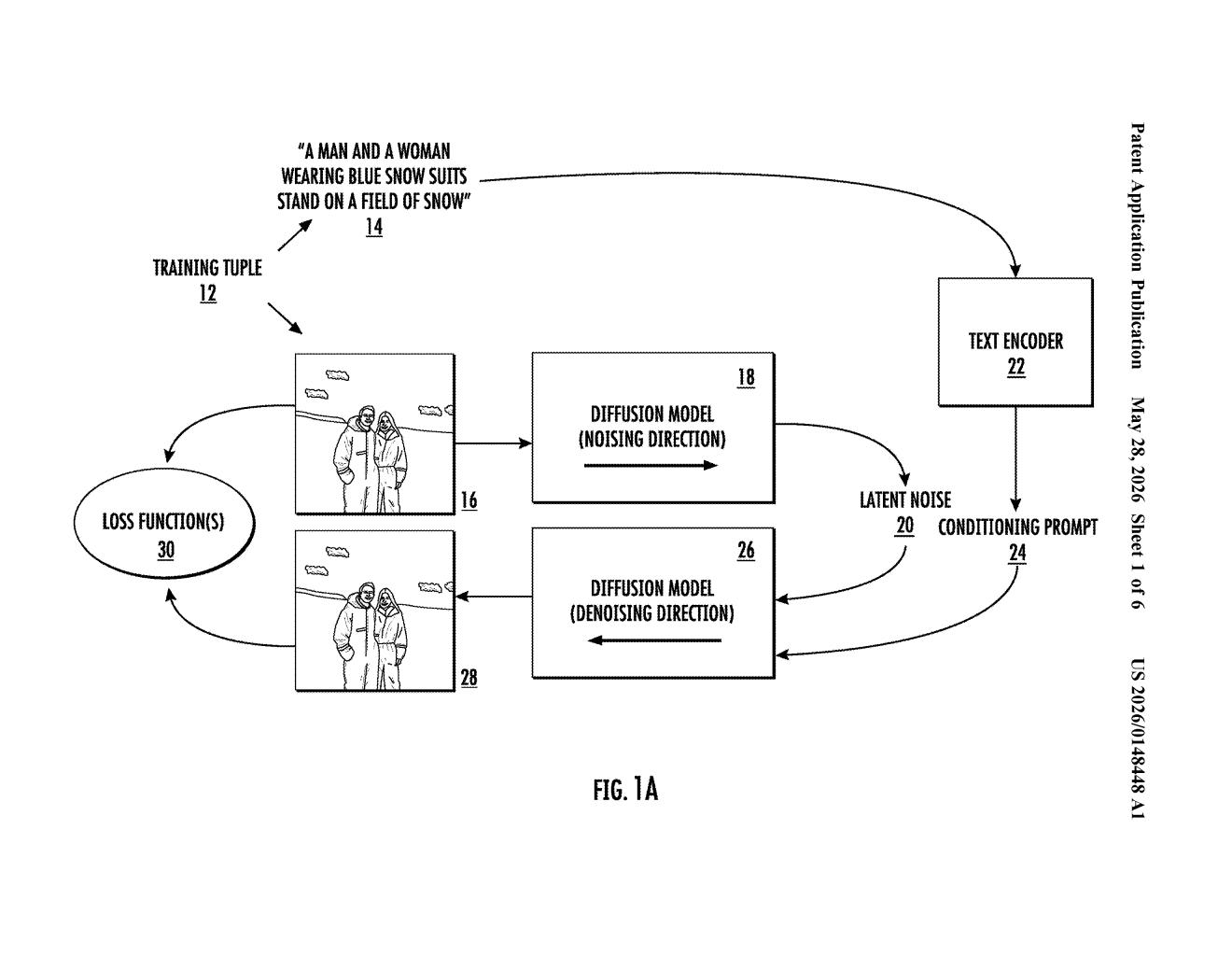
What Google's UniTune image editing actually does
Imagine you have a photo of two people standing in a snowy field and you just want to change their jackets to red. With most AI editing tools, you'd have to manually select the jackets, maybe provide a reference sketch, and hope the tool doesn't smear the background. It's fiddly work.
Google's UniTune system takes a different approach. You give it the photo and a plain-English description of what you want changed — that's it. No masks, no sketches, no extra inputs. The system uses a text-only instruction to make the edit while keeping everything else in the image looking faithful to the original.
The trick is that UniTune temporarily fine-tunes a large AI image model specifically on your single photo before making any changes. That short training session teaches the model what your image looks and feels like, so when it applies your edit, it doesn't accidentally reinvent the whole scene. The result is edits that feel targeted and visually consistent rather than AI-generated from scratch.
How UniTune fine-tunes Imagen on a single image
UniTune is built on top of a large diffusion model — the same class of AI behind tools like Stable Diffusion or Google's own Imagen. Diffusion models generate images by learning to remove noise from a noisy signal, guided by a text prompt.
The core innovation here is image-specific fine-tuning. Before generating any edited output, the system creates what the patent calls finetuning tuples — pairs of the base image alongside a descriptive prompt that captures what the image contains. The diffusion model is briefly trained on these tuples, nudging its weights to be highly faithful to the specific visual and semantic content of your input photo.
Once that short fine-tuning step is done, the system takes your edit prompt (your natural-language instruction, e.g., "make the snow suits red") and runs it through the now-image-aware model. Because the model has been conditioned on the original image, it can make expressive edits without losing the structural and contextual integrity of the scene.
Key characteristics the patent emphasizes:
- Works on arbitrary images — no domain-specific training required
- Requires only a text description of the desired change, not masks or sketches
- Balances visual fidelity (it still looks like your photo) with semantic fidelity (the scene still makes sense)
- Fine-tunes on a single image at inference time, not at dataset scale
What this means for AI photo editing tools
The friction in today's AI image editing tools is often the setup work — masking regions, aligning references, and correcting artifacts after generation. A system that skips that layer and delivers coherent edits from text alone lowers the barrier significantly. For anyone using Google Photos, Workspace, or a future Pixel-era creative tool, the practical upside is that you describe what you want and get something that still looks like your photo.
The deeper strategic point is that Google is building toward editing pipelines where the model adapts to your content rather than you adapting to the model's quirks. That's a meaningful shift in who does the work. Whether UniTune ships as a consumer feature or stays as research infrastructure, the approach it demonstrates — fast single-image fine-tuning at inference time — is a direction the whole field is moving toward.
UniTune is a genuinely interesting research contribution, and the no-mask, text-only approach is the right UX target for mainstream image editing. The single-image fine-tuning idea is elegant: instead of building a complicated inpainting pipeline, you just teach the model what matters about this photo before you touch it. The real question is latency — fine-tuning at inference time adds cost, and that tradeoff will determine whether this stays a paper or becomes a product.
There are more where this came from
We read every patent application Big Tech publishes and send you the ones worth knowing. Plain English, free, every week.
Want this weekly breakdown for a company we don't cover? Patentlyze Pro →