
Google Patents a Way to Let AI Reconstruct Any Camera Angle From a Few Photos
Google wants an AI to look at a handful of photos of a place and confidently generate what the scene would look like from a completely different angle it never saw. A new patent describes a key piece of that puzzle: teaching the model exactly where each photo was taken before it starts synthesizing.
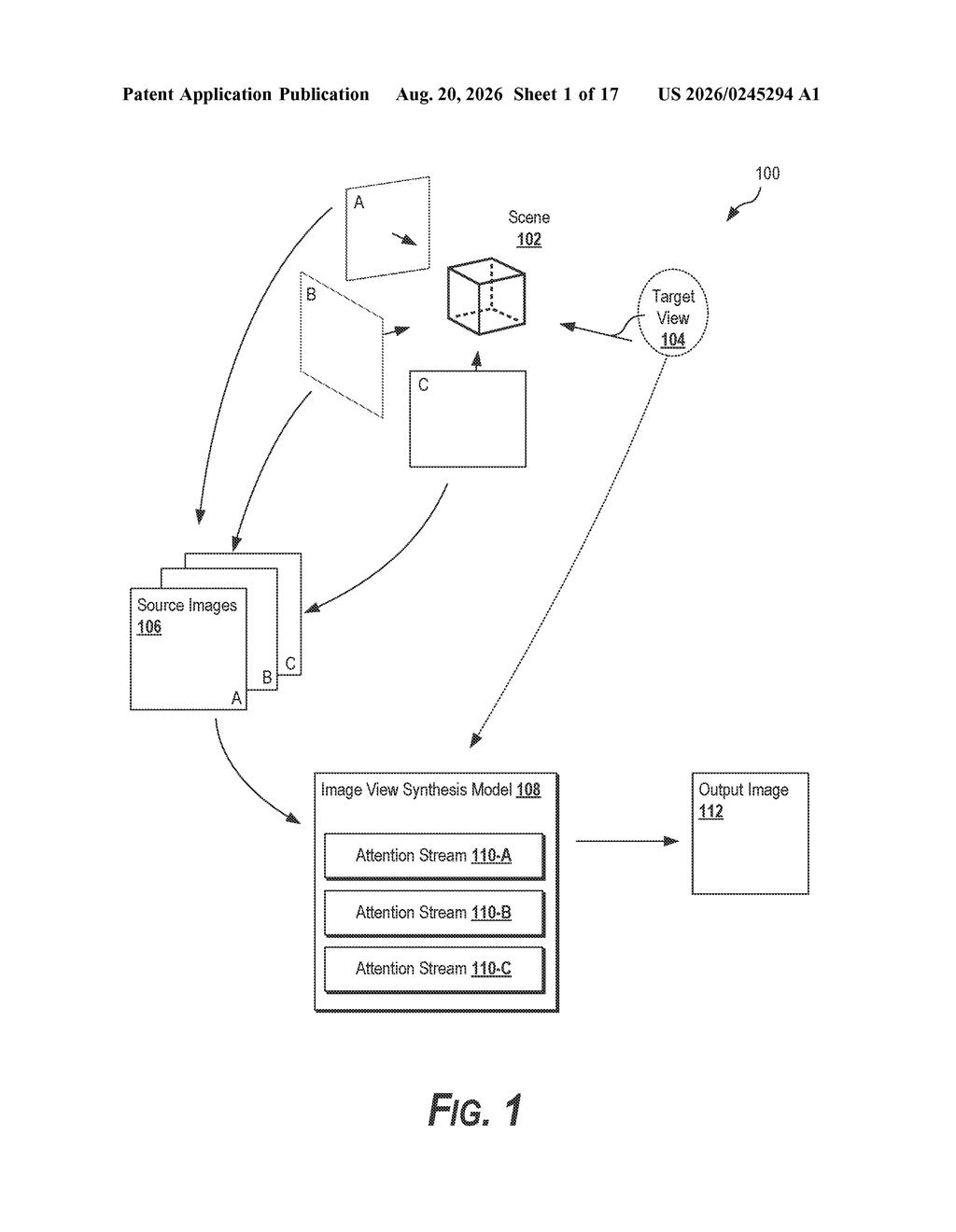
What Google's view-synthesis attention system actually does
A photographer snaps six pictures of a sculpture from different spots in a gallery. Then a viewer at home wants to see the sculpture from a seventh angle no one ever photographed. That gap between what exists and what someone wants to see is the problem Google is working on.
Google's patent describes a system where, before an AI tries to fill in that missing viewpoint, it gets told the precise camera position behind each of the six photos it does have. The AI uses that location information to figure out how each existing photo relates to the new angle being requested. Instead of guessing blindly, it knows the geometry before it starts.
The result is a model that can generate a new image of the scene from an angle that was never photographed, using only a small set of reference images and their camera positions as inputs.
… generating, by the computing system and based on the query, a plurality of pose-augmented queries, each respective pose-augmented query encoding pose information relative to a respective source pose associated with a respective source image of the plurality of source images; …
Translation: The system combines the target angle with data about where the original photos were taken.
How pose-augmented queries guide each attention stream
The patent covers a method called pose-augmented query generation for image view synthesis. Here is how it breaks down:
- Query: The system is given a target viewpoint, a description of the angle from which the output image should appear. This is the "question" the AI needs to answer.
- Source poses: The system identifies the camera positions (called poses) for every reference photo it has available. A pose encodes where the camera was in 3D space and which direction it pointed.
- Pose-augmented queries: Rather than sending one generic question to the model, the system creates a separate, modified version of the query for each reference image. Each version is adjusted to encode how the target angle relates geometrically to that specific source photo.
- Parallel attention streams: Each modified query is processed by its own attention stream (a focused sub-pathway inside the neural network that weighs how relevant different parts of a reference image are to answering the query). Running them in parallel lets the model consider all reference images simultaneously.
The model then combines the outputs of all those attention streams to produce the final synthesized image. The core idea is that baking camera-position math directly into the query, rather than leaving it to the model to figure out implicitly, gives the neural network a cleaner signal about spatial relationships.
… processing, by the computing system, the plurality of pose-augmented queries respectively with a plurality of attention streams of a machine-learned image view synthesis model; …
Translation: An artificial intelligence model processes these angles using multiple streams of data at once.
What this means for AI-generated 3D imagery
View synthesis sits at the heart of several active product areas: AR/VR scene reconstruction, photo editing tools that let you "move" the camera after a shot is taken, and 3D map generation from street photos. Google has obvious commercial interest in all three. A model that handles relative camera positions more explicitly could produce fewer visual artifacts and require fewer reference images to do its job well, which matters a lot for any application where you cannot control how many photos a user provides.
The technique is specifically targeted at neural network attention, the same architectural ingredient that powers large language models and image generators, so improvements here tend to be broadly applicable. Google's work in this area sits alongside the steady flow of new Big Tech patents pushing AI-generated imagery closer to the kind of spatial accuracy that real-world AR and mapping products demand.
Google's 39th filing we've tracked since May in our AI photo editing race coverage builds on earlier applications like dual-sensor sharpening and teaching AI from photo examples.
The first and broadest claim covers the general idea of asking a computer to build separate questions about each camera angle and then process them all at once in parallel. It names no specific math, no specific design, no minimum number of photos.
That vagueness matters enormously. If approved as written, this claim could cover almost any system that follows the same basic steps, no matter how differently the engineering works under the hood.
Everything depends on how the US Patent Office reads one key phrase about how those camera-angle questions are formed. But as written, this filing plants a flag over a method that sits at the heart of how computers today build instant 3D images from ordinary photos.
There are more where this came from
We read every patent application Big Tech publishes and send you the ones worth knowing. Plain English, free, every week.
The drawings
17 drawing sheets from US 2026/0245294 A1 · click any drawing to enlarge


Want this weekly breakdown for a company we don't cover? Patentlyze Pro →
Be the first to weigh in