
A New IBM Patent Lets Chips Skip Steps When Crunching Encrypted Data
IBM has filed a patent application for a chip design that lets some encrypted calculations finish in as few as 1 or 2 steps, where older designs take 12. It does this by adding a few switches to circuits that chips already have.
How IBM reuses chip circuits to shuffle encrypted data
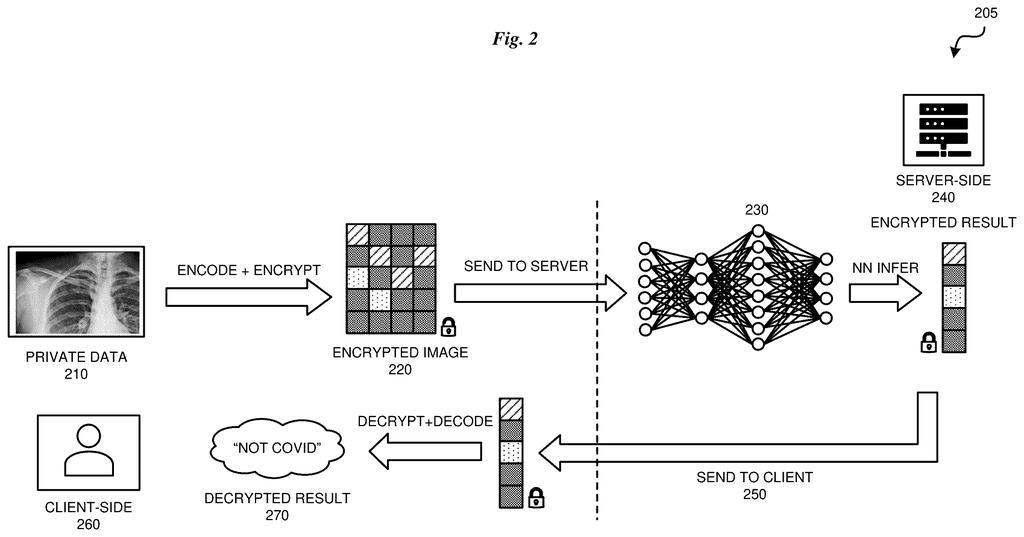
Every time a cloud service does math on data it isn't allowed to read, it pays a steep price in speed. That is the deal with homomorphic encryption, a method that lets a server work on locked-up information, such as medical records, and send back a locked answer only you can open. The filing says this is orders of magnitude slower than working on plain data.
IBM's patent application goes after one chore in that process: reshuffling the encrypted values so they line up for the next calculation. Instead of building a separate piece of dedicated hardware for it, IBM adds simple on/off switches to circuits that chips already use for another kind of math. A short instruction tells each switch what to do for the shuffle you need.
The payoff is that, for many shuffles, the data can leave the circuit early. Fewer steps means less time and less power spent on the job.
… generating, by executing a specially purposed configuration instruction within a configuration component of the Homomorphic Encryption system, a switch rule for each processing cell of the set of processing cells; …
Translation: The chip creates specific rules for each processing unit by running special setup commands.
How the switches let a chip skip stages
Homomorphic encryption lets a server add and multiply data that stays encrypted the whole time. The filing focuses on a scheme called CKKS (popular for machine learning because it handles decimal numbers), where one encrypted package holds a whole list of values in "slots." Rotating that list under encryption is done by an automorphism, which reshuffles the numbers inside the underlying polynomial (the math object that stores the data) using the rule i × 5^r mod N.
Existing designs use dedicated Benes or Omega networks (fixed webs of switches), which take (2 log N - 1) or log N stages no matter which rotation you want. IBM's claims describe a butterfly network instead: rows of small processing cells wired in stages, the same layout used in chips that run Fourier-style transforms. Each cell gets multiplexors (electronic switches) so it can either pass or swap values for the shuffle, or do its usual transform math.
- A special configuration instruction takes the polynomial size and the rotation amount, and outputs a switch rule: a set of configuration bits for each cell.
- The network then runs the shuffle using fewer than log N stages, and one version uses N/2 cells for a rotation on N elements.
- The rules can be worked out ahead of time and stored for later.
In the filing's examples for N=4096, half of the rotations take 10 stages versus 12 for Omega and 23 for Benes. A rotation of 512 takes just 1 or 2 stages, and other rotations take 8 to 10.
… where the Homomorphic Encryption system computes an automorphism operation by traversing the butterfly network according to a number of input elements of the automorphism operation.
Translation: The system calculates encrypted data transformations by routing them through a network of processing cells.
Why faster encrypted math matters for private data
If you ever use a service that analyzes your health or financial records without seeing them, chip work like this decides whether that service is fast and affordable. The filing's own diagnosis is that encrypted computing is too slow for many real uses, and extra dedicated circuits add chip area and power draw. Reusing existing transform circuits and exiting early attacks both costs.
The filing describes hardware such as FPGAs and ASICs, not a specific IBM product. The examiner's first review rejected the claims as filed, which is routine at this stage and usually followed by amendments, so the final scope could change.
IBM's 437th filing in our IBM coverage since May adds to a pattern that includes a secret AI identity quiz and code-purpose memory for AI tools.
Hospitals and banks want to run AI on sensitive records without exposing them, but encrypted math is so slow it rarely leaves the lab. The filing acknowledges that gap directly, and it is the main reason private computing has not reached everyday products.
The specific problem attacked here is a shuffling step inside that encrypted math, and the patent claims it can be done in one or two passes instead of twelve. That is a narrow fix on a large slowdown, but fixing it without adding new chip hardware means the saving comes essentially for free.
Engineers building the chips that will eventually power private medical and financial services will find this useful. The rest of us will feel it only when the cumulative effect of many such fixes finally brings encrypted computing to the speed where real products can be built.
Get our take in your Top Stories
Liked this breakdown? Add Patentlyze as a preferred source on Google, and our plain-English take shows up more often in your Top Stories the next time IBM patent news breaks.
There are more where this came from
We read every patent application Big Tech publishes and send you the ones worth knowing. Plain English, free, every week.
The drawings
11 drawing sheets from US 2026/0352438 A1 · click any drawing to enlarge


Show the other 3 sheets


Want this weekly breakdown for a company we don't cover? Patentlyze Pro →
Be the first to weigh in