
Google Patents a Way to Catch Cheating Clients in Encrypted Database Searches
When you search a database privately, how does the server know you're playing by the rules? Google has filed a patent for a hidden verification trap that catches clients trying to game encrypted search systems, without ever revealing what you actually searched for.
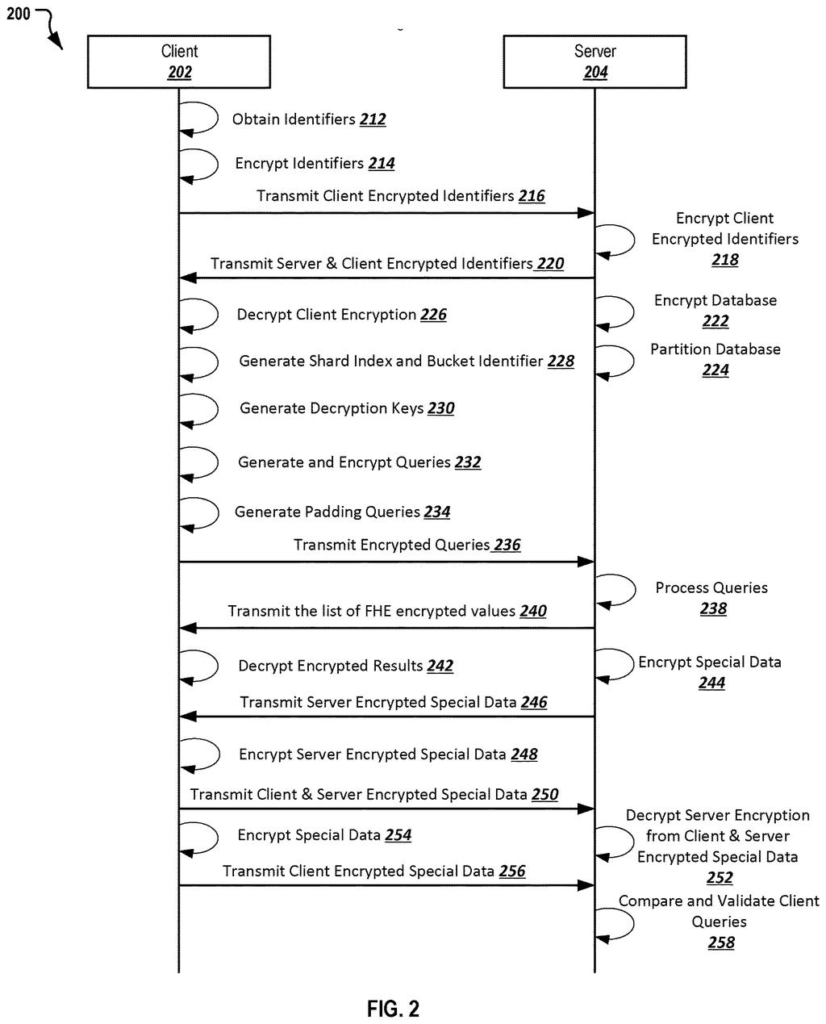
How Google's secret-share trap works in private searches
Private database search has a trust problem built into its design. To hide what you're really looking for, clients typically send a mix of real queries and fake "padding" ones, so the server can't tell which question actually matters. But that same cover also makes it easy for a dishonest client to skip the fake queries and break the privacy guarantees the system depends on.
Google's patent describes a way to catch that kind of cheating using what it calls "secret shares." The server hides pieces of a secret code inside the padding queries. If your device is playing fair, it will accidentally collect those pieces and hand them back in a way that lets the server verify you followed the rules. If you skipped the padding, the pieces won't add up, and the server can lock you out.
Critically, none of this reveals what you were actually searching for. Your real queries stay private. The trap only checks how you searched, not what you searched for.
… receiving, at the server device and from a client device, a batch of queries comprising real queries and padding queries, wherein the padding queries are directed to the special buckets; …
Translation: The server watches for fake searches mixed in with real ones to test the client.
How the server plants and verifies its hidden secret shares
The system operates on a type of private database called a partitioned database (one split into "shards," or chunks, spread across a server). Standard private-information-retrieval protocols require the client to send extra "padding" queries alongside real ones so the server cannot identify which query is genuine.
Google's method turns those padding slots into a verification mechanism:
- The server generates secret shares, fragments of a secret value that only make sense when enough pieces are combined, and tucks one into each shard's "special bucket."
- When the client sends its batch of real and padding queries, the padding queries hit those special buckets and pull back the secret-share fragments.
- The client must reconstruct the full secret from the pieces it received and send that reconstruction back to the server.
- The server compares the returned reconstruction to the original secret. A match means the client sent proper padding. A mismatch flags cheating.
If cheating is detected, the server withholds the cryptographic salt (a random value used to derive the encryption keys that unlock the database). Without that salt, the client cannot decrypt any of the results it received, making the attack useless.
The scheme relies on the mathematical property of secret sharing: you need a minimum number of fragments to reconstruct the secret. A client that skips padding queries will be missing fragments and will fail the check.
The client device is classified based on how many of the secret shares are included in both of the client-encrypted secret shares received from the client device and the full set of client-server-encrypted secret shares received from the client device.
Translation: The system catches cheaters by checking if they properly processed hidden test data.
What this means for private search tools and user trust
Private information retrieval is a building block for services where you want to look something up without the server knowing what you looked for, think password-breach checkers, private contact discovery, or privacy-preserving ad targeting. These systems are only trustworthy if clients cannot game the protocol to gain an advantage or reduce their own costs by dropping the required padding.
This patent makes enforcement possible without adding a surveillance layer. The server learns nothing about your real queries; it only learns whether you followed the protocol. For developers building privacy tools on top of Google's infrastructure, that distinction matters: you can have accountability and privacy at the same time, at least within the limits this design sets.
Google's 746th filing in our Google coverage since May continues its AI sensing work, joining applications like the locked video background and the face-recognizing TV.
The verification scheme works by watching whether you send the right number of decoy queries, which means the server learns something new about your behavior. A system designed to be blind to what clients do is now, in a narrow but real way, watching.
That cost lands differently depending on who you're worried about. If the threat is a cheating user who skips the decoys and degrades privacy for everyone else, this tradeoff makes sense. If the threat is the server learning too much about the people using it, this design moves in the wrong direction.
The underlying mechanism, repurposing the decoy queries as a compliance check, is a clever reuse of existing machinery. But the shift is meaningful: from a server that cannot see client behavior, to one that can verify it. Any deployment should say that plainly.
There are more where this came from
We read every patent application Big Tech publishes and send you the ones worth knowing. Plain English, free, every week.
The drawings
6 drawing sheets from US 2026/0291718 A1 · click any drawing to enlarge


Want this weekly breakdown for a company we don't cover? Patentlyze Pro →
Be the first to weigh in