
Microsoft Patents an AI Coordinator That Picks the Right Helpers for Each Question
Most AI assistants treat every question the same way. Microsoft's new patent describes a smarter approach: a coordinator that reads your question, ranks a roster of specialized sub-agents, and only calls in the ones most likely to actually help.
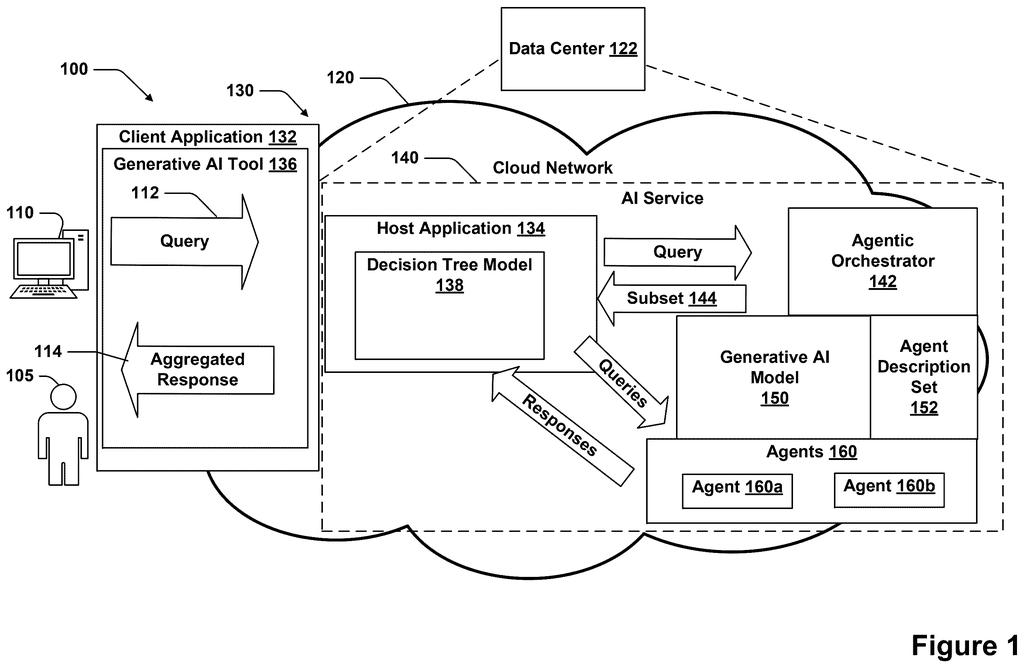
How Microsoft's AI dispatcher decides who answers your question
Right now, when you ask an AI assistant something, the whole system often has to sort through every tool and database it has access to, even the ones that have nothing to do with your question. That wastes time and can muddy the answer.
Microsoft's patent describes a "meta-orchestrator," essentially a dispatcher that sits above a team of specialized AI agents. Each agent handles a particular topic or task. When you send in a question, the orchestrator scores every agent on how relevant it is to your specific query, then forwards the question only to the agents that ranked high enough.
There's also a clever self-limiting mechanism. The system includes a "separator" entry in the ranking list. If your question doesn't clearly fall into any agent's area, the separator tells the system to stop adding agents rather than pulling in everything it has. The responses from the selected agents are then combined into a single answer sent back to you.
… apply the query to an orchestrator to select a subset of agents to answer the query, the orchestrator applying a relevance ranking algorithm to the query and an agent description set including a description of each agent and a description of a separator class having a description of context outside of a domain of the plurality of artificial intelligence agents …
Translation: The system uses an orchestrator with a relevance ranking algorithm to choose the best helper agents for any given question.
Inside the separator-class ranking that filters out wrong agents
The system centers on three layers working together.
The orchestrator is the top-level coordinator. It receives a query and runs a relevance ranking algorithm (a scoring method that measures how well each candidate matches the question) against a list called the agent description set. That set contains a plain-text description of what each agent does, plus one special entry: the separator class.
The separator class is the key novelty here. Its description covers context that falls outside the domain of any real agent. When the orchestrator ranks all the entries, the separator's position in the ranked list tells the system exactly how many agents are genuinely relevant. Any agent that scores below the separator gets dropped from consideration automatically.
The selected agents each receive the original query independently and return their own responses. The host application then aggregates (combines) those responses into one unified reply for the user.
- Query comes in from the client application
- Orchestrator scores all agents plus the separator entry
- Agents ranking above the separator are selected; the rest are ignored
- Selected agents each answer the query in parallel
- Aggregated response is returned to the user
The orchestrator may dynamically select a number of the agents in the subset based on a ranking of the separator class, which is associated with a description of context outside of a domain of the plurality of artificial intelligence agents.
Translation: It can automatically decide how many helpers to use based on whether the question falls outside their expertise.
What multi-agent routing means for your everyday AI assistant
As AI products add more specialized tools, the question of which tool to call becomes its own hard problem. Calling too many wastes compute and can produce contradictory answers; calling too few means missing information the user needed. Microsoft's separator trick gives the system a principled way to draw that line automatically, without a human manually tuning how many agents to use for each type of question.
For products like Microsoft 365 Copilot, which already connects AI to email, documents, spreadsheets, and web search simultaneously, Microsoft has been filing around multi-agent AI orchestration since early 2025 a routing layer like this could mean faster, more focused answers rather than an AI that throws everything at the wall. The practical payoff for you would be responses that arrive more quickly and stay on topic.
Microsoft's 34th filing we've tracked since May in our AI teams of models watch, following a chain-of-networks video approach and role-specific meeting assistants.
The gap between this patent and a working product is unusually small. Everything described runs on software and existing computer infrastructure, with nothing that requires new physical hardware to be invented first.
The one clever addition is a built-in stopping rule. Rather than a developer manually deciding how many helpers to involve for each type of question, the system slots a special "none of the above" option into its ranking and uses wherever that option lands as a natural cutoff, automatically scaling up or down without anyone rewriting the rulebook.
Twelve named inventors on a single filing suggests this idea has already been argued over and refined inside the company, not just sketched out. That is a reasonable sign that something built on this approach could reach everyday users faster than a typical patent filing might imply.
There are more where this came from
We read every patent application Big Tech publishes and send you the ones worth knowing. Plain English, free, every week.
The drawings
7 drawing sheets from US 2026/0300782 A1 · click any drawing to enlarge


Want this weekly breakdown for a company we don't cover? Patentlyze Pro →
Be the first to weigh in