
IBM Files Patent for Picking the Best AI Model When One Score Isn't Enough
Choosing between AI chatbots usually comes down to one blended score, which can hide the rare bad answers. IBM's patent application ranks models on several measures at once and then puts the winner to work.
What IBM's AI model ranking system actually does
Today, comparing AI language models often means boiling many qualities, such as fluency, instruction following and harmlessness, down to a single number. IBM's filing says that shortcut ignores how those qualities relate to each other, and it overlooks the risk of the occasional biased or harmful answer hiding behind a good average.
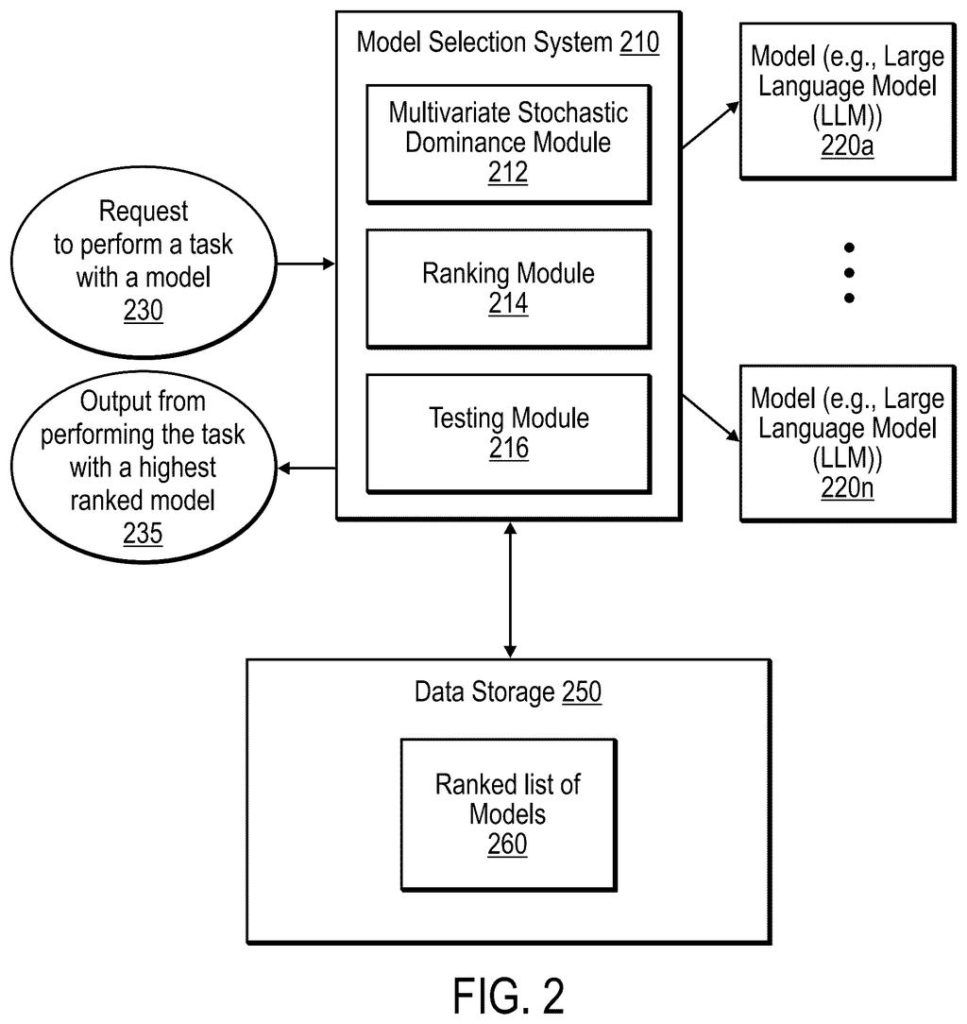
So IBM describes a system that takes your request, say a task plus the measures you care about, and finds a group of models suited to the job. It then compares every pair of models head to head across all your measures together, producing a score between zero and one for each matchup.
Those scores turn into a ranking, and the top model does the work. If you asked for safe, accurate writing, the model that holds up best across the board gets the job, not just the one with the best average.
… computing a multivariate stochastic dominance violation ratio for each pair of the plurality of models to output normalized indices using the plurality of metrics …
Translation: Comparing how well different AI models perform across several different measurements at the same time.
How IBM scores every pair of AI models
The patent describes a model selection system that takes a request to do a task, plus a list of metrics (the scores you care about). It finds candidate models for that task. For example, classification models for a classification job, or medical models for a diagnosis job.
The core step is a multivariate stochastic dominance violation ratio. In plain terms, one model "dominates" another if it does better across the whole range of outcomes, including the unlucky ones. The ratio measures how badly that dominance is violated, and it is calculated for each pair of models. The top half is a measure of how far model A falls short of dominating model B, and the bottom half rescales the result to sit between zero and one. Under the example in the filing, a score below 0.5 means the first model ranks higher.
The math behind it uses Optimal Transport (a way of measuring how much one set of results would have to shift to match another).
The filing also describes adding bootstrap statistics, meaning the metric values are resampled many times to see how stable the ranking is. From those, the system can run:
- A relative test, which needs no threshold
- An absolute test, which uses a threshold set by a user or administrator
In the filing's experiment, it ranked 12 language models across nine metrics.
A request is received to perform a task using a model, where the request specifies a plurality of metrics.
Translation: A user asks an AI to do a job while listing several specific goals it needs to meet.
Why picking the right AI model matters to you
If you use AI tools at work or at home, the model behind them was chosen somehow, often by a blended average score. A system that weighs several measures together, and pays attention to rare bad outcomes, could mean fewer surprises like a biased or harmful answer from a model that looked great on paper.
The filing says its ranking matched scores from an AI judge more closely than methods that squash the metrics into one number first, and it held up with fewer samples. It also describes ways to estimate how confident you can be in the ranking. IBM's interest in AI model evaluation fits a business where companies must pick among many models, though this filing only describes the selection method.
IBM's 68th filing we've tracked since May in the AI guardrails race adds to a run that includes one to design secure systems and one shielding innocent sentences from filters.
If you have ever picked a product from a star rating and been burned, you already get the problem. A single average hides the rare terrible outcome, and with chatbots that can mean a biased or harmful answer reaching a customer.
This patent tries to fix that by judging models across several measures together and by checking how stable the ranking is. You would likely notice it only indirectly, as an AI tool that stumbles less often in the ways that matter to you.
The idea is mostly math and sits well behind the scenes, so the benefit depends on companies actually using it when they choose models. The strongest point is the confidence testing, which tells you when two models are too close to call.
Get our take in your Top Stories
Liked this breakdown? Add Patentlyze as a preferred source on Google, and our plain-English take shows up more often in your Top Stories the next time IBM patent news breaks.
There are more where this came from
We read every patent application Big Tech publishes and send you the ones worth knowing. Plain English, free, every week.
The drawings
23 drawing sheets from US 2026/0329647 A1 · click any drawing to enlarge


Show the other 15 sheets


Want this weekly breakdown for a company we don't cover? Patentlyze Pro →
Be the first to weigh in