
Samsung Patents a Diffusion Model Pipeline for Ultra-High-Resolution Image Synthesis
Samsung is patenting a way to use diffusion models — the same technology behind AI image generators like Stable Diffusion — to synthesize images at resolutions far beyond what those systems typically handle. The trick is in how it breaks the problem apart.
What Samsung's mega-resolution image generator actually does
Imagine asking an AI to generate a poster-sized photo at full print quality. Most AI image generators choke at high resolutions — they run out of memory, slow to a crawl, or produce blurry, incoherent output when pushed past a certain size. Samsung's patent is aimed squarely at that problem.
The approach works by first running your input image through an encoder — a model that compresses the image into a compact, information-rich representation. That compressed version is then handed off to a diffusion model, which does its generation work in what's called a latent space (a kind of abstract mathematical shorthand for the image, rather than the full pixel grid). Working in latent space is dramatically cheaper in terms of compute.
The "patched" part of the name suggests the system also tiles or chunks the image — processing it in overlapping sections rather than all at once, which is a known technique for scaling AI image work to very large canvases. The final result is then reassembled into the full-resolution output image.
How the encoder and diffusion model split the workload
The patent describes a pipeline with a few distinct stages. First, an encoder model takes one or more input images and compresses them into a lower-dimensional representation — essentially a summary that preserves the important structural and semantic information without dragging around every pixel.
That encoded output is then fed into a diffusion model (the class of AI model that powers tools like Stable Diffusion and DALL-E — they work by learning to reverse a noise-adding process, gradually denoising a random signal into a coherent image). Crucially, the diffusion model operates in latent space (a compressed mathematical representation of the image rather than raw pixels), which keeps memory and compute requirements manageable even at extreme output sizes.
The "patched" framing in the title hints at a patch-based processing strategy — dividing a large image canvas into overlapping tiles and processing each patch through the model, then stitching results into a seamless high-resolution final image. This is a common approach for scaling generative models beyond their native training resolution.
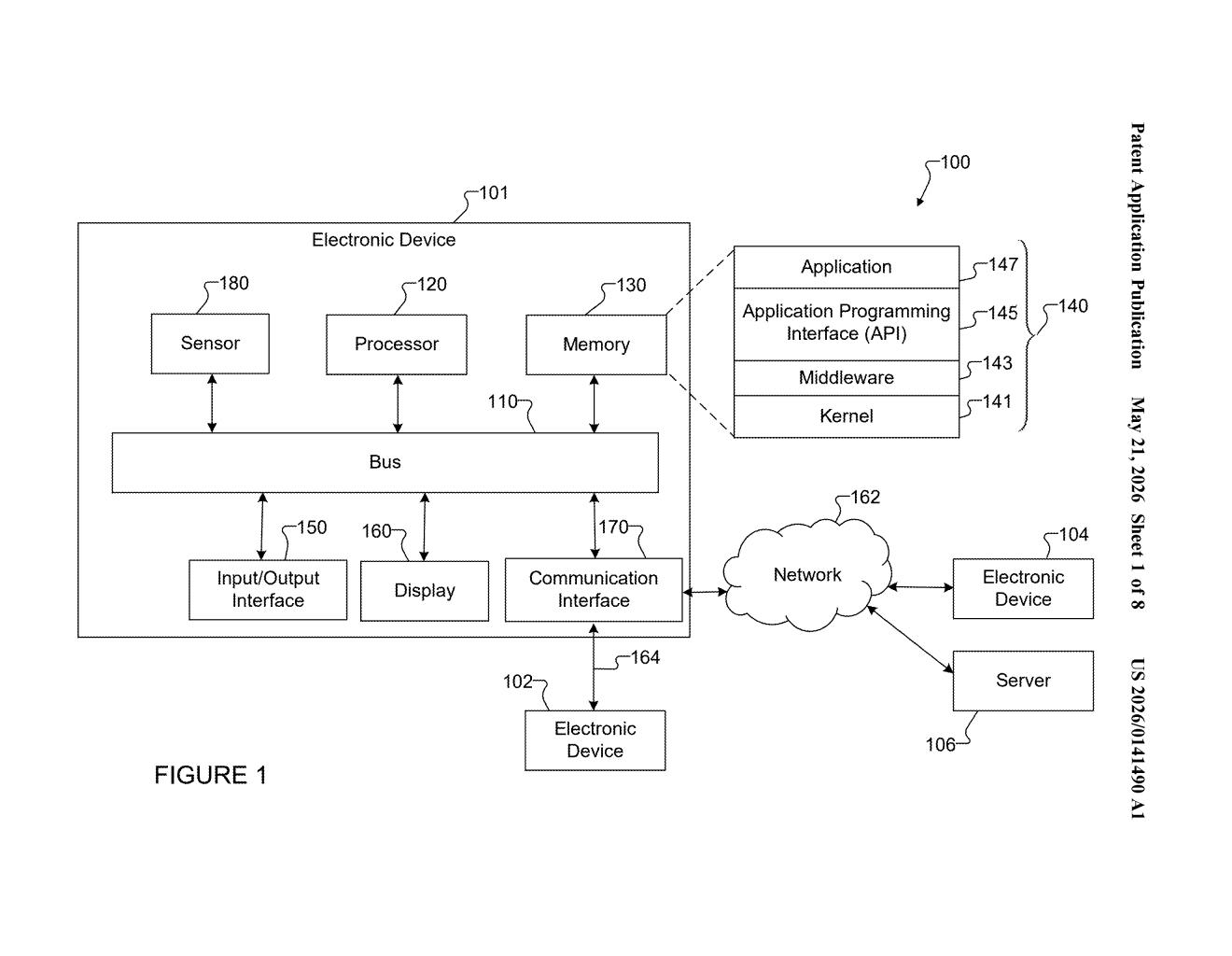
The system is designed to run on or in coordination with an electronic device connected via an API to a server, suggesting it could operate as a cloud-assisted pipeline — heavy lifting on the server side, with results delivered back to the device.
What this means for Samsung cameras and AI image tools
For Samsung, this patent fits neatly into a broader push to differentiate its Galaxy camera hardware with AI-powered computational photography. Being able to generate or upscale images at "mega" resolutions — think 100+ megapixel output — would be a meaningful capability for pro-tier phones or Samsung's imaging software stack.
More broadly, high-resolution diffusion synthesis is a genuinely hard problem in AI imaging right now. If Samsung's approach handles the memory and coherence challenges of large-canvas generation more efficiently than existing methods, it could be relevant not just for phones but for professional content creation tools, display technology, and any use case where pixel density really matters.
This patent is light on technical specifics — the first claim is almost comically broad, covering the basic encode-then-diffuse pipeline that describes most latent diffusion systems. What's interesting is the explicit targeting of 'mega high resolution,' which signals Samsung is investing in this as a competitive differentiator for imaging hardware. Whether the actual implementation has a novel twist that makes it meaningfully better than existing tiled diffusion approaches isn't clear from what's published here.
There are more where this came from
We read every patent application Big Tech publishes and send you the ones worth knowing. Plain English, free, every week.
Want this weekly breakdown for a company we don't cover? Patentlyze Pro →