
Meta Patents Active Ground-Tracking Circuit for Cleaner Biosensing Wearables
When a wearable tries to read electrical signals from your body, tiny voltage mismatches between the device's ground and your skin can corrupt the data. Meta's new patent tackles that problem head-on with a real-time compensation circuit baked into the wearable itself.
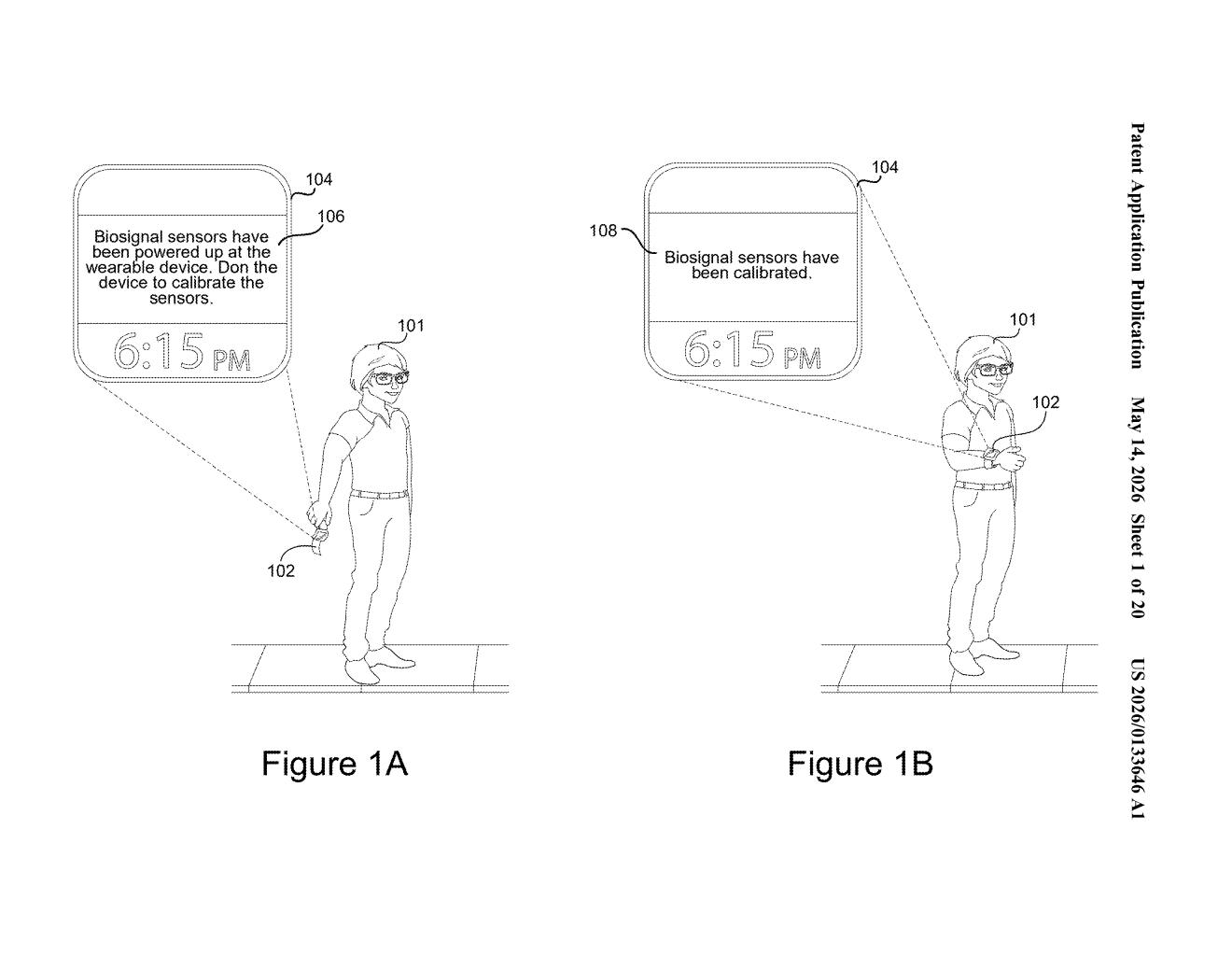
What Meta's body-potential compensation system actually does
Imagine your smartwatch is trying to read your heart or muscle activity — tiny electrical pulses your body naturally produces. The problem is that the device's internal electronics have their own electrical reference point (called a ground), and your body has its own. When those two don't match perfectly, you get noise that drowns out the signal you actually care about.
Meta's patent describes a wearable that actively corrects for this mismatch in real time. One electrode on the inside of the wearable reads your biopotential signals. A second electrode, also touching your skin, delivers a tiny compensation current back to your body to close the gap between the device's ground and your body's electrical baseline.
The result is cleaner biosignal readings — whether that's muscle activity (EMG), heart rhythms (ECG), or brain signals (EEG) — without relying on a traditional bulky ground electrode strapped somewhere else on your body.
How the closed-loop amplifier tracks and cancels ground offset
The patent centers on a compensation circuit built around a closed-loop amplifier (an amplifier that continuously monitors its own output and self-corrects). The circuit has three jobs:
- Measure the offset: It uses data from the first (sensing) electrode to calculate the difference between the wearable's ground potential and the user's body potential — essentially figuring out how far apart the two electrical references are.
- Generate a compensation current: It synthesizes a small corrective current whose size and direction are tuned to cancel out that offset.
- Inject it back: That current is delivered to the user's body through a second electrode on the wearable's interior surface, nudging the body's local potential to align with the device's ground.
The claim also covers multiple sensing modes — monopolar (one electrode vs. a distant reference), pseudomonopolar (a software-approximated single-ended reading), and differential (comparing two nearby electrodes). This flexibility matters because different biosignals and body locations call for different measurement strategies.
The closed-loop design is key: rather than a one-time calibration, the circuit continuously tracks drift as the wearable shifts on the skin or as body impedance changes with sweat or movement.
What this means for Meta's biosensing wearable ambitions
For Meta, this is squarely about making wrist-worn EMG sensing — the core input method for its neural interface roadmap — actually reliable in the real world. EMG signals from forearm muscles are small and easily corrupted. A ground offset that fluctuates as you move your wrist can make the difference between a gesture being recognized cleanly and being misread entirely.
For you as a potential user, better ground tracking means fewer false inputs, more accurate health metrics, and a device that doesn't need you to attach a separate ground strap somewhere awkward. It's the kind of unglamorous signal-integrity work that separates a lab demo from a product you'd actually wear daily.
This is genuinely solid signal-processing engineering dressed up in dry patent language. Ground offset is a well-known headache in biosensing, and the closed-loop injection approach is a real solution — not a paper workaround. Given Meta's public investment in EMG wristbands for AR/VR input, this reads like foundational plumbing for that product line.
Get our take in your Top Stories
Liked this breakdown? Add Patentlyze as a preferred source on Google, and our plain-English take shows up more often in your Top Stories the next time Meta patent news breaks.
There are more where this came from
We read every patent application Big Tech publishes and send you the ones worth knowing. Plain English, free, every week.
Want this weekly breakdown for a company we don't cover? Patentlyze Pro →