
Livestreaming Glasses Patent Adds Smart Capture Controls
When you're livestreaming from a pair of smart glasses, you can't exactly glance at a notification panel. Meta's latest patent solves that with a system that plays different audio cues in your ear depending on what's happening with your stream.
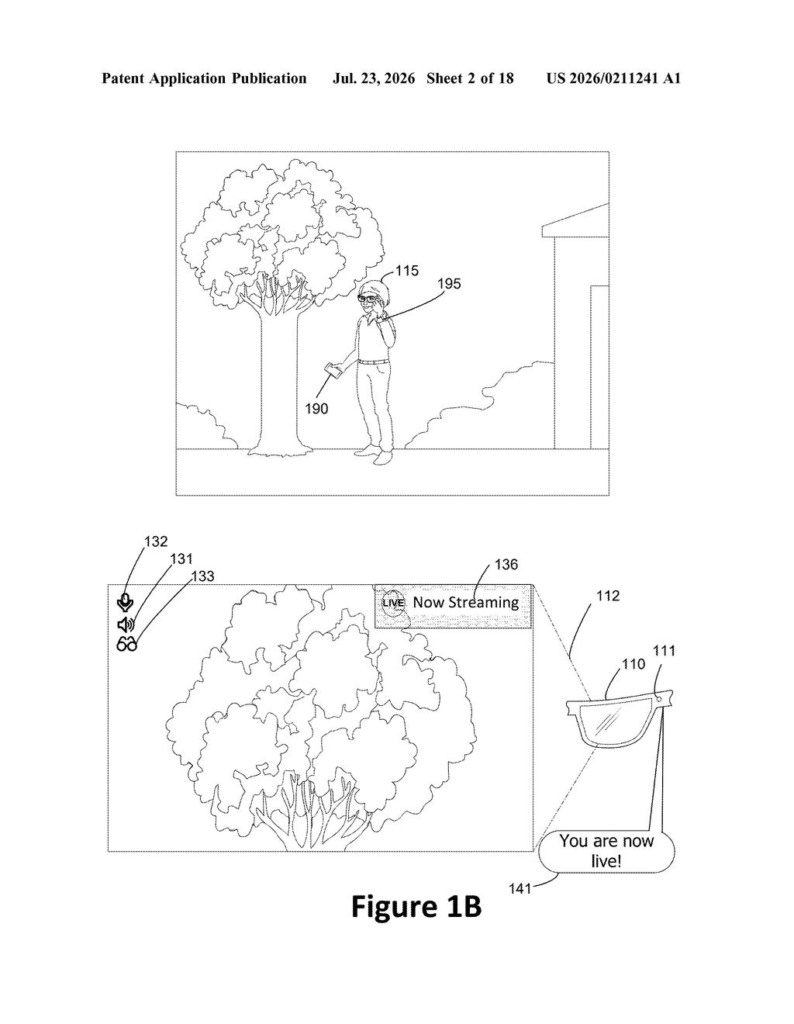
What Meta's livestreaming glasses audio cues actually do
Imagine you're wearing a pair of camera-equipped glasses and broadcasting live to your followers. Your phone is in your pocket and your eyes are on the world in front of you. How do you know if someone just joined your stream, if your connection dropped, or if a viewer sent a message? You can't look at a screen.
Meta's patent describes a system that handles this by playing distinct audio cues through a connected speaker or earbud. Each type of event gets its own unique sound, so you can tell the difference between, say, a new viewer joining versus a streaming error, just by listening. No need to pull out your phone or look away.
The same system also manages when the glasses' camera is allowed to run. If certain conditions aren't met, the camera shuts off and the interface shifts to another screen, like your phone. It's a way of keeping the experience in sync across your glasses and your other devices.
How the glasses decide which sound to play and when
The core of this patent is an audio trigger system for head-worn cameras during a live stream. While the glasses are actively broadcasting, the device monitors for specific events. When one occurs, it plays a corresponding audio cue through a paired speaker or earbud.
The key detail is that different event types produce different sounds. The first independent claim spells this out: a first event (say, a viewer joining) plays one audio cue, while a second event of a different type (say, a connection warning) plays a distinctly different cue. The system can handle a whole list of these audio trigger conditions simultaneously.
The patent also covers a broader mode-switching behavior. The glasses check whether certain capture criteria are satisfied, such as whether the device is worn, whether the connection is stable, or whether the user has permissions. If those criteria are met, the glasses camera streams and the glasses display shows the app interface. If not, the camera is disabled and the interface moves to a connected phone or other screen instead.
- Distinct audio alerts for each event type during live streaming
- Automatic camera enable or disable based on capture conditions
- UI shifts between the glasses display and a paired phone depending on state
What this means for Meta's Ray-Ban smart glasses line
Meta's Ray-Ban Meta smart glasses already support livestreaming to Instagram and Facebook. This patent points toward a more polished version of that experience, one where you can broadcast hands-free and still know what's happening without ever reaching for your phone. That's the gap the audio cue system fills: replacing the visual notifications you'd normally rely on with sounds that work even when your eyes are busy.
For Meta, this is infrastructure for a product line that's clearly growing. The company has sold millions of Ray-Ban Meta glasses and has pushed livestreaming as a headline feature. A reliable, non-intrusive alert system makes that feature usable in more situations, like sports, travel, or events, where stopping to check your phone defeats the whole point of wearable cameras.
This is a focused, practical patent rather than a conceptual moonshot. The audio cue system solves a real and obvious problem with hands-free livestreaming, and the fact that Meta is filing around it suggests the Ray-Ban glasses line is getting a genuine software upgrade rather than just a spec bump. Worth tracking if you follow the wearable camera space.
There are more where this came from
We read every patent application Big Tech publishes and send you the ones worth knowing. Plain English, free, every week.
The drawings
18 drawing sheets from US 2026/0211241 A1 · click any drawing to enlarge


Want this weekly breakdown for a company we don't cover? Patentlyze Pro →
Be the first to weigh in