
Meta's Latest Patent Lets Drivers Control Their Car by Looking at It
Imagine glancing at your car's climate vent and flicking your finger to crank up the heat — no touchscreen, no voice command needed. That's exactly what Meta is patenting with its latest AR glasses filing.
What Meta's gaze-and-gesture car control actually does
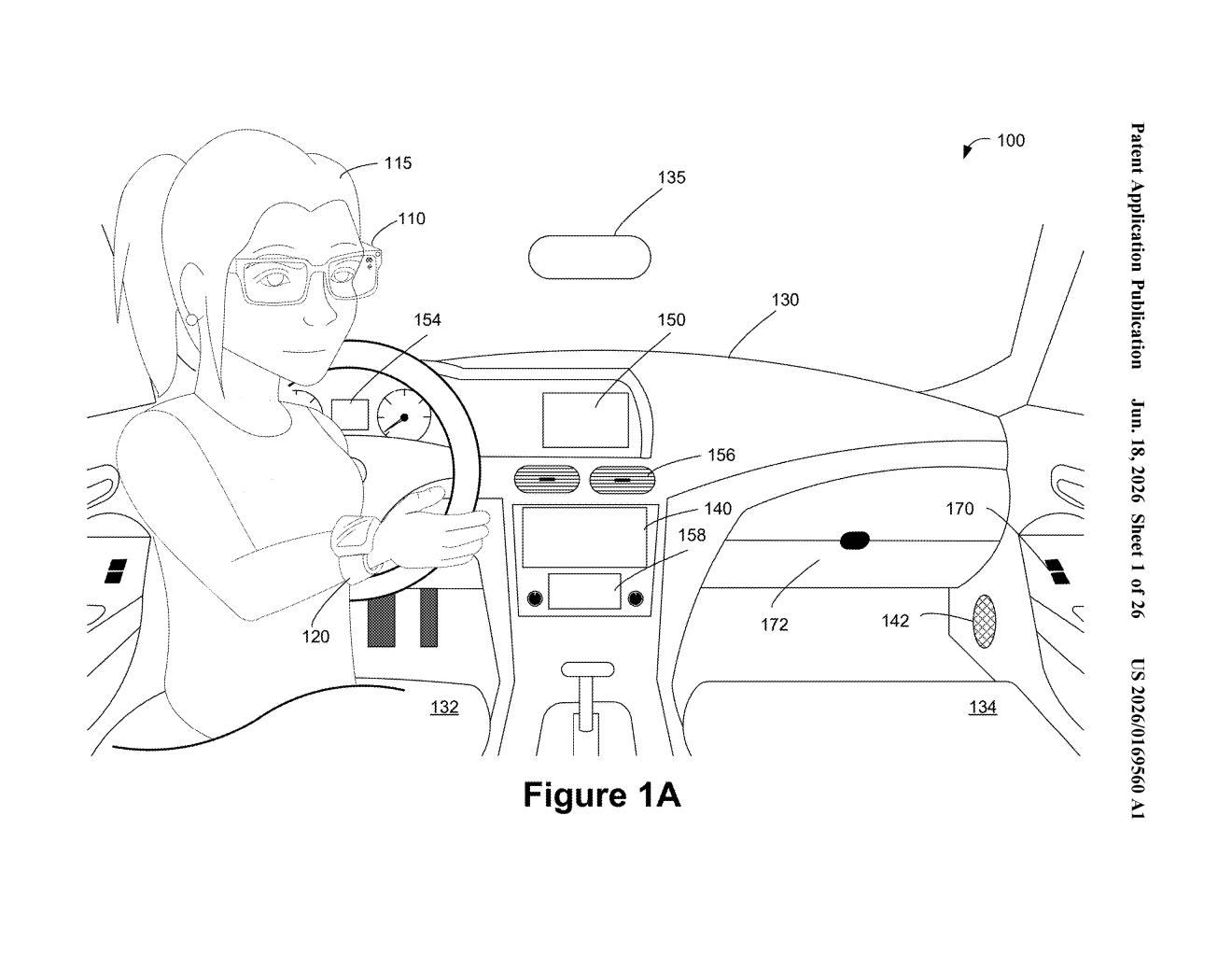
Picture this: you're sitting in your car wearing a pair of AR glasses. Instead of reaching for a touchscreen or saying 'Hey, turn up the volume,' you just look at the speaker and make a small hand gesture. The glasses notice what you're looking at, recognize your gesture, and send the right command to the car.
That's the core idea in Meta's new patent. The glasses use their built-in cameras to figure out which part of the car is in your line of sight at any given moment — the radio, the AC controls, the window — and then pair that with whatever hand gesture you make. Different gestures trigger different actions, and different controls respond depending on where your eyes are pointed.
The system is designed so that each 'look + gesture' combination maps to a specific car function. You're essentially pointing with your eyes and commanding with your hand, letting the car figure out the rest.
How the headset links your gaze to the right car control
The patent describes a head-wearable device — think AR glasses — that stays connected to a vehicle's control system over a wireless link. The glasses continuously monitor two things at once: what the user is looking at (using onboard cameras to identify which car component is in the field of view) and what gesture the user's hand is making (captured by sensors on or near the device).
The system works like this:
- The glasses identify a vehicle component — say, the dashboard radio — inside the wearer's field of view.
- The wearer performs a hand gesture, such as a pinch or a swipe.
- The glasses send a vehicle-control instruction tied to that gesture-plus-target combination — in this case, perhaps adjusting the volume.
- A different gesture aimed at a different component (say, the air conditioning unit) triggers an entirely separate command.
The key design choice is that the same gesture can mean different things depending on where you're looking, and the same target can respond differently to different gestures. That combinatorial approach lets the system support a large number of distinct commands without requiring the driver to memorize a complex gesture vocabulary.
The patent covers the underlying software layer — the logic stored on the device that maps gaze targets and gestures to specific car actions — not any particular hardware design.
What this means for AR glasses and in-car interfaces
For anyone who has fumbled with a buried touchscreen menu while driving, this patent points to a genuinely different direction for in-car interfaces. Instead of layers of menus or voice commands that mishear you, the interaction model here is purely physical and spatial: look at the thing you want to change, gesture to change it. That's a much closer match to how people naturally interact with objects in the real world.
For Meta specifically, this patent extends the potential use case for its Ray-Ban smart glasses line — or whatever comes after them — beyond social and media functions into the vehicle space. Cars are one of the last places where people spend significant time and have a real need for hands-free, eyes-on-the-road control. If Meta can establish AR glasses as a credible in-car interface layer, that's a meaningful expansion of the platform's everyday relevance.
This is a genuinely interesting patent because it solves a real problem — in-car touchscreen overload — with an interaction model that actually fits how people use their eyes and hands. The gaze-plus-gesture combo isn't new in research labs, but filing it specifically for vehicle control, tied to Meta's AR glasses roadmap, signals this is something the company is taking seriously as a platform play, not just a lab experiment.
There are more where this came from
We read every patent application Big Tech publishes and send you the ones worth knowing. Plain English, free, every week.
Want this weekly breakdown for a company we don't cover? Patentlyze Pro →