
Microsoft Patents an AI Engine That Pre-Writes Teacher Feedback on Student Essays
Grading essays is one of the most time-consuming things a teacher does. Microsoft is filing patents on an AI system that watches how a teacher has commented on past work — then writes the first draft of feedback on new essays, in that teacher's own voice.
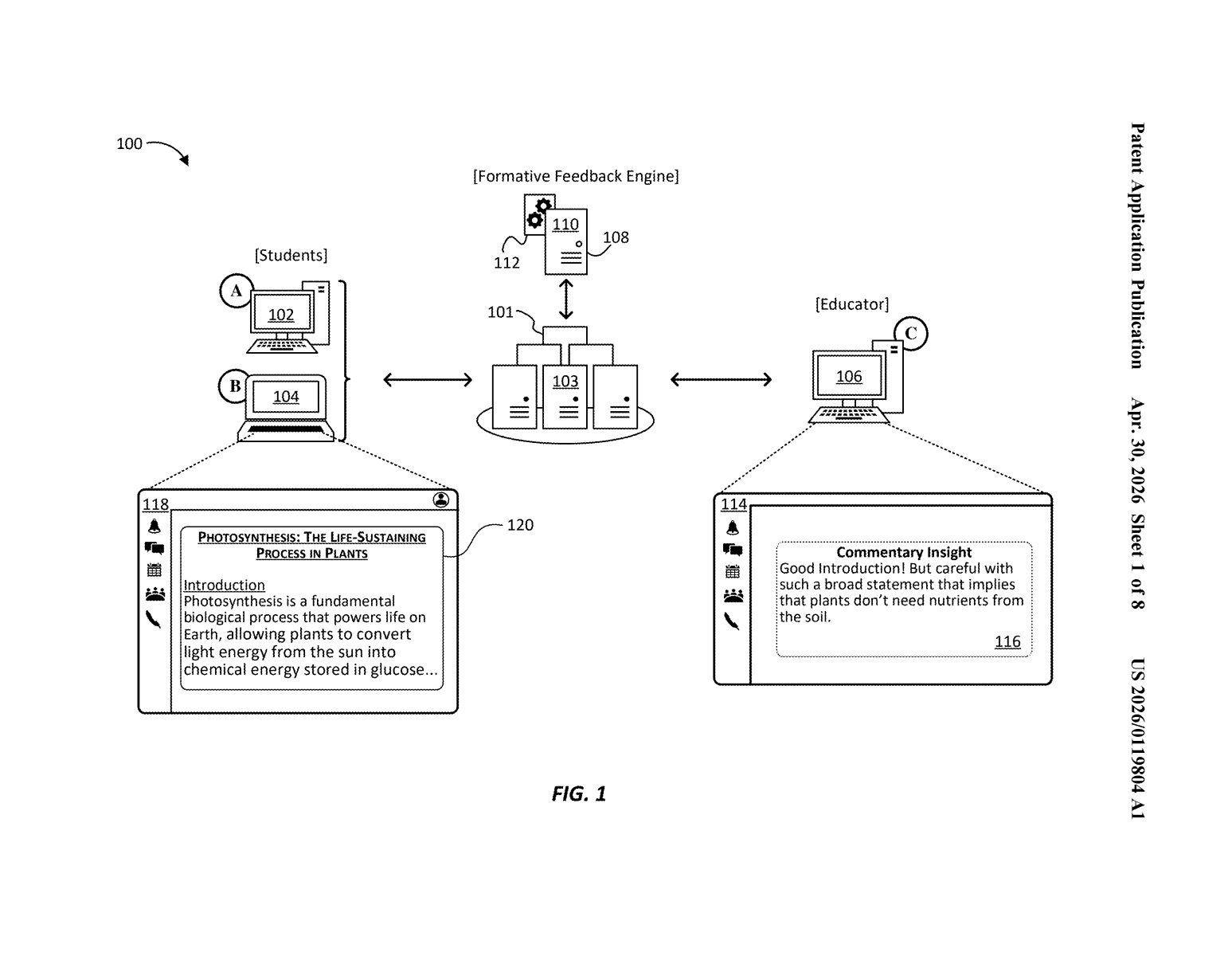
How Microsoft's AI drafts feedback in a teacher's voice
Imagine you're a teacher who has graded hundreds of essays. Every time a student makes the same vague claim — say, "photosynthesis powers all life" without nuance — you write a version of the same correction. Microsoft's new system aims to learn those patterns and write that correction for you, before you've even opened the essay.
Here's how it works from your perspective as a teacher: a student submits a draft, the AI reads it, finds passages that look semantically similar to things you've commented on before, and generates a commentary insight — a suggested note in your writing style. You then review it, tweak it if needed, and send it to the student. You're still in the loop; the AI just handles the first draft.
For students, the experience is pretty seamless — they just see feedback appearing inline in their essay, contextually placed, the way a teacher's margin notes would look. The goal is faster, more consistent feedback without burning out the humans doing the grading.
How the semantic matching engine finds relevant past feedback
The core of the system is a formative feedback engine that sits between a student's submitted essay and the teacher reviewing it. When a student submits work, the engine:
- Vectorizes the essay text — converts it into a numerical representation (think of it as a fingerprint of the writing's meaning, not just its words) so it can be compared mathematically to other text.
- Searches a database of semantically equivalent content — passages from previous essays that carry the same meaning, even if worded differently — and retrieves the feedback a teacher left on those passages.
- Uses that retrieved feedback to generate a commentary insight styled to match how the specific reviewer (teacher) typically writes their comments.
- Surfaces the generated comment to the teacher for review before it ever reaches the student.
The key technical move here is semantic vectorization — rather than matching text by keyword, the system understands meaning. So if one student wrote "plants turn sunlight into sugar" and another wrote "photosynthesis converts solar energy to glucose," the engine recognizes these as the same concept and retrieves relevant teacher feedback for both.
The patent also specifies that the teacher must review and can modify the generated insight before it's shown to the student — the system is explicitly designed as an assist tool, not a fully autonomous grader.
What this means for teachers and EdTech platforms
For teachers, the immediate value is time. Writing individualized feedback at scale is genuinely hard, and feedback quality tends to drop as a teacher's grading stack grows. A system that says "here's a comment that looks like what you've written before — want to use it?" could meaningfully reduce that burden without removing the human judgment that makes feedback valuable.
For Microsoft's EdTech ambitions, this fits squarely into the ecosystem around Microsoft 365 Education and Teams for Education. An AI feedback engine baked into Word or Teams assignments would be a concrete, teacher-facing feature that goes well beyond the generic Copilot pitch. It also raises real questions about consistency, bias in historical feedback, and what happens when a teacher's past comments were wrong — but the patent's human-in-the-loop design at least acknowledges that teachers should stay accountable.
This is one of the more practical EdTech AI patents to cross the wire in a while — it's solving a real, documented problem (teacher feedback load) with a genuinely sensible approach (learn from the teacher's own history, keep them in the loop). The semantic matching at its core is not novel technology, but applying it specifically to personalize feedback generation by reviewer style is a clean, defensible idea. Worth paying attention to if you're tracking Microsoft's Education product roadmap.
There are more where this came from
We read every patent application Big Tech publishes and send you the ones worth knowing. Plain English, free, every week.
Want this weekly breakdown for a company we don't cover? Patentlyze Pro →