
Microsoft Patents a System That Gives Data Files Permanent Nicknames
Every time a data file moves or gets renamed, the code pointing to it breaks. Microsoft's new patent tries to fix that by giving data a permanent nickname that always knows where the real file is.
What Microsoft's aliased data mapping actually does for you
Every time a data analyst renames a folder or migrates a database to a new server, every script and program that pointed to the old location stops working. Someone then has to hunt down every broken reference and update it by hand. It's tedious, error-prone, and happens constantly.
Microsoft's patent describes a system that lets you refer to data by a short, fixed nickname, called an aliased name, instead of its actual location. A behind-the-scenes service called a name resolution service keeps track of where the real data actually lives and translates your nickname into the right path whenever your program asks for it.
If the underlying data moves, gets renamed, or changes access credentials, the nickname stays the same. Only the translation layer needs updating, not every piece of code that uses the data. For anyone who works with large, frequently reorganized data pipelines, that's a meaningful reduction in maintenance headaches.
… receive a first indication the data has been modified, andupdate the mapping of the aliased name to the data based at least on the first indication.
Translation: The system automatically updates the nickname link when the underlying file changes.
How the map manager resolves names and updates credentials
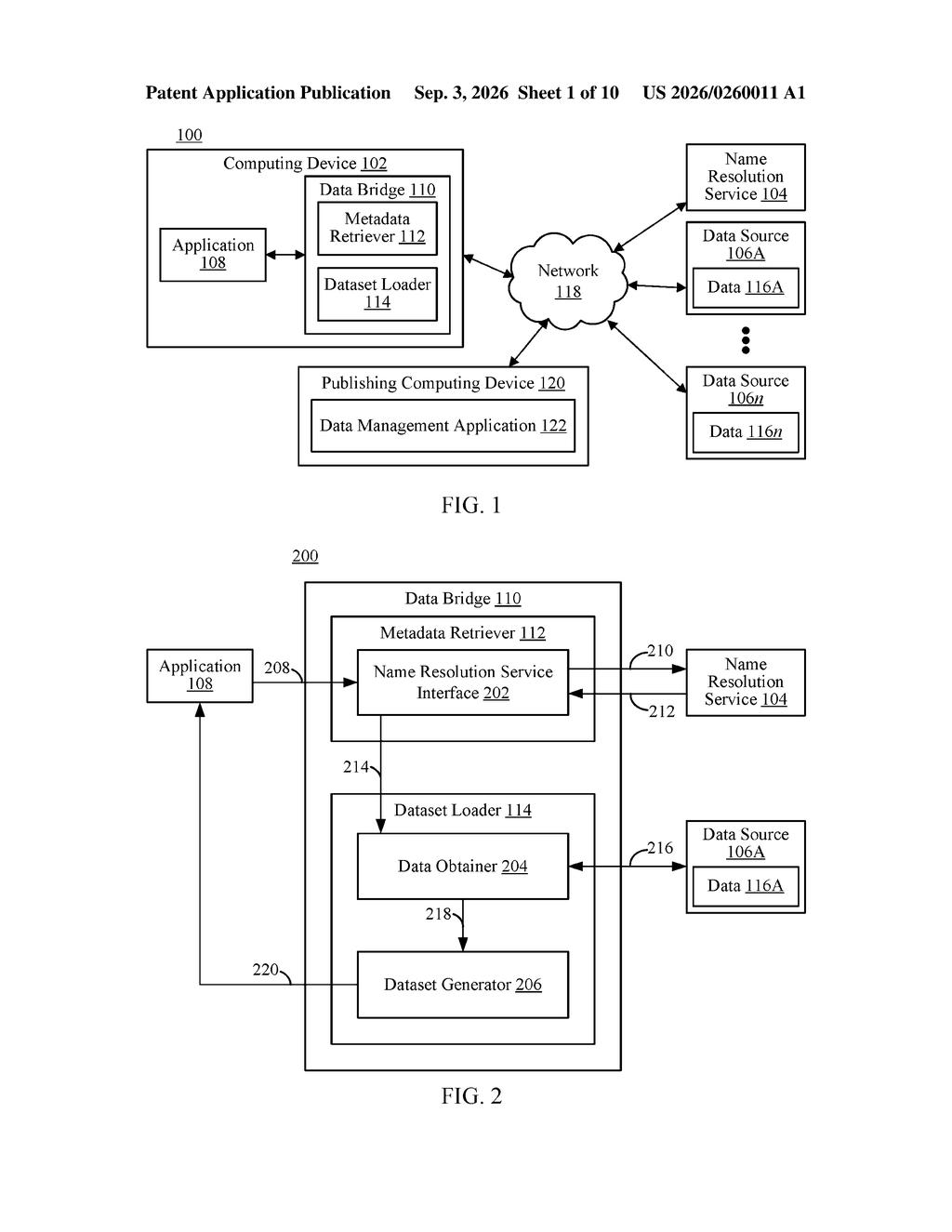
The patent describes a map manager, a software component that sits between a program and its data sources. When a program requests data using an aliased name (a short label the developer chooses, not the file's actual path or address), the map manager sends that alias to a name resolution service running on a connected device.
The name resolution service looks up the alias in a stored mapping table and returns metadata (information about the data, such as its location, format, and access credentials) rather than the data itself. The map manager then uses that metadata to fetch the actual data from the original source and hands a clean dataset back to the calling program.
The system also handles credential management. The first response to a data request can include a flag indicating that a specific credential or permission is required to access the data. This keeps authentication details out of the program code itself.
Critically, the map manager listens for change notifications. If the underlying data is modified, moved, or replaced, the mapping is updated automatically. The patent also describes an importable library that developers can drop into a project to gain access to all of this without building the resolution logic themselves.
A call is transmitted to a name resolution service executing on a computing device. The call comprises the aliased name and is configured to cause the name resolution service to identify the data associated with the aliased name.
Translation: A background service translates the permanent nickname into the actual file location.
What this means for developers who manage shifting data sources
For developers and data engineers, the practical payoff is fewer broken pipelines. Microsoft's run of data-infrastructure filings suggests the company is thinking carefully about the friction points in large-scale data work, and this one targets a genuinely common annoyance: the fragility of hardcoded data references in production code.
For end users, the benefit is indirect but real. Apps and dashboards that pull from live data sources are less likely to silently fail or serve stale information when the underlying storage gets reorganized. The credential-management piece also matters for security: keeping passwords and access tokens out of source code and centralized in a resolution service reduces the risk of accidental exposure.
Microsoft's 374th filing we've added to our Microsoft coverage since May joins earlier work like reusing predictions for speed and learning from AI mistakes.
When a company moves its data from one storage location to another, every report, dashboard, or app that depended on the old location breaks. Users see stale numbers, error screens, or nothing at all, and they rarely know why. This patent is Microsoft's answer to that problem: give each piece of data a stable nickname, so that when the underlying location changes, the nickname still works and nothing downstream notices.
For most people, the benefit is invisible in the best possible way. The dashboard loads, the numbers are current, the report runs on time.
The failure this prevents is the kind that erodes trust: a sales team making decisions on last quarter's figures because a file moved and nobody caught it. That is a real and common problem, and a reliable fix for it matters more than it sounds.
Get our take in your Top Stories
Liked this breakdown? Add Patentlyze as a preferred source on Google, and our plain-English take shows up more often in your Top Stories the next time Microsoft patent news breaks.
There are more where this came from
We read every patent application Big Tech publishes and send you the ones worth knowing. Plain English, free, every week.
The drawings
10 drawing sheets from US 2026/0260011 A1 · click any drawing to enlarge


Show the other 2 sheets


Want this weekly breakdown for a company we don't cover? Patentlyze Pro →
Be the first to weigh in