
Microsoft Patents a Safety Certificate System That Checks Software Before It Runs
When you download and run a piece of software, how do you know it hasn't been tampered with or secretly written to do something dangerous? Microsoft has filed a patent for a system that bakes a cryptographic proof directly into a finished program at the moment it's compiled, so anyone running it later can check its safety record without having to re-run a full security scan.
What Microsoft's built-in software safety stamp actually does
A stranger hands you a sealed envelope and says the letter inside is safe to read. You can't open the envelope to check yourself, and you have no idea who wrote the letter originally. That's roughly the situation most people, and most computers, are in when they receive and run a finished software program.
Microsoft's patent describes a system that fixes this by attaching a tamper-evident digital certificate to a program during the moment it's built. That certificate only gets added if the program passes a security scan first. Think of it like a food-safety inspection sticker on a restaurant's window: a sign that says an official check happened and the place passed.
The certificate travels with the program wherever it goes. Before your computer loads and runs the software, it can check the certificate and confirm that a trusted build process already did the safety work, no repeat scanning needed.
… executing, by a static analysis tool, a safety verification of the intermediate representation of the computer program, wherein the static analysis tool classifies the computer program as a safe program based on an analysis of the sequence of instructions; …
Translation: An automated tool scans the translated code to ensure it meets safety standards.
How the build pipeline signs a native image after verification
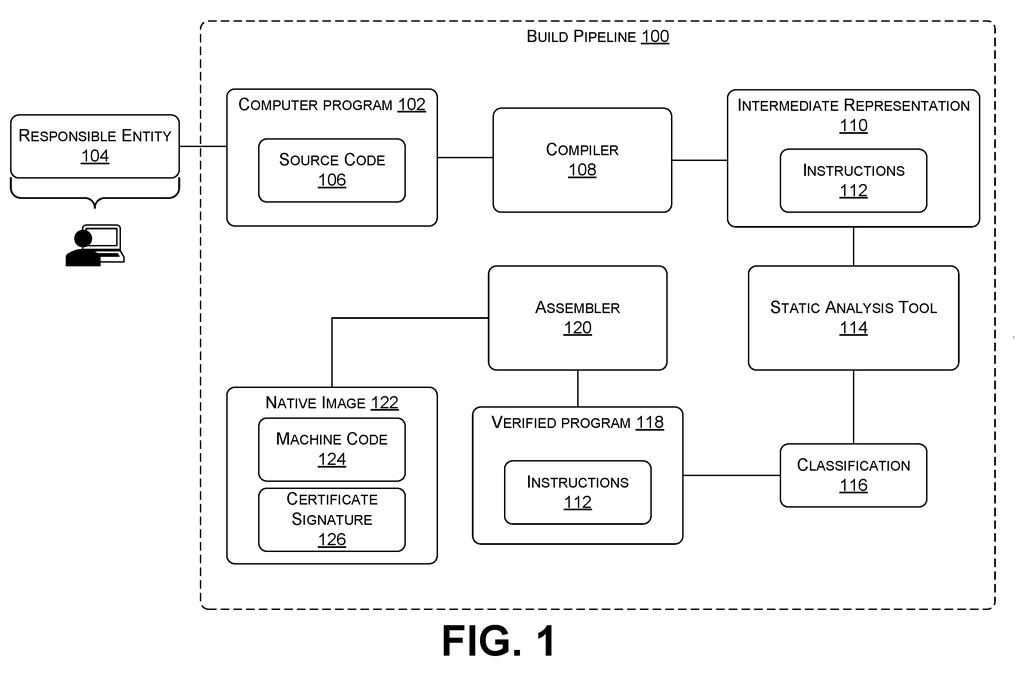
The patent describes a build pipeline (the automated factory-line process that turns a developer's code into a finished, runnable program) that runs a safety check at a specific stage and, if the check passes, embeds a signed certificate into the final output.
Here's the sequence:
- A developer submits source code to the build pipeline.
- The pipeline compiles that code into an intermediate representation (a halfway form between raw source code and the final machine-readable binary) and runs a static analysis tool against it. Static analysis means inspecting the code's structure without actually executing it, the way an editor proofreads a document without reading it aloud.
- If the static analysis tool classifies the program as safe, the pipeline generates a native image (the final, directly-runnable version of the program) and attaches a certificate signature containing a cryptographic key. If the program fails the safety check, no certificate is added.
- When a consumer or a host system later receives this native image, it can verify the certificate's cryptographic signature to confirm the program passed inspection, without needing to redo the expensive static analysis scan.
The key engineering insight is that the certificate is an if-and-only-if gate: the signature is present exclusively because the program passed, and its absence is itself a signal that something is wrong.
The build pipeline includes the certificate signature if and only if the computer program passes a safety verification during compilation.
Translation: The security stamp is added to the software only if it successfully passes the automated safety check.
What this means for software supply-chain security
Software supply-chain attacks, where malicious code sneaks into a legitimate program between when a developer writes it and when you install it, have become one of the more serious security problems of the last several years. The standard defenses require either access to original source code or running a heavy security scan every time software is loaded, neither of which is practical at scale.
This patent's approach lets a finished binary carry its own verifiable safety record. That matters most in environments where software changes hands repeatedly: enterprise software deployments, cloud platforms, or any situation where the person running code is not the person who wrote it. If this made it into a shipping product, system administrators could enforce a simple policy: no certificate, no execution, without doing any scanning themselves.
Microsoft's 481st filing in our Microsoft coverage since May adds to a privacy push that includes a data-leak spotter and a breach-learning security scorer.
The idea is software-only: during the normal process of packaging an app for release, a safety check runs, and if the app passes, a signed stamp of approval travels with it. No new hardware needed, and the core building blocks (signing tools, build pipelines) already exist in most professional software shops.
What has to come first is agreement on what "safe" actually means. The stamp is only as trustworthy as the check behind it, and this document describes the stamping process, not the safety rules themselves.
The shortest path to a real product is probably as an optional feature inside tools developers already use, turned on for companies that face regulatory pressure around software security. For everyone else, it would run in the background, which means there is little urgency to prioritize it unless a specific customer or law demands it.
There are more where this came from
We read every patent application Big Tech publishes and send you the ones worth knowing. Plain English, free, every week.
The drawings
6 drawing sheets from US 2026/0300490 A1 · click any drawing to enlarge


Want this weekly breakdown for a company we don't cover? Patentlyze Pro →
Be the first to weigh in