
Microsoft Patents a Way to Control Smart Devices by Moving a Tag Through the Air
Forget buttons and voice commands. Microsoft has filed a patent describing a system where physically moving a small wireless tag through a defined area in the air is enough to control the smart devices around you.
What Microsoft's air-gesture tag system actually does
Today, controlling smart devices typically means hunting for an app, pressing a button, or saying a wake word. Microsoft's patent describes a different approach: you carry a small wireless tag, and the system watches how you move it through a designated zone in space, then triggers actions on nearby devices based on your movements.
The key hardware here is Ultra-Wideband (UWB), a short-range radio technology already inside many phones and smart speakers that can pinpoint location far more precisely than Bluetooth or Wi-Fi. The system uses several UWB sensors placed around a room to track the tag's movements in three dimensions. A specific sequence of movements, say a swipe left then up, gets matched to a pre-set action like dimming the lights or locking a door.
Those zones and those movement-to-action pairings can be customized per location or even per person. So your kitchen counter could respond differently to the same gesture than your living room would. No menu to navigate, no screen to tap.
How UWB tracking maps your movements to device commands
Ultra-Wideband (UWB) is a radio technology that uses very short pulses to measure distance and position with centimeter-level accuracy, far better than GPS indoors. The patent builds a gesture system on top of this.
Here is how the pieces fit together:
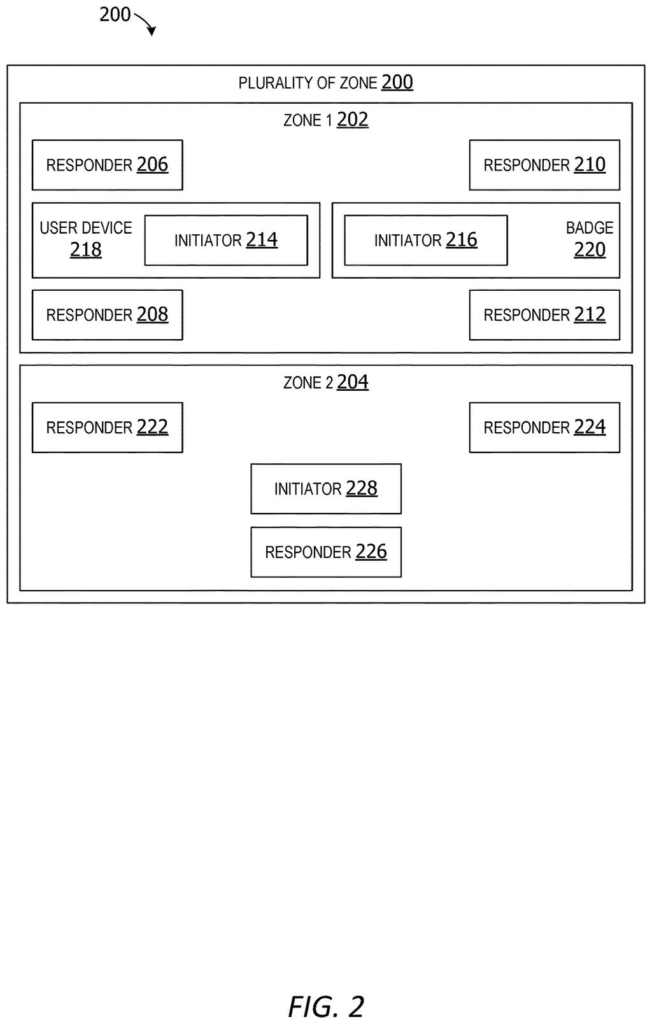
- A small UWB-enabled device (called the initiator) acts as the tag you carry or hold.
- Multiple UWB sensors (called responders) are fixed around a room. They continuously measure the tag's position and send that data to a central piece of software called the tag manager.
- The tag manager defines virtual geo-fenced zones, which are invisible three-dimensional regions in a room. Think of them as boxes drawn in space. When the tag enters a zone, the system starts paying close attention to how it moves inside that box.
- The tag manager records a sequence of 3D movements and looks up that sequence in a mapping table, which is essentially a lookup chart pairing movement patterns with device commands.
- Once a match is found, the system sends the command to a target device, which could be a smart bulb, a lock, a thermostat, a PC, or even the tag device itself.
The mapping table can be configured per zone (so the same gesture means different things in different rooms) or per user (so your gesture profile differs from a colleague's). This is what the patent calls menuless operations: no on-screen menu is ever opened; the gesture IS the menu.
What this means for touchless control in shared spaces
The most obvious home for this technology is in shared or industrial spaces where touching a screen is inconvenient or unsanitary, think hospital rooms, factory floors, commercial kitchens, or accessibility contexts where a user cannot easily tap a screen or speak a command. If UWB sensors are already installed (increasingly common in modern buildings), adding this layer is mostly a software change.
For everyday consumers, the leap is larger. UWB chips are present in recent iPhones and some Android devices, but the responder infrastructure needed to track you around a room does not exist in most homes. The patent describes a genuinely useful idea, but it depends on a sensor network that almost nobody has yet. Microsoft's run of spatial-computing filings suggests the company is building toward that future, even if the hardware still has to catch up.
Microsoft's 432nd filing in our Microsoft coverage since May follows applications like the browser action suggester and the legacy code rewriter.
The ship path for this one is long. The patent describes a software layer that coordinates UWB sensors, but those sensors have to be physically installed in specific positions around a room before any of this works. That is a hardware deployment problem, not a software one, and it is the main thing standing between this filing and a product.
There is a shorter route in specialized settings. A conference room, a hospital bay, or a warehouse aisle could be wired with UWB anchors as part of a building fit-out. In those contexts, this system is plausible sooner than in a consumer home. The per-user and per-zone mapping is a real differentiator for multi-person environments.
For the living room version of this idea, the honest answer is that it probably needs UWB to become as common as Wi-Fi before it stops feeling like a science project. Interesting direction, but the infrastructure bet is the whole story.
There are more where this came from
We read every patent application Big Tech publishes and send you the ones worth knowing. Plain English, free, every week.
The drawings
8 drawing sheets from US 2026/0292445 A1 · click any drawing to enlarge


Want this weekly breakdown for a company we don't cover? Patentlyze Pro →
Be the first to weigh in