
Microsoft Patents a System That Grades and Repairs Its Own AI Agents
When you chain a bunch of AI models together to complete a complex task, one weak link can derail the whole operation. Microsoft has filed a patent for a system that watches each AI agent in the chain, grades its work, and rewires or replaces the underperformers automatically.
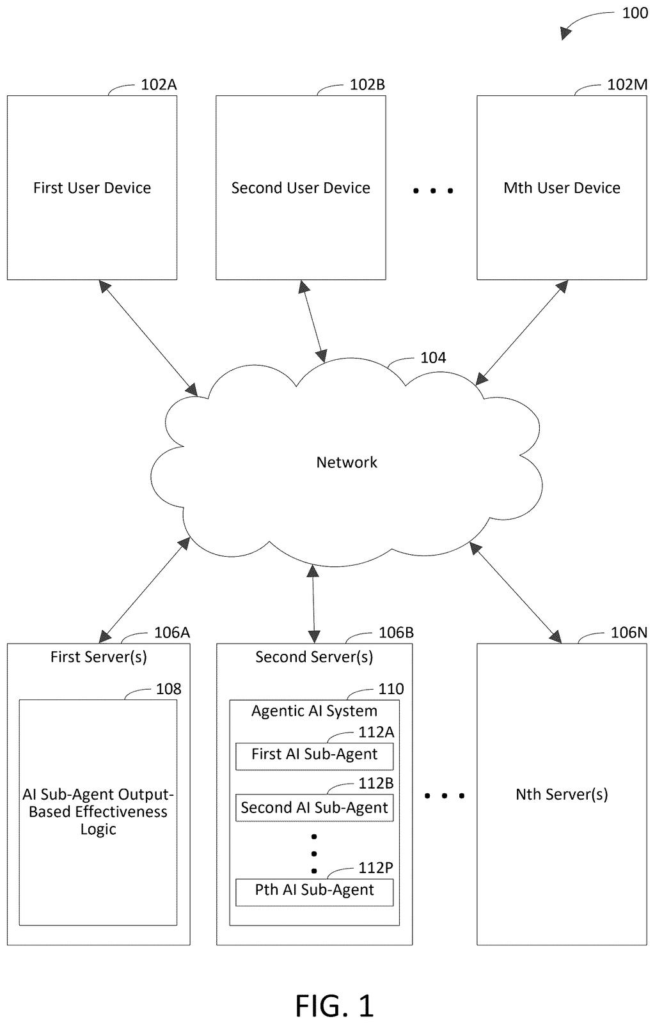
How Microsoft's self-correcting AI agent network works
You're running a company that uses AI to handle everything from answering customer questions to generating reports. Behind the scenes, several AI models are working in sequence, each handling a piece of the job. If one of them starts giving bad answers, the whole pipeline produces garbage, and it can be really hard to figure out which AI is to blame.
Microsoft's patent describes a way to score each AI agent in a chain based on how well it completes its specific piece of the work. The system compares what each agent was asked to do against what it actually produced, then weighs that against whether the final result matched the overall goal.
When a particular agent's score drops below a set threshold, the system automatically adjusts that agent's configuration to bring it back in line. You don't have to manually dig through logs or restart the whole workflow from scratch. The fix happens at the source.
determine an extent to which an input-output pair corresponds to a goal of an agentic artificial intelligence (AI) flow that is implemented by a plurality of AI sub-agents in an agentic AI system …
Translation: The system checks how well the final result matches what the AI was actually supposed to achieve.
How the scoring system finds and fixes underperforming agents
The patent describes an agentic AI system, which is a setup where multiple AI models (called sub-agents) each handle a specific sub-task in a larger automated workflow. Think of it like an assembly line where each station performs one step.
The system evaluates performance on three levels:
- Overall goal match: Does the final output from the whole system actually answer the original request?
- Sub-task match: For each individual agent, does its output properly complete the specific piece of work it was assigned?
- Invocation path evaluation: How well did the sequence of agents work together to get from the input to the output?
Using these three signals, the system assigns a score to each sub-agent. If a particular agent's score falls below a threshold, the system doesn't just flag it for a human to review. Instead, it automatically reconfigures that agent, adjusting the underlying algorithm that defines how it behaves.
The patent also covers reconfiguring the overall chain itself, not just individual agents. That means the system can reroute tasks to different agents or restructure the order of operations if the path itself is the problem.
The effectiveness of the invocation path is increased by reconfiguring the invocation path and/or by reconfiguring or replacing an AI sub-agent.
Translation: When an AI worker fails, the system fixes or swaps out the underlying code to make it work better.
What this means for AI-powered business software
Companies are increasingly building AI workflows where multiple models hand off work to each other, handling customer service, document processing, code generation, and more. The problem is that these chains are fragile. One agent that degrades in quality, whether because the underlying model drifted or the task definition was too vague, can corrupt everything downstream without anyone noticing for days.
This patent addresses a real operational headache for any business deploying multi-agent AI systems. Automatic diagnosis and repair at the agent level, rather than requiring a full system restart or manual intervention, could make these pipelines far more reliable. the pattern in Microsoft's agentic AI filings points toward making Copilot and Azure AI products more self-sustaining over time, which matters if you're a business depending on these tools staying accurate without a dedicated AI engineer babysitting them.
Microsoft's 35th filing we've tracked in our AI teams working together watchlist since May builds on earlier applications like the AI coordinator pick and the chain-of-networks video work.
When a chain of AI assistants handles a business task and the final result is wrong, no one can easily tell which assistant in the chain caused the problem. Tracing the failure by hand is slow, expensive, and gets worse as companies build more of these chains for more purposes.
Microsoft's approach assigns each assistant a score based on how well it handled its specific piece of the work, turning a dead-end verdict into a directed investigation. That matters because the real cost of AI failure in complex workflows isn't the mistake itself, it's the hours spent figuring out where things went wrong before anyone can fix them.
The open question is whether a system that grades itself and then adjusts itself will start optimizing for a good grade rather than a good outcome. That risk is real, and this filing does not describe how a person would detect that kind of drift before it compounds across high-stakes decisions.
There are more where this came from
We read every patent application Big Tech publishes and send you the ones worth knowing. Plain English, free, every week.
The drawings
8 drawing sheets from US 2026/0300748 A1 · click any drawing to enlarge


Want this weekly breakdown for a company we don't cover? Patentlyze Pro →
Be the first to weigh in