Microsoft
Microsoft · Display · Filed May 29, 2025 · USPTO published Jul 9, 2026 · Jul 9 release
Microsoft Patents a Hinge That Keeps Both Halves of a Folding PC Moving in Sync
Folding devices live or die by their hinge, and Microsoft is filing patents on a mechanism designed to keep both halves of a foldable device rotating together at exactly the same rate, no wobble, no misalignment.
- Publication number
- US 2026/0197379 A1(US20260197379A1)
- Applicant
- Microsoft Technology Licensing, LLC
- Filed · Published
- May 29, 2025 · Jul 9, 2026
- Inventors
- Daniel C PARK, Eric WITT, Devin CAPLOW-MUNRO, Denys V YAREMENKO, Brett TOMKY, Karsten AAGAARD, Tung Yuen LAU
- Status when we published
- Waiting for an examiner
- Document
- 24 claims
- US classification
- 455/575.3
- Parent application
- National Stage Entry of PCT/CN2022/140965 (filed Dec 22, 2022)(PCTCN2022140965)
What Microsoft's synchronized folding hinge actually does
Imagine folding a laptop in half, but one side of the hinge rotates a little faster than the other. The screen flexes unevenly, the device feels cheap, and over time the crease wears unevenly. That's a real engineering headache for any foldable device.
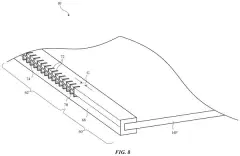
Microsoft's patent describes a hinge system built around a "timing shuttle," a small mechanical part that sits between the two halves of the hinge and physically forces both sides to rotate at the same speed, like a coordinating bar between two spinning wheels. There's also a clutch-like stack of components that tightens or loosens depending on the angle you've folded the device to, giving more resistance at some positions and less at others.
The result is a hinge that feels controlled and deliberate at every angle, not just at the fully open or fully closed position. Think of it like the hinge on a high-end notebook that stays put wherever you leave it, except this version uses an interlocking mechanical system to make that happen precisely across both pivot points.
How the clutch stack and timing shuttle control rotation
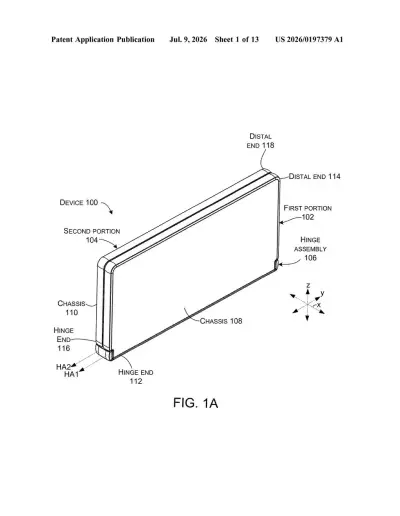
The patent describes a dual-axle hinge for a foldable device, meaning there are two separate rotation points side by side rather than one single pivot. Each half of the device is attached to one of these axles.
The key innovation is a timing shuttle: a component positioned between the two axles that physically engages with angled surfaces on each hinge guide. As each half rotates, the shuttle is pushed and pulled in a way that forces both sides to move at the same rate. Think of it like the timing belt in a car engine, but mechanical and spatial rather than rotational.
Layered on top of that is a clutch stack, a series of components that span both axles and can be compressed (tightened) or released (loosened). Compression creates friction, which creates resistance when you're folding or unfolding. The patent's notable detail is orientation-dependent cams, angled surfaces that automatically change how much the clutch compresses depending on the fold angle:
- At some angles, the cams limit compression, so the hinge moves more freely
- At other angles, the cams allow compression, so the hinge holds its position with more firmness
This means the hinge can be tuned to feel stiff near certain positions (like fully flat) and looser through the mid-range of the fold, all passively, with no motors or sensors.
What this means for Microsoft's foldable PC ambitions
Foldable devices have had a hinge problem since day one. A hinge that lets one side outpace the other puts uneven stress on flexible displays and creates a sloppy feel that erodes user confidence fast. A mechanical system that enforces synchronized movement without electronics could be more reliable and thinner than motor-driven alternatives.
Microsoft has a history with foldable hardware, most visibly the Surface Duo line. A patent like this signals ongoing investment in the hinge engineering that makes or breaks that category. If this mechanism makes it into a product, you'd feel it as a device that opens and closes with a smooth, consistent pull rather than the uneven flex that plagues cheaper foldables.
Source: US 2026/0197379 A1 at the USPTO (PDF). Full patent text and figures are in the official publication.
Get our take in your Top Stories
Liked this breakdown? Add Patentlyze as a preferred source on Google, and our plain-English take shows up more often in your Top Stories the next time Microsoft patent news breaks.
Add Patentlyze on Google
One click.
There are more where this came from
We read the new patents from Big Tech, carmakers and more and send you the ones worth knowing. Plain English, free, every week.
More from Microsoft
All 681 Microsoft patents →

More in Display
All 746 Display patents →
Samsung
Samsung Patents a Protective Edge Cover for Foldable Phone Displays
Samsung
Samsung Patents a Foldable Phone That Vibrates Differently When Folded
Samsung
Samsung Patents an Antenna System That Treats Both Halves of a Foldable Phone as One
Apple