
Samsung Patents an AI System That Reads Raw Text and Pulls Out Verified Events
Samsung is patenting a pipeline that feeds raw, messy text into a large language model, extracts meaningful events from it, then cross-checks those events against a structured knowledge base before committing to an answer.
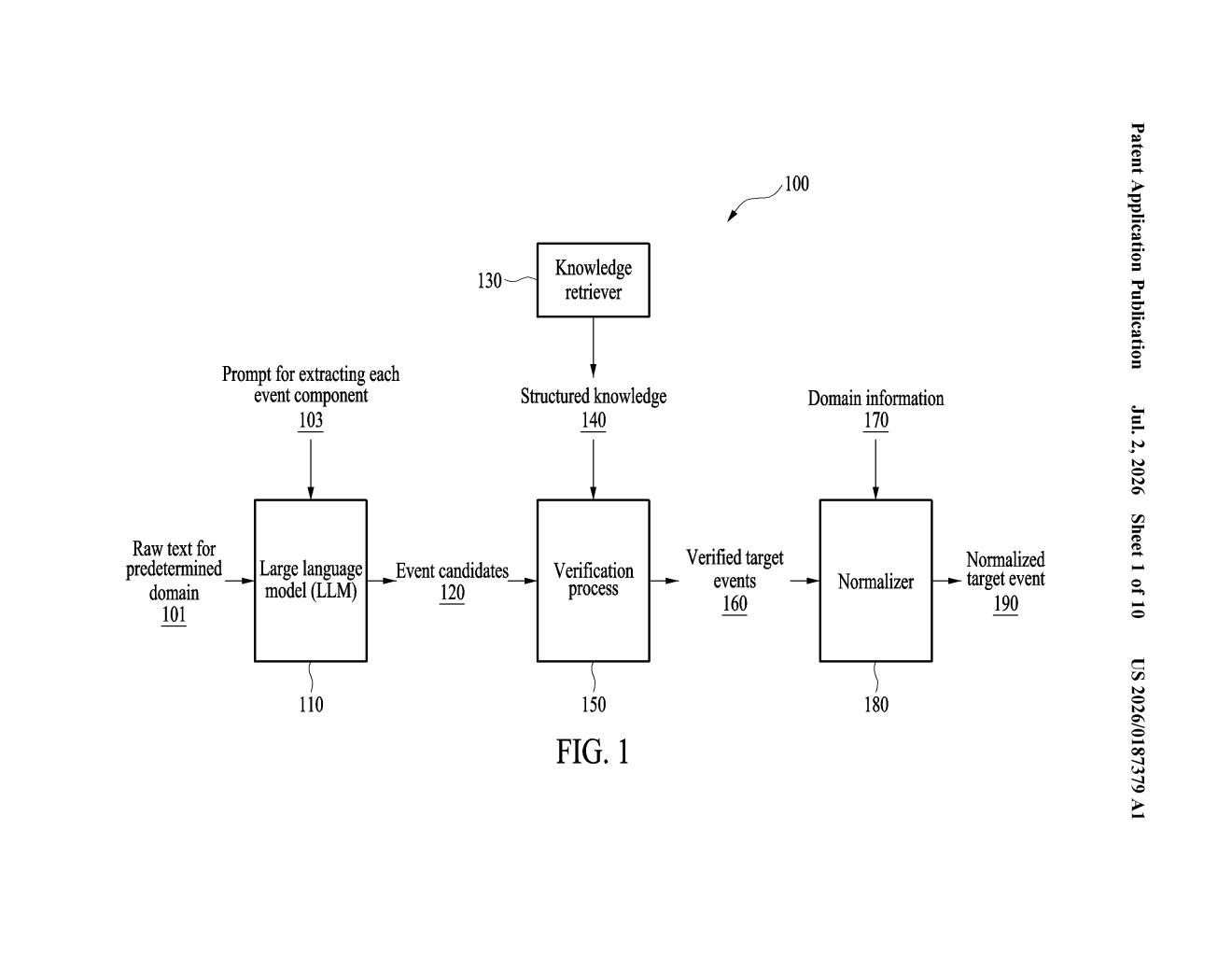
What Samsung's text-to-event AI actually does
Imagine you dump a wall of news articles or meeting notes into an app and ask it to tell you what actually happened. Most AI tools will give you a summary, but Samsung's patent is after something more specific: a list of discrete, verified events, each one cleaned up and confirmed against a known knowledge structure before it reaches you.
The system works in steps. First it uses a large language model to generate a rough list of candidate events from the text. Then it checks each candidate against structured knowledge (think of it like a fact-checking layer) to weed out hallucinations or misreadings. Finally, it normalizes the surviving events so they follow a consistent format tied to the domain you're working in.
The result is meant to be more reliable than a raw AI summary. Instead of a fluent but potentially wrong paragraph, you get a tidy, domain-specific list of things that actually occurred, ready for a database, a calendar, or a downstream application.
How the LLM pipeline checks and cleans its own output
The patent describes a four-stage processor pipeline for event extraction, the task of identifying specific occurrences (who did what, when, where) inside unstructured text.
- Input generation: The system combines raw text with a domain-specific prompt (for example, a prompt tuned for medical records, financial filings, or news) to frame the task for the model.
- Candidate generation: A large language model (LLM) processes the framed input and produces a set of event candidates, essentially a first-pass guess at what happened in the text.
- Verification: Each candidate is checked against structured knowledge (a curated knowledge graph or ontology) to confirm it's a real, recognizable event type and not a hallucination or misinterpretation.
- Normalization: Verified events are standardized using domain-specific reference information, so dates, entity names, and event types all follow a consistent schema before being output.
The key architectural choice here is the verification step. Rather than trusting the LLM's output directly, the system uses an external structured source as a gatekeeper. This is sometimes called a retrieval-augmented or grounded approach, and it directly targets the tendency of language models to generate confident but incorrect information.
What this means for Samsung's AI assistant ambitions
Pulling clean, structured events out of raw text is foundational work for a huge range of applications: smart calendars that read your emails, financial systems that monitor news for market-moving announcements, medical tools that track patient history from clinical notes. A pipeline that can do this reliably across different domains is genuinely useful infrastructure, not just a demo.
For Samsung, the patent fits into a broader push to make its Bixby and Galaxy AI ecosystems more capable of understanding context from your data, not just answering generic questions. If this system works as described, it could power features that automatically surface structured information from messages, documents, or web content on your Galaxy device without you having to ask.
This is a solid, workmanlike patent on a real problem. Event extraction from text is notoriously hard to do accurately, and the verification-plus-normalization architecture Samsung describes is a sensible engineering response to LLM hallucination. It's not a flashy consumer feature patent, but the kind of foundational plumbing that shows up later inside polished products.
Get our take in your Top Stories
Liked this breakdown? Add Patentlyze as a preferred source on Google, and our plain-English take shows up more often in your Top Stories the next time Samsung patent news breaks.
There are more where this came from
We read every patent application Big Tech publishes and send you the ones worth knowing. Plain English, free, every week.
Want this weekly breakdown for a company we don't cover? Patentlyze Pro →