
Nvidia Patents an AI That Maps Your Body's Position Inside a Moving Car
Nvidia is patenting a system that uses a single camera and AI to figure out exactly where your body is in three-dimensional space inside a vehicle — and even estimate how big you are — all in real time.
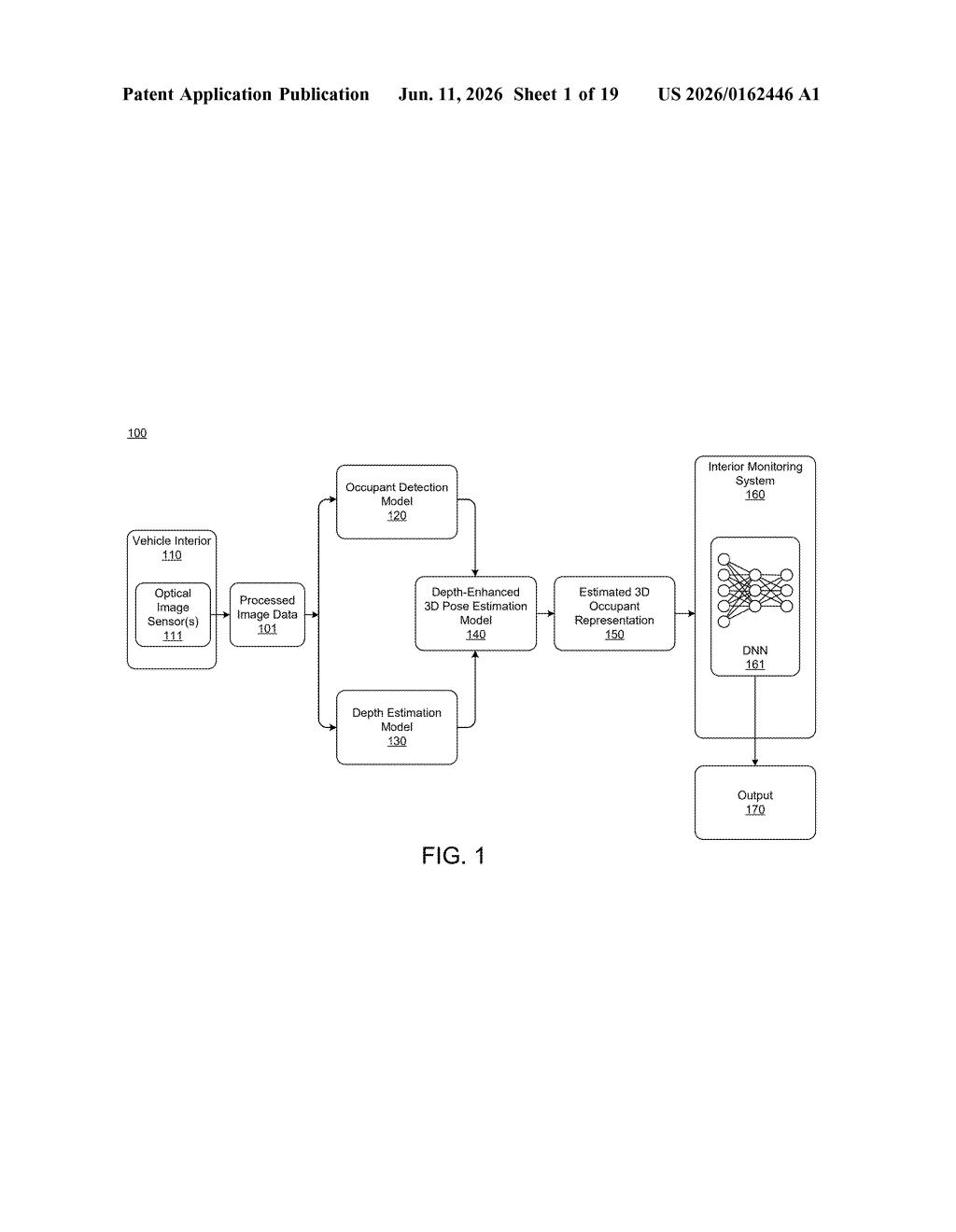
What Nvidia's in-car body-tracking system actually does
Imagine a car's interior camera that doesn't just see you — it understands your posture, estimates your height, and figures out where your limbs are, even if the seatbelt or steering wheel is partly blocking the view. That's the idea behind this Nvidia patent.
The system takes a regular camera image of the car's interior and uses AI to build a 3D map of whoever is sitting inside. It identifies key points on the body — like your shoulders, knees, and head — and estimates where each one sits in three-dimensional space, not just as a flat picture. It also estimates the person's physical size.
The clever part is how it handles obstructions. If your arm is hidden behind the steering wheel, the system knows that data point is less reliable and adjusts accordingly, so a blocked elbow doesn't throw off the whole body estimate. The result is a more accurate read of your position and proportions than a standard camera could provide.
How the depth-aware neural network handles hidden body parts
The patent describes a pipeline that starts with a single interior camera — no stereo rig or radar required. From that one image, the system generates a monocular depth map (a per-pixel estimate of how far each part of the scene is from the camera, inferred by the AI rather than measured directly). That depth map is then stacked with the regular color image into a four-channel input — red, green, blue, and depth — and fed into a neural network.
The network includes an occlusion-aware masking layer. Occlusion just means something is hidden or partially blocked. For each key body point (shoulder, elbow, knee, etc.), the network produces an occlusion score — a confidence rating for how visible that point is. A low score means the point is probably obscured by a seatbelt, door panel, or another body part.
Those scores feed into a weighting system: body points the network is confident about contribute more to the final 3D estimate, while uncertain or hidden points are down-weighted. Scaling functions then combine the depth data with these weighted estimates to pin down the absolute position of each body point in 3D space and derive an overall size estimate for the occupant.
The whole system runs on a neural network that can be trained to handle the wide variety of postures, body types, and lighting conditions found inside real vehicles.
What this means for airbags, seats, and in-car safety systems
Accurate, real-time knowledge of where a person's body is — and how large they are — is directly useful for adaptive safety systems. Airbags, for example, are calibrated for a standard adult body in an upright seated position. If the system knows a child is in the front seat, or that a passenger is reclined or leaning forward, it could theoretically adjust deployment force or timing. Seat systems could auto-adjust before a crash.
For Nvidia specifically, this fits squarely into its push into automotive AI hardware and software — the company's DRIVE platform already powers in-cabin monitoring in some vehicles. A system like this could run on that existing silicon, giving automakers a richer picture of occupant state without adding new sensor hardware.
This is genuinely useful work in a domain — in-cabin sensing — that the auto industry is actively investing in. The occlusion-aware weighting is a real engineering insight, not a trivial extension of existing pose estimation. Whether Nvidia licenses this to automakers or bundles it into its DRIVE platform, there's a clear commercial path here.
There are more where this came from
We read every patent application Big Tech publishes and send you the ones worth knowing. Plain English, free, every week.
Want this weekly breakdown for a company we don't cover? Patentlyze Pro →