
Nvidia Patent Reveals a Self-Improving AI Loop Built for Next-Gen Robots
Nvidia has filed a patent for a training system that cycles two types of AI learning back and forth in a loop, each one feeding the other, so a robot's skills keep compounding over time without human intervention.
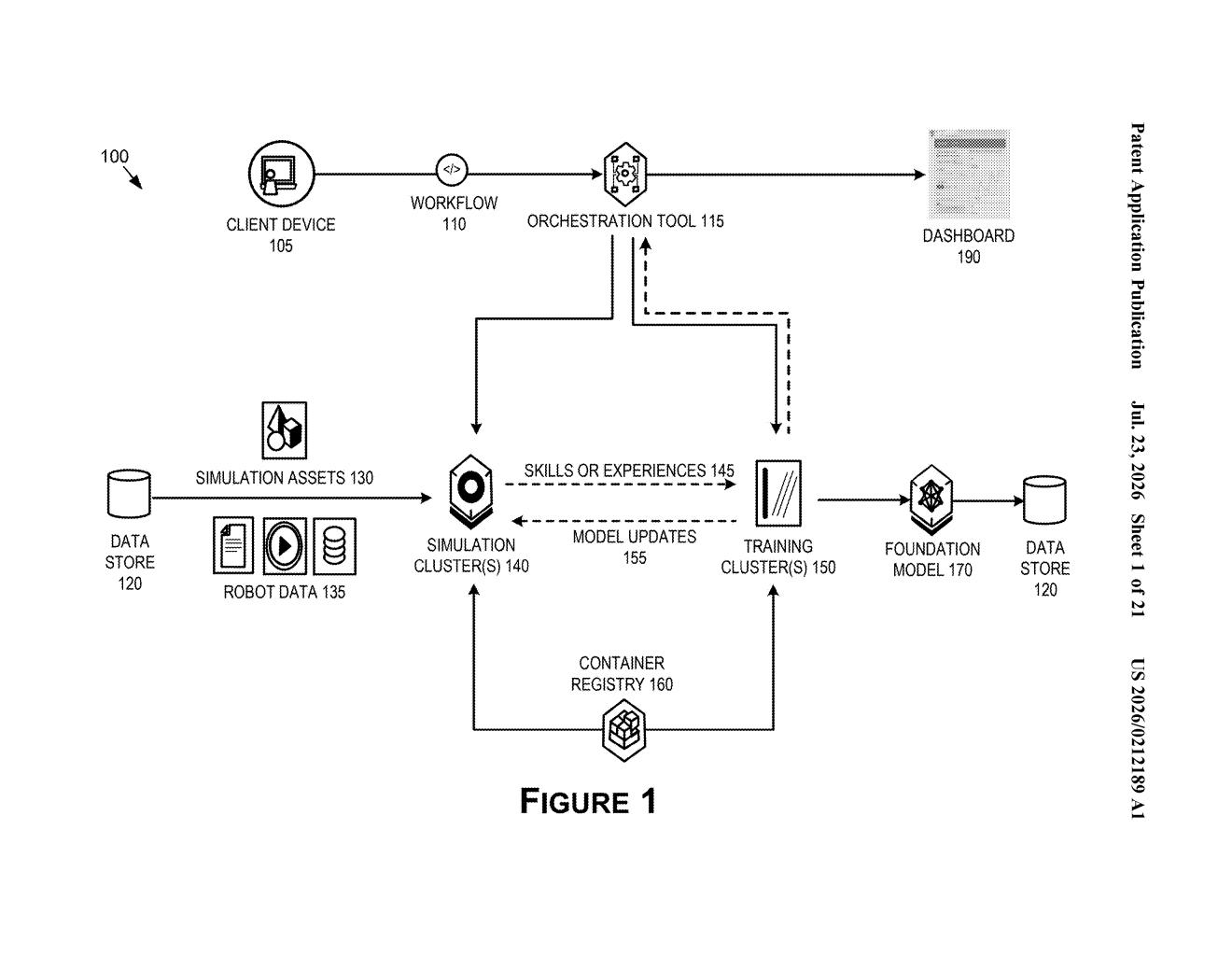
How Nvidia's robot-brain training loop actually works
Imagine you're learning to cook. First, you study recipes from a book (that's structured instruction). Then you go into the kitchen and experiment, picking up tricks the book never mentioned. Then you go back to the book, now better equipped to understand it. Nvidia's patent describes essentially this same loop, but for robots.
The system runs two types of AI training at the same time on separate banks of computer hardware. One side teaches the robot by showing it examples (called supervised learning). The other side lets the robot try things in a simulated environment and rewards it when it succeeds (called reinforcement learning). The key trick is that the results from each side constantly feed into the other, creating a cycle where the robot gets a little better with every pass.
Nvidia says this approach can scale across large clusters of computers and is aimed at training humanoid robots and other physical AI systems. The idea is to automate what would otherwise be a slow, manual back-and-forth process.
Inside the cyclic supervised and reinforcement learning pipeline
The patent describes a cyclic workflow that alternates between two training methods running in parallel on separate hardware clusters.
- Supervised learning cluster: Takes the latest version of a "robotics foundation model" (a general-purpose AI brain for robots) and trains it using a library of skills or experiences already learned. Multiple copies of the model train simultaneously across many machines to speed things up.
- Reinforcement learning cluster: Takes the updated model and puts it through simulated trials, rewarding it for good outcomes. New skills discovered here get added to the shared library of experiences.
- Cyclic handoff: The output of each stage becomes the input for the next. The loop runs continuously through multiple iterations, compounding improvements automatically.
The patent emphasizes that each cluster can use specialized hardware tuned to its task. Supervised learning, for instance, is well-suited to GPU arrays, while reinforcement learning simulations might benefit from different compute configurations. By separating the two workloads physically, neither bottlenecks the other.
The claims are anchored to a "robotics foundation model", a term Nvidia uses for a base AI model that can be adapted for many physical-world tasks, similar to how large language models serve as a base for text applications.
What this means for Nvidia's humanoid robot ambitions
Nvidia has been publicly investing in humanoid robotics and physical AI through projects like GR00T, its platform for robot learning. This patent points to the infrastructure thinking behind that bet: to make robots that can learn reliably and at scale, you need a training loop that doesn't require constant human babysitting. The cyclic approach described here is a direct attempt to automate that process.
For anyone watching the race to build capable humanoid robots, this filing signals that Nvidia sees the training pipeline itself as a competitive advantage, not just the chips or the models. If this system works as described, it could mean Nvidia's robot AI gets meaningfully better with each hardware generation, simply by running the loop longer.
This is one of the more consequential AI infrastructure patents Nvidia has filed in the robotics space. The core idea, automating the back-and-forth between structured training and trial-and-error learning, is exactly the kind of plumbing that separates a research demo from a production system. It's worth taking seriously.
Get our take in your Top Stories
Liked this breakdown? Add Patentlyze as a preferred source on Google, and our plain-English take shows up more often in your Top Stories the next time Nvidia patent news breaks.
There are more where this came from
We read every patent application Big Tech publishes and send you the ones worth knowing. Plain English, free, every week.
The drawings
21 drawing sheets from US 2026/0212189 A1 · click any drawing to enlarge


Show the other 13 sheets


Want this weekly breakdown for a company we don't cover? Patentlyze Pro →