
Nvidia Patents an AI That Rebuilds Missing Detail on 3D Objects
Nvidia is teaching a neural network to look at a rough, low-detail 3D shape and figure out exactly where the missing surface points should go, by studying thousands of examples where those points were deliberately removed.
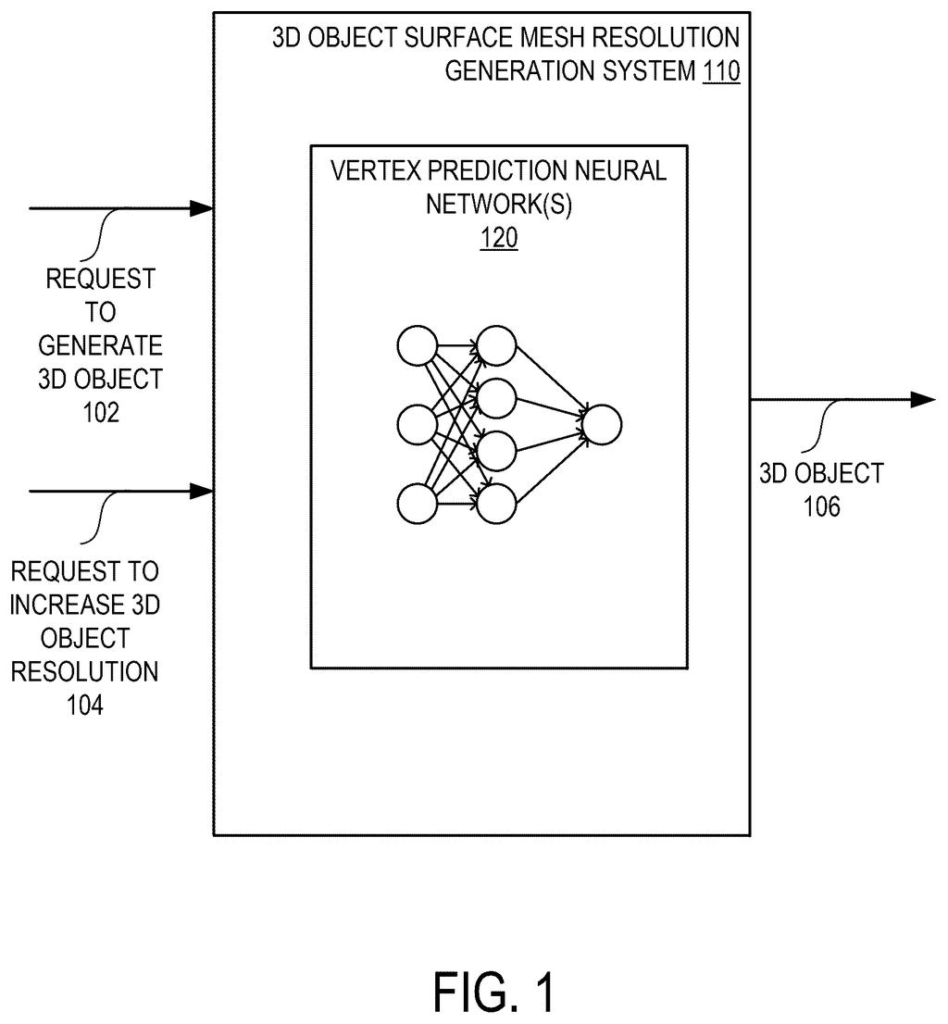
What Nvidia's mesh-repair AI actually does
Imagine a sculptor's digital model that's been reduced to a blocky, low-quality version of itself. The fine details, the curves, the sharp edges, all stripped away. Normally, an artist would have to add those back by hand, which takes hours.
Nvidia's patent describes an AI that learns to predict where those missing surface points belong. It trains by studying 3D objects that have had detail points deliberately removed, so it learns the pattern of what's missing and how to fill it back in.
For you as a user, that could mean 3D models that automatically become more detailed without anyone having to sculpt the extra geometry by hand, whether you're playing a game, designing a product, or generating 3D content with AI tools.
How the network learns from stripped-down 3D shapes
A 3D object on a computer is defined by a surface mesh: a web of triangles whose corner points, called vertices, describe the shape. More vertices mean finer detail; fewer vertices mean a blocky approximation. Moving between those two levels of detail is a constant challenge in graphics pipelines.
This patent describes a processor that runs one or more neural networks (AI models trained on example data) to predict which vertices should be added back to a coarse mesh. Critically, the network doesn't just learn from the object it's currently working on. It learns from different 3D objects that have had vertices removed, so it builds a general understanding of surface geometry rather than memorizing a single shape.
The training approach works like this:
- Take a detailed 3D mesh and strip out some of its vertices to create a lower-detail version.
- Train the network to predict where those removed vertices were.
- Repeat across many different objects so the model learns general surface patterns.
- At inference time, apply that learned knowledge to a new, incomplete mesh.
The result is a network that can up-res a low-detail mesh (add resolution back) in a principled, learned way rather than through simple geometric interpolation.
What this means for 3D content and real-time graphics
Generating and rendering detailed 3D geometry is expensive. Games, simulations, and AI-driven 3D creation tools all face the same trade-off: high detail costs time and memory, while low detail looks rough. A neural network that can intelligently restore surface detail on demand could let systems store or transmit simpler meshes and reconstruct quality only when needed, saving significant compute and storage.
For Nvidia specifically, this fits squarely into its push into AI-accelerated content creation through platforms like Omniverse. If a tool can automatically sharpen the geometry of AI-generated 3D objects, that closes one of the most obvious quality gaps in current text-to-3D pipelines, where shapes tend to come out mushy and low-resolution.
This is a focused, practical patent rather than a sweeping AI claim. The core idea, training a network on deliberately degraded meshes so it can restore them, is the kind of elegant data-engineering trick that tends to actually ship. Given Nvidia's investment in 3D content tools and the known weakness of current AI-generated geometry, this feels like infrastructure that could end up inside a real product.
There are more where this came from
We read every patent application Big Tech publishes and send you the ones worth knowing. Plain English, free, every week.
The drawings
26 drawing sheets from US 2026/0220892 A1 · click any drawing to enlarge


Want this weekly breakdown for a company we don't cover? Patentlyze Pro →