
Patent Turns a Single Audio Track Into Surrounding Sound From Every Direction
Google is patenting a way to take a single-channel audio recording and use a generative AI model to reconstruct a full, three-dimensional sound field around it. Think of it as the audio equivalent of turning a flat photo into a 3D scene.
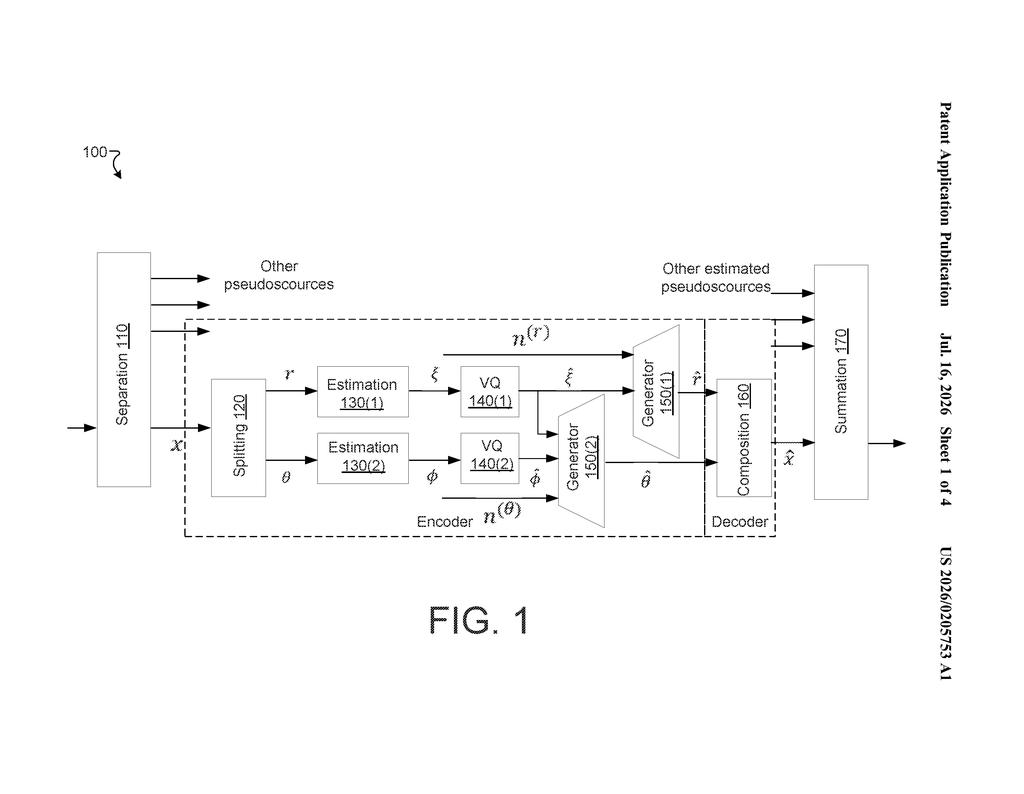
How Google turns one audio track into surround sound
Imagine you recorded a live concert on a single microphone. Everything you captured is flat, with no sense of which sounds came from the left, the right, or behind you. Getting that full spatial experience normally requires recording with many microphones at once.
Google's patent describes a system that can take that single recording and intelligently generate the missing spatial information around it. Instead of hard-coding fixed rules for where sounds should appear in space, it uses a generative AI model that has learned from training data how sounds plausibly exist in a real environment. It then uses that learned knowledge to place sounds in a believable three-dimensional arrangement.
The system can work in two modes: it can try to reconstruct what the original spatial recording actually sounded like, or it can simply generate a convincing spatial version on its own, guided by what it has learned. Either way, you end up with multi-channel audio from a source that started as just one track.
How the generative model samples spatial placement data
The patent centers on something called a Spatial Audio (SA) model, which describes sound in terms of individual audio sources (called pseudosources) and their positions in space. Traditional systems encode that spatial position information directly and deterministically, meaning they store exactly where each sound is placed. Google's approach replaces that fixed encoding with a stochastic (probability-based) generative process.
Specifically, the system uses a conditional model distribution, which is a learned probabilistic model that takes two inputs:
- A conditioning sequence derived from the single-channel (mono) reference audio signal
- A conditioning sequence that describes what kind of spatial arrangement is desired
From those two inputs, the model samples a spatial arrangement sequence rather than looking one up. Sampling here means the model draws a plausible answer from a range of statistically likely options, much like how a language model generates text word by word. The sampled spatial arrangement is then combined with the original audio to produce a full multi-channel output.
The approach also allows the system to lean entirely on what it learned during training, without needing explicit spatial instructions. That makes it flexible enough to work even when good reference spatial data isn't available.
What this means for streaming, calls, and VR audio
For consumers, this kind of technology could improve spatial audio quality in situations where full multi-microphone recordings were never made, such as older music archives, phone calls, or podcast recordings. If Google integrates this into products like YouTube, Google Meet, or its Immersive View features, your existing mono or stereo content could be presented in a richer, more three-dimensional way without anyone re-recording anything.
For the industry more broadly, replacing deterministic spatial encoding with a generative model is a meaningful architectural shift. It means the system can fill in missing spatial information intelligently rather than defaulting to silence or a fixed stereo spread, which matters most for VR, AR, and next-generation audio codecs where spatial accuracy is central to the experience.
This is a genuinely interesting signal from Google's audio research group. Spatial audio has been a quiet battleground across Apple, Sony, and Dolby for years, and using a generative model to synthesize spatial information rather than encode it rigidly is a real departure from how the field typically works. It won't make headlines the way a new phone does, but it's the kind of foundational codec-level work that could improve audio quality across a lot of Google's products.
Get our take in your Top Stories
Liked this breakdown? Add Patentlyze as a preferred source on Google, and our plain-English take shows up more often in your Top Stories the next time Google patent news breaks.
There are more where this came from
We read every patent application Big Tech publishes and send you the ones worth knowing. Plain English, free, every week.
Want this weekly breakdown for a company we don't cover? Patentlyze Pro →