
Nvidia Patents a Prediction-Based Power Steering System for Data Centers
As GPU clusters push power draw to the edge of what electrical infrastructure can handle, Nvidia is patenting a system that predicts how much power a data center will consume — before it consumes it — and throttles components accordingly.
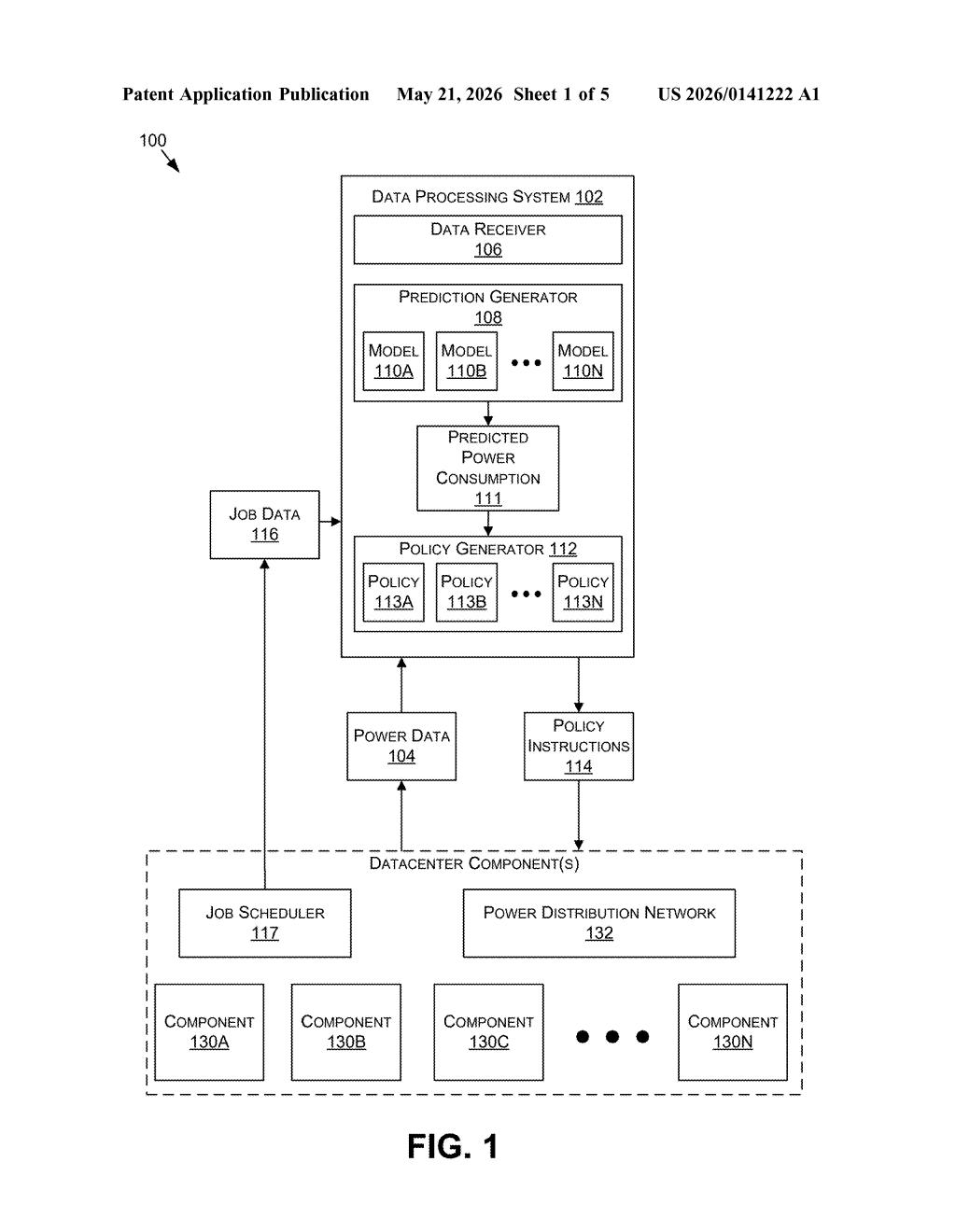
How Nvidia's data center power forecasting actually works
Imagine your home's circuit breaker could sense that you're about to turn on the oven, the dryer, and the dishwasher at the same time — and quietly dimmed a few lights before you even flipped a switch. That's roughly what Nvidia's patent is doing, but for entire data centers packed with GPU servers.
The system continuously collects power consumption data from every component in the facility. A prediction model takes that data and forecasts how much power the whole data center will need during the next time window. Based on that forecast and the current state of the facility, it generates a power policy — basically a set of limits distributed to each component before demand spikes.
Instead of reacting to an overload after it happens, the system tries to prevent it. Each server or component receives instructions to cap its own power draw for the upcoming period. The goal is to keep the entire facility within safe and efficient operating limits without human intervention.
How the prediction model drives real-time power policy
The patent describes a closed-loop power management pipeline operating at data center scale. Here's how the pieces connect:
- Data Receiver: Collects real-time power consumption telemetry from a large population of data center components — GPUs, CPUs, networking gear, storage — across a first time period.
- Prediction Generator: Feeds that telemetry into one or more prediction models to forecast aggregate and per-component power consumption for an upcoming second time period. The patent references multiple models (110A, 110B, etc.), suggesting an ensemble or component-specific approach.
- Policy Generator: Takes the predicted consumption figures alongside the current state of the data center (available headroom, active jobs, infrastructure limits) and produces power policies — per-component limits for the upcoming window.
- Job Scheduler integration: Job data is also factored in, meaning the system can account for scheduled workload changes when generating its predictions.
The policies are pushed as policy instructions through the power distribution network to each component, which then enforces its own cap. This is a proactive model, not reactive — the system acts on forecasts, not alarms. The architecture suggests a centralized orchestrator with distributed enforcement, which maps well to how modern hyperscale data centers are already organized.
What this means for AI cluster power budgets
Data centers running dense GPU clusters — the kind used for training large AI models — regularly operate at the edge of their power envelopes. A single unexpected surge can trigger thermal throttling, hardware faults, or blown capacity limits with utility providers. Proactive power steering could meaningfully reduce those events, keep hardware healthier, and allow operators to safely run closer to maximum power draw without safety margins eating into performance.
For Nvidia specifically, this matters because the company sells not just GPUs but entire data center infrastructure through its DGX and GB200 NVL product lines. A software layer that makes those systems easier and safer to operate at scale strengthens the case for buying Nvidia's full stack rather than mixing in commodity gear.
This is unglamorous but genuinely useful infrastructure work. Power management at data center scale is a real operational pain point — especially as AI workloads push energy density to new highs — and prediction-based approaches are a sensible evolution over reactive throttling. It's not a flashy AI patent, but it's the kind of systems-level thinking that compounds into real advantages when you're running thousands of GPUs under one roof.
Get our take in your Top Stories
Liked this breakdown? Add Patentlyze as a preferred source on Google, and our plain-English take shows up more often in your Top Stories the next time Nvidia patent news breaks.
There are more where this came from
We read every patent application Big Tech publishes and send you the ones worth knowing. Plain English, free, every week.
Want this weekly breakdown for a company we don't cover? Patentlyze Pro →