
Nvidia Patents a System That Keeps Video Sharp While Cutting File Size
Nvidia is patenting a smarter way to compress video: scan the footage once to build a plan, then scan it again to refine that plan before actually encoding anything. The result is better quality without wasting bits on frames that don't need them.
What Nvidia's adaptive video compression actually does
Imagine you're packing a suitcase. A rough approach is to guess how much space each item needs and shove things in. A better approach is to lay everything out first, figure out which items are bulky and which are tiny, then repack with that knowledge. Nvidia's patent applies that same logic to video compression.
When a video encoder compresses footage, it has to decide how many bits to spend on each frame. Action-heavy scenes need more detail preserved; static scenes need far fewer bits. Nvidia's system scans the video twice before encoding: a first pass to understand what's in the footage, and a second pass to refine the compression plan based on what it learned.
The payoff is that video quality goes up without increasing file size, because bits get spent where they actually matter. This kind of encoding work happens behind the scenes in streaming platforms, video game capture tools, and professional post-production pipelines.
How the two lookahead passes reshape the encoding plan
The patent describes a dual lookahead encoding pipeline with two pre-encoding analysis passes before a single final encode.
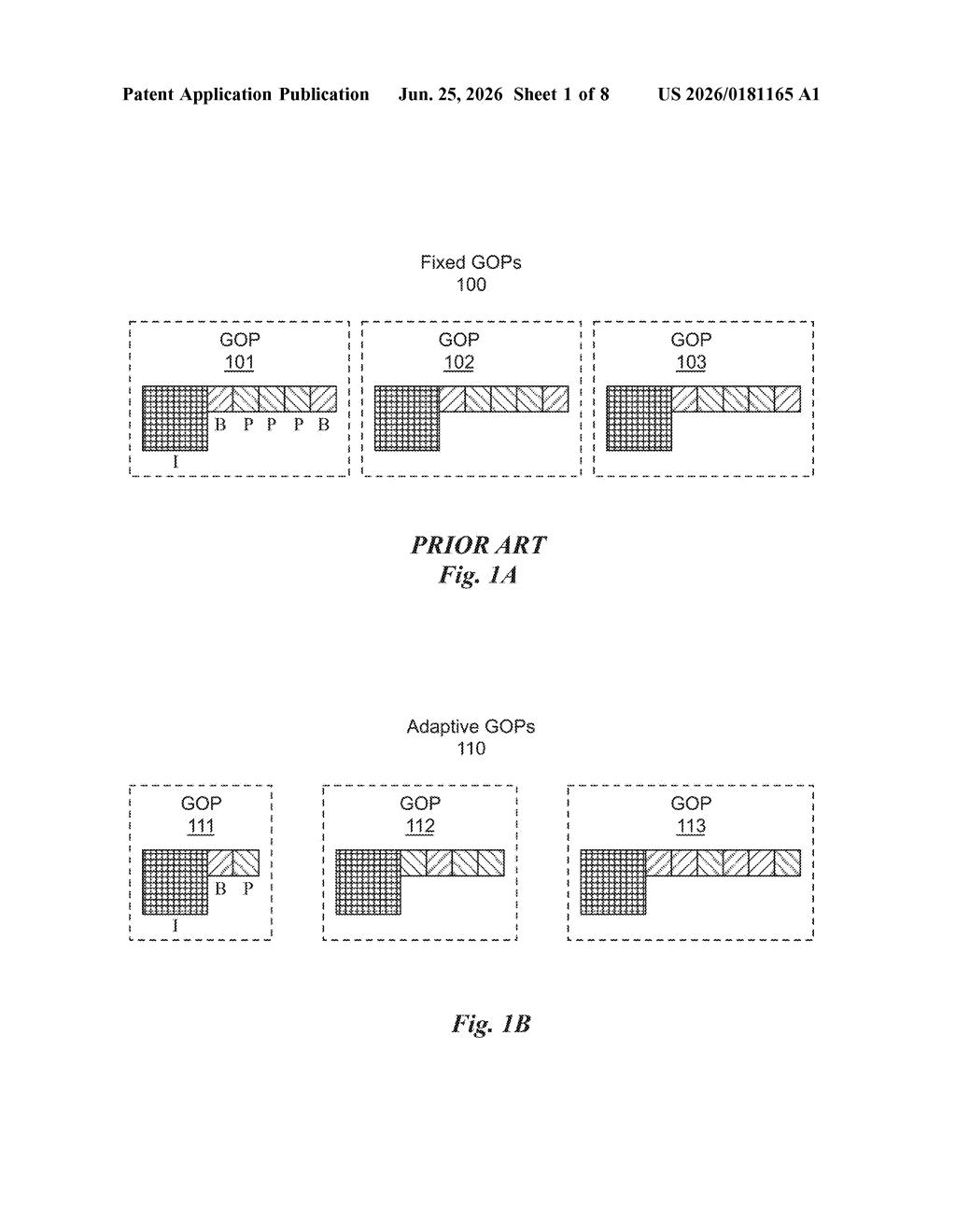
- First lookahead pass: The encoder scans incoming frames and extracts characteristics, things like scene complexity, motion levels, and where detail is concentrated. It uses this data to build a fixed Group of Pictures (GOP) structure, which is a plan defining how frames are grouped and which ones act as reference points for others.
- Optimization step: The fixed GOP structure is then reworked into an adaptive GOP structure, one that can change group sizes and keyframe placement based on what the first pass actually found in the footage.
- Second lookahead pass: The encoder reruns its analysis using the new adaptive structure, updating its per-frame measurements to reflect the improved grouping. This produces a refined quantization parameter (QP) map, essentially a per-region map of how much compression to apply to each part of each frame.
The final encode then runs against both the adaptive GOP structure and the QP map. The key insight is that the two passes talk to each other: the first pass informs the structure, and the second pass recalibrates the detail measurements to match that structure.
What this means for streaming and GPU-based video tools
For anyone watching or streaming video, this kind of work translates to fewer compression artifacts, the blurry or blocky patches that appear during fast motion or scene cuts, without needing a larger file or higher bitrate. That matters for services pushing video at scale, where even small efficiency gains compound across millions of streams.
For Nvidia specifically, this fits squarely into its NVENC hardware encoder business, the video encoding chip built into GeForce and data-center GPUs. Faster, more efficient encoding is a direct selling point for cloud gaming, video conferencing, and professional video production customers who run encoding workloads on Nvidia hardware around the clock.
This is a focused, practical engineering improvement rather than a flashy AI story. Two-pass encoding has existed for years in software encoders like x264, so the real question is whether Nvidia can implement this efficiently enough in hardware to matter for real-time or near-real-time workloads. If they can, it's a genuine competitive edge for NVENC.
There are more where this came from
We read every patent application Big Tech publishes and send you the ones worth knowing. Plain English, free, every week.
Want this weekly breakdown for a company we don't cover? Patentlyze Pro →