
Nvidia Patents Technology That Shrinks 3D Scene Files Without Retraining Per Scene
Nvidia has patented a way to compress the data structures used to represent 3D scenes — and unlike existing approaches, it doesn't need to be retrained every time you switch to a different scene.
What Nvidia's reusable 3D compression actually does
Imagine you want to stream a 3D environment — a game world, a virtual room, a digital city — over the internet in real time. The data describing that scene needs to be compact enough to travel quickly, but detailed enough to look good. Right now, most compression tools for this kind of data are trained specifically for one scene, meaning you'd need a new tool for every new environment. That's slow and impractical.
Nvidia's patent describes a compression approach that works like a shared dictionary. Instead of building a custom solution per scene, it uses a pre-built lookup table (called a codebook) that stores common visual building blocks. Any 3D scene can then be encoded using entries from that shared table and quickly reconstructed on the other end — no scene-specific tuning required.
This matters most in situations where 3D content needs to move fast: cloud gaming, augmented reality, or digital twins. If your device can decompress a scene using a single general-purpose tool rather than waiting for a custom one to load, everything gets quicker and more flexible.
How the codebook reconstructs compressed triplane data
The patent centers on a data format called a triplane — a way of encoding a 3D scene into three flat, grid-like feature maps (think of slicing a cube along its three axes). Triplanes are popular in neural rendering (where AI generates images from data rather than traditional geometry) because they're more compact than raw 3D data while still capturing rich visual detail.
The problem is that even triplanes are large enough to create bottlenecks when streaming. Existing compression techniques address this, but they require joint training — the compression model must be trained at the same time as the scene representation itself. That means it only works for the scene it was trained on.
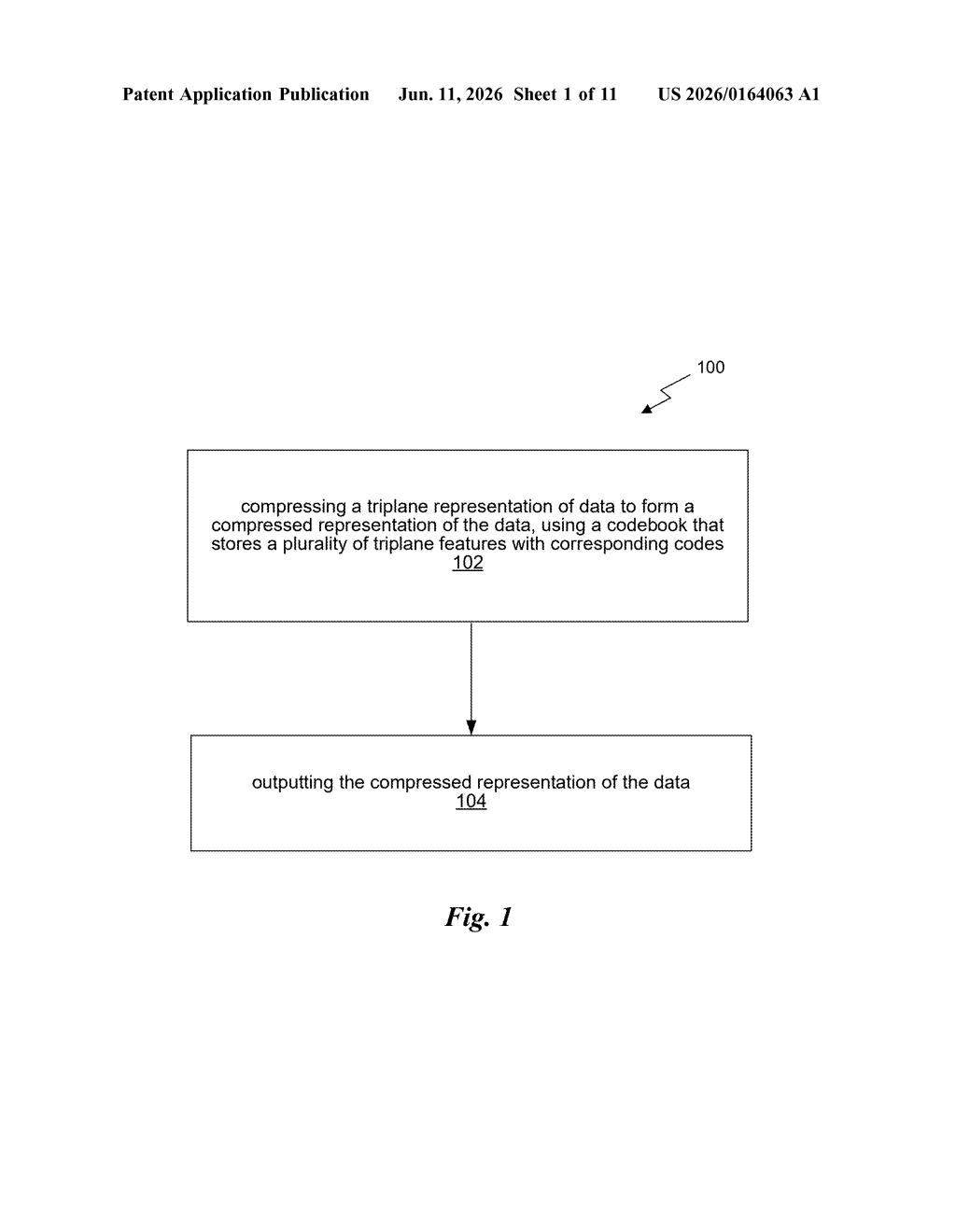
Nvidia's solution introduces a generalizable compression pipeline using a codebook — a pre-learned table of triplane feature snippets paired with short numeric codes. To compress a triplane, the system maps its features to the closest matching codes in the codebook. To decompress, a receiving device looks up those codes and reconstructs the original feature data.
- No per-scene training: the codebook is trained once and reused across arbitrary scenes.
- Decompression at the edge: a lightweight device can reconstruct the scene using just the codebook and the incoming codes.
- Flexible output: the reconstructed triplane feeds directly into existing neural rendering pipelines.
What this means for streaming and real-time 3D graphics
The immediate practical gain is bandwidth. If Nvidia can compress triplane-based 3D scenes without requiring a custom model per environment, it opens the door to streaming high-quality neural 3D content the same way you stream video today — encoded on a server, decoded on your device.
This has real implications for cloud gaming, mixed-reality headsets, and industrial digital twin applications, where 3D environments need to update dynamically and travel across networks quickly. For you as an end user, the downstream effect would be higher-quality 3D visuals arriving faster and with less processing overhead on your device — without the rendering hardware needing to do the heavy lifting upfront.
This is genuinely useful infrastructure work. The 'generalizable' aspect is the real contribution here — compressing one specific scene is a solved problem, but building a codec that works for any scene without retraining is a meaningful step toward making neural 3D rendering practical at scale. It's not flashy, but it's the kind of unglamorous plumbing that has to exist before the exciting applications can ship.
There are more where this came from
We read every patent application Big Tech publishes and send you the ones worth knowing. Plain English, free, every week.
Want this weekly breakdown for a company we don't cover? Patentlyze Pro →