
Nvidia Patents a Memory Shortcut That Lets Small AI Models Draw Sharper Images
Nvidia's filing hands an image-drawing AI a table of notes it learns along the way. The company's own examples show a tiny network producing a sharp picture in as little as five seconds of training.
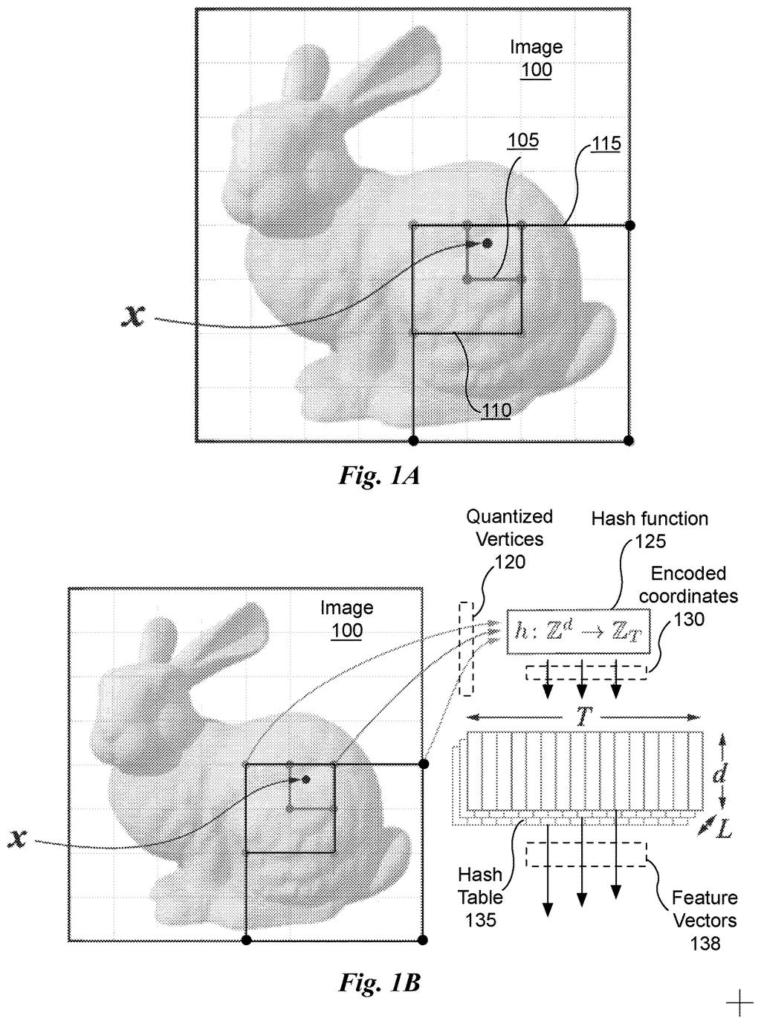
What Nvidia's learned lookup table actually does
Every time a computer draws a 3D scene with AI, it has to answer the same tiny question millions of times: what color is this exact spot? A neural network (software that learns patterns from examples) normally does all of that work by itself, and it can be slow to train and costly to run.
Nvidia's patent application gives the network a cheat sheet. Instead of handing it a raw location, the system looks that spot up in a table of notes learned during training, then passes the notes along. The table is checked at several zoom levels, from big shapes down to fine detail like skin or hair.
Because the notes improve as training goes on, the AI itself can stay small. In Nvidia's examples, a small network produced a clear image after five seconds to two minutes of training, while the older method's picture looked blurry.
… obtaining, using the encoded coordinates, the learned feature vector stored at an entry of a hash table; and generating, by inputting the learned feature vector to the neural network model, a prediction of task-specific data at the multi-dimensional input coordinates.
Translation: It pulls stored details from a quick lookup table and feeds them into the AI to predict specific data points.
How the table is read at several zoom levels
The patent application describes a way to prepare the input for a neural network. Normally you hand the network a position, like a point in a 3D scene, and it works out an answer such as color. Here, the position is first snapped to the corners of the grid cell around it. Those corners are run through a hash function (a formula that scrambles a set of numbers into a slot number in a table).
- Each slot holds a short list of numbers (a feature vector) that was learned during training.
- The lookup is repeated on several grids, from coarse to fine, each with its own independently learned table.
- The stored lists for the cell's corners are blended (interpolated) based on exactly where the point sits, then joined together and fed to the network.
Two different positions can land in the same slot, which is called a collision. Instead of adding extra code to sort that out, the filing says the network learns to tell them apart. That keeps the work easy to run in parallel on graphics chips. During training, the error signal updates the network's weights and only the few table entries that were actually used. The tables can also be sized to fit in a chip's fast on-chip memory.
The claims cover a method, a system with memory and a processor, and a processor. Dependent claims name tasks like predicting 3D shapes and light, plus a long list of settings from autonomous machines to language models.
The set of encoded coordinates is used to lookup D-dimensional feature vectors in a table of size T that have been learned. The learned feature vectors are filtered (e.g., linearly interpolated, etc.) based on the coordinates of the point to compute a feature vector corresponding to the point.
Translation: These coordinate codes search a learned data table, and the results are blended together to figure out the final point.
Why smaller AI models matter for 3D graphics
Faster learning of 3D scenes could show up for you as shorter waits and sharper results in the tools that build graphics, simulations and virtual worlds. In one of Nvidia's comparisons, a small two-layer network with the table made a more detailed image in five minutes than a larger network using the older method.
The filing lists simulation, digital twins, robots, extended reality and game streaming as places the method could run. The trade-off is memory: the example network stored about 25 million learned values, versus roughly 11,000 for the older method. Keep in mind this is a patent application, which describes an idea and does not promise a product.
Nvidia's 44th filing we've tracked since July in our GPU rendering race watch adds to a run that includes applications on sharper game shadows and a frame-rate capability check.
This patent application sits close to a shippable feature because it needs no new hardware. The filing describes the method running on ordinary Nvidia graphics chips, with two software programs (called CUDA kernels) handling the lookups and the training updates.
What has to exist first is a product that needs it: a renderer, simulator or robot-training tool that learns scenes from examples. Once a team has that, adding the lookup table is a software change, and the document shows it working on images, shadows and 3D shapes.
The cost is memory. The example network held about 25 million learned values against roughly 11,000 for the older method. The shortest route to a product is a setting for tools running on chips with room to spare.
Get our take in your Top Stories
Liked this breakdown? Add Patentlyze as a preferred source on Google, and our plain-English take shows up more often in your Top Stories the next time Nvidia patent news breaks.
There are more where this came from
We read every patent application Big Tech publishes and send you the ones worth knowing. Plain English, free, every week.
The drawings
12 drawing sheets from US 2026/0350393 A1 · click any drawing to enlarge


Show the other 4 sheets


Want this weekly breakdown for a company we don't cover? Patentlyze Pro →
Be the first to weigh in