Nvidia
Nvidia · AI / ML · Filed Jan 13, 2026 · USPTO published May 21, 2026 · May 21 release
Nvidia Patents ML-Driven Road Hazard Detection Using Stereo Camera Disparity
Nvidia has filed a patent for a machine learning system that detects road hazards — potholes, debris, obstacles — by comparing tiny pixel mismatches between two cameras mounted on a self-driving vehicle. It's a clever twist on how stereo vision already works, turned into an active safety net.
- Publication number
- US 2026/0141732 A1(US20260141732A1)
- Applicant
- NVIDIA Corporation
- Filed · Published
- Jan 13, 2026 · May 21, 2026
- Inventors
- Yue WU, Liwen LIN, Xin TONG, Gang PAN
- Status when we published
- Waiting for an examiner
- Document
- 20 claims
- US classification
- 382/103
- Parent application
- Continuation of 17/733,508 (filed Apr 29, 2022)(17733508)
How Nvidia's stereo-camera hazard detector spots danger
Imagine holding your hand in front of your face and closing one eye, then the other. Your hand appears to jump sideways — that shift is called disparity, and your brain uses it to judge depth. Self-driving cars do the same thing with two cameras mounted side by side.
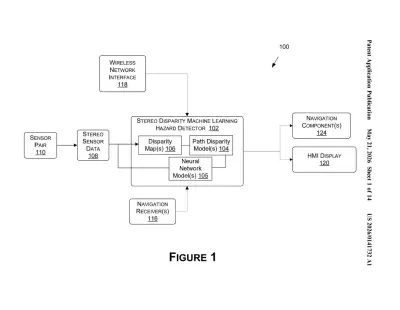
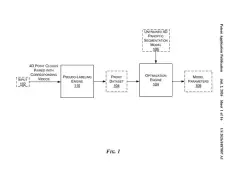
Nvidia's patent takes that idea one step further. Instead of just measuring depth, it builds a baseline model of what the road ahead should look like through those two cameras. If a pixel pair from both cameras doesn't match the baseline — say, because there's a pothole or a rock in the way — the system flags it as a potential hazard.
Once suspicious pixels are identified, nearby flagged pixels get grouped together to form a coherent picture of the hazard. That information then feeds directly into the vehicle's navigation and control systems, so the car can steer around the problem or slow down in time.
How disparity deviation flags hazard pixels on the road
The system starts by ingesting a stereo image pair — two slightly offset images from cameras with overlapping fields of view. It calculates disparity values (the pixel-level offset between matching features in both images) to build a path disparity model: essentially a learned expectation of what the drivable surface should look like in disparity space.
A machine learning classifier then compares real-time disparity readings against that model. When a pixel's disparity deviates from the expected road surface by more than a set threshold, it's tagged as a hazard pixel. The key insight is that the ML model uses feature vector similarity metrics — mathematical representations of local image texture and structure — so it can still match corresponding pixels even when lighting, color, or surface conditions make them look slightly different to a naive comparison.
The patent also describes an optional optimization: projecting the disparity data into a V-space disparity map, where one axis represents disparity values and the other represents pixel rows. This compressed 2D representation makes it faster to estimate the road surface model without processing every pixel individually.
- Hazard pixels are clustered with neighboring flagged pixels to form coherent obstacle regions.
- Those regions feed directly into planning, navigation, and control operations for the ego-vehicle.
- The approach handles wet roads, shadows, and low-contrast surfaces better than simple depth thresholding alone.
What this means for autonomous vehicle safety pipelines
For autonomous vehicles, detecting low-lying hazards — a shredded tire on the highway, a shallow pothole, spilled gravel — is genuinely hard. Lidar can miss flat debris, and monocular cameras struggle with depth. Stereo vision is already common in AV sensor stacks, so a system that repurposes existing stereo hardware for active hazard detection rather than just depth mapping is an efficient win.
For Nvidia, whose DRIVE autonomous vehicle platform competes directly with Mobileye, Qualcomm, and others, this kind of perception IP helps differentiate its stack at the software and model level — not just the chip level. If this approach gets baked into DRIVE inference pipelines, it could quietly raise the bar on what a "standard" AV perception suite is expected to handle.
Source: US 2026/0141732 A1 at the USPTO (PDF). Full patent text and figures are in the official publication.
Get our take in your Top Stories
Liked this breakdown? Add Patentlyze as a preferred source on Google, and our plain-English take shows up more often in your Top Stories the next time Nvidia patent news breaks.
Add Patentlyze on Google
One click.
There are more where this came from
We read the new patents from Big Tech, carmakers and more and send you the ones worth knowing. Plain English, free, every week.
More from Nvidia
All 665 Nvidia patents →
More in AI safety
All 60 AI safety patents →
IBM
IBM Patent Locks AI Models Inside an Encrypted Vault From All Parties
IBM
IBM Patents a System That Baits Its Own AI Chatbots Into Saying Harmful Things
IBM
IBM Patents a System for Grading AI-Written Articles Against Human-Edited Ones
IBM