Nvidia
Nvidia · AI / ML · Filed Dec 26, 2025 · USPTO published Jul 2, 2026 · Jul 2 release
Nvidia's New Patent Teaches Self-Driving Cars to Tell a Cyclist from a Trash Can
Teaching a self-driving car to tell a cyclist from a trash can, in real time, across dozens of laser-scanned frames, is one of the hardest problems in robotics. Nvidia is patenting a way to do it without paying humans to label millions of training examples by hand.
- Publication number
- US 2026/0187807 A1(US20260187807A1)
- Applicant
- NVIDIA Corporation
- Filed · Published
- Dec 26, 2025 · Jul 2, 2026
- Inventors
- Yushan Zhang, Aljosa Osep, Tim Meinhardt, Laura Leal-Taixe
- Status when we published
- Waiting for an examiner
- Document
- 20 claims
- US classification
- 382/100
- Parent application
- Claims priority from a provisional application 63739482 (filed Dec 27, 2024)
How Nvidia's system sees and labels a moving world in 3D
Imagine a self-driving car's sensors sweeping a busy intersection several times per second, building a 3D map of everything around it. The car doesn't just need a snapshot; it needs to know what each object is and where it's going across time. That combination of labeling things AND tracking them through time is what engineers call "panoptic 4D segmentation," and it's notoriously expensive to train because someone usually has to sit down and manually tag thousands of examples.
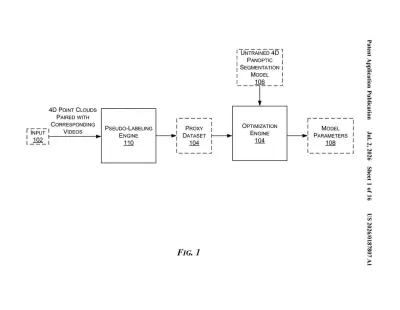
Nvidia's patent describes a way to sidestep most of that manual work. Their system uses existing AI models (trained on ordinary video) to automatically generate consistent labels across a sequence of 3D laser-scan frames. Those auto-generated labels then become the training data for a new, specialized network.
The end result is a model that can look at a fresh scene it has never encountered before and still correctly identify and track every pedestrian, vehicle, or obstacle in it. That capability is central to making autonomous vehicles and robots work reliably in the real, unpredictable world.
How the model builds its own training data from video and laser scans
The patent centers on training a neural network to perform panoptic segmentation (labeling every point in a scene by both category, like "car" or "person," and individual identity, like "car #3") on 4D point clouds (3D laser-scan data captured across multiple time steps, making time the fourth dimension).
The key engineering challenge is building a training dataset. Manually labeling 4D point clouds is expensive and slow, so Nvidia's approach uses vision foundation models (large, general-purpose AI models pre-trained on images and video) to automatically produce pseudo-labels, meaning labels generated by the AI rather than by a human annotator. Critically, the system ensures these labels stay temporally consistent, so the same car is tagged with the same identity across every frame, not just within a single snapshot.
Once the training data is built, a segmentation model is trained on it using a standard supervised loop:
- Feed a 4D point cloud in, get predicted labels out
- Compare predicted labels to the pseudo-labels to compute an error (the "loss")
- Adjust the network's internal parameters to reduce that error
The goal is zero-shot segmentation, meaning the trained model can correctly label scenes it was never explicitly trained on, which is essential for deployment in unpredictable real-world environments like city streets.
What this means for self-driving cars and robotics perception
For autonomous vehicles, perception is everything. A car that can't reliably distinguish a pedestrian stepping off a curb from a fire hydrant is a car that shouldn't be on public roads. The expensive bottleneck has always been labeled data: you need enormous amounts of it, and labeling 3D time-series data by hand is far more painstaking than tagging a photograph. Nvidia's approach of using existing AI to generate its own training labels is a direct attack on that cost.
For Nvidia, the strategic picture is clear. The company sells the chips and increasingly the software stack that runs inside autonomous vehicle systems. A patent on the core perception training pipeline puts Nvidia deeper into the value chain, well beyond just supplying the GPU.
Source: US 2026/0187807 A1 at the USPTO (PDF). Full patent text and figures are in the official publication.
Get our take in your Top Stories
Liked this breakdown? Add Patentlyze as a preferred source on Google, and our plain-English take shows up more often in your Top Stories the next time Nvidia patent news breaks.
Add Patentlyze on Google
One click.
There are more where this came from
We read the new patents from Big Tech, carmakers and more and send you the ones worth knowing. Plain English, free, every week.
More from Nvidia
All 665 Nvidia patents →
More in AI training & infrastructure
All 324 AI training & infrastructure patents →
Amazon
Zoox Patents a Way to Train Its Self-Driving AI on Situations It Rarely Sees
Waymo (Google)
Waymo Patents Contrastive Learning to Align Self-Driving Sensor Data with Language
Qualcomm
Qualcomm Patents a Negotiation System for Phones Training AI Together Over a Network
Amazon