
Nvidia Patents Adaptive Voxel Radiance Field Rendering for Real-Time 3D Scenes
Nvidia is patenting a way to build and render 3D scenes using optimized voxel grids — small 3D cubes that get iteratively refined against real reference images — sorted using a spatial indexing trick called Morton codes to make the whole thing fast enough to run in real time.
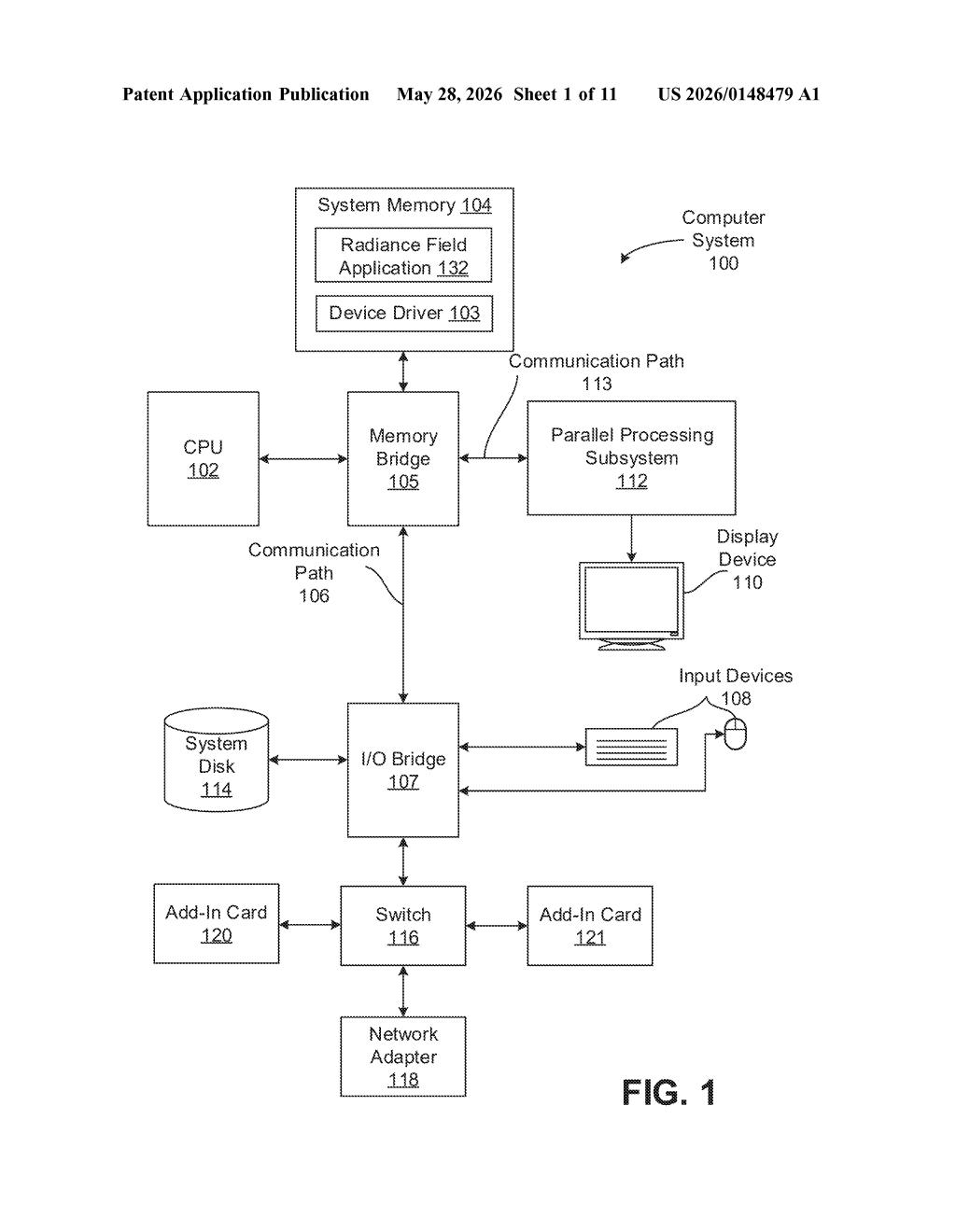
What Nvidia's voxel radiance field system actually does
Imagine trying to recreate a real-world location in 3D from a handful of photos. Traditional approaches can produce beautiful results, but they're painfully slow to render — not great if you need a live preview or a real-time simulation.
Nvidia's approach described in this patent breaks the scene into a grid of tiny 3D blocks called voxels (think Minecraft cubes, but microscopic and much more precise). The system starts with a rough first guess, then repeatedly tweaks those voxels — comparing their appearance against reference images — until the rendered scene looks as close to reality as possible.
The clever part is how Nvidia keeps this fast. Each voxel is assigned a Morton code, a compact number that encodes the voxel's position in 3D space along a Z-shaped curve. Sorting by these codes keeps nearby voxels next to each other in memory, which dramatically cuts down on the computational overhead when rendering the full scene.
How Morton codes drive Nvidia's voxel render order
The patent describes a pipeline with two main phases: optimization and rendering.
In the optimization phase, the system initializes a first set of voxels to represent a 3D scene, then runs iterative refinement passes comparing those voxels against one or more reference images of the real scene. Think of it as gradient descent (an algorithm that nudges parameters toward a better answer step-by-step) applied to a volumetric 3D grid — similar in spirit to Neural Radiance Fields (NeRF), which reconstruct 3D scenes from 2D photos using neural networks, but here structured around an explicit voxel representation rather than a pure implicit neural model.
In the rendering phase, all voxels are sorted using Morton codes — a space-filling curve encoding that interleaves the binary representations of X, Y, and Z coordinates into a single integer. Sorting by Morton code produces a Z-order curve traversal, which preserves spatial locality: voxels that are close together in 3D space end up close together in memory. This matters enormously for GPU cache performance.
The rendered output is a final image generated from the optimized, sorted voxel representation. The system's modular design — with a distinct Optimization Module and Rendering Module — suggests it's built to run on GPU hardware where memory bandwidth and cache coherence are the primary bottlenecks.
What this means for real-time 3D graphics and NeRF
NeRF-style scene reconstruction has been one of the hottest research areas in graphics over the past few years, but real-time performance has been a persistent sticking point. Most NeRF pipelines are too slow for interactive or game-engine use. Nvidia's voxel-plus-Morton-code approach is a direct engineering attack on that bottleneck — trading some of the flexibility of pure neural representations for the GPU-friendliness of structured spatial data.
For you as a developer or end user, this kind of technique is what bridges the gap between "beautiful pre-rendered 3D scenes" and "real-time interactive 3D worlds." Nvidia has obvious motivation to push this into its Omniverse platform, game rendering pipelines, or next-gen DLSS-style upscaling systems — anywhere that fast, photorealistic 3D reconstruction from images has value.
This is solid, focused engineering work rather than a conceptual moonshot. The Morton code sorting trick is well-established in spatial computing, and iterative voxel refinement against reference images is a known approach — but packaging them together into a real-time-capable pipeline is where the genuine value lies. Nvidia filing this now lines up neatly with the industry push to make NeRF-style rendering practical for interactive applications, and Nvidia's GPU architecture is purpose-built to benefit from exactly this kind of cache-locality optimization.
There are more where this came from
We read every patent application Big Tech publishes and send you the ones worth knowing. Plain English, free, every week.
Want this weekly breakdown for a company we don't cover? Patentlyze Pro →