
Samsung Patents Technology That Fills Missing Puzzle Pieces for Sharper Video Playback
When a video decoder tries to reconstruct a frame by referencing another part of the same image, what happens if that reference hasn't been decoded yet? Samsung's new patent describes a method for filling in those missing pieces on the fly.
How Samsung fills in the blanks during video decoding
Imagine a jigsaw puzzle where you're trying to place a piece by looking at a nearby section of the board, but that nearby section hasn't been filled in yet. That's a problem modern video decoders run into constantly.
When your phone or TV decodes compressed video, it often saves space by saying "this block of pixels looks like that block over there in the same frame, just copy it." But sometimes the "that block over there" hasn't been processed yet, so the decoder is stuck.
Samsung's patent describes a way to handle exactly that situation. Instead of stopping or skipping, the decoder estimates the missing pixel values using whatever has already been reconstructed nearby, then uses that estimate to finish the job. It's a smarter fallback that keeps the decoding process moving without sacrificing image quality.
How the decoder patches unreconstructed reference samples
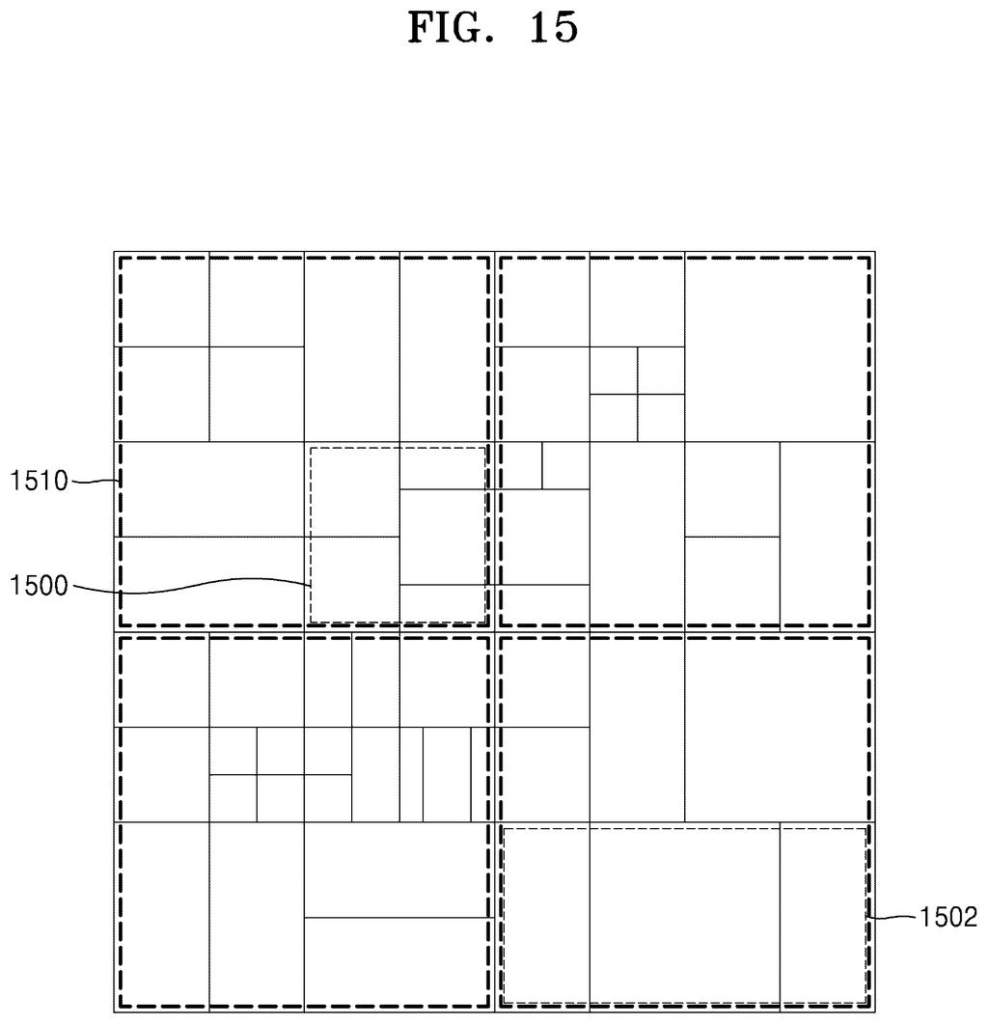
The patent covers an intra-prediction decoding method, meaning the decoder is referencing pixels within the same image (not from a previous or future frame) to reconstruct a block of the picture.
Here's the flow the patent describes:
- The decoder checks whether the reference block it needs is fully reconstructed.
- If yes, it uses that reference block directly to rebuild the current block.
- If some samples (individual pixel values) in the reference block are not yet decoded, the decoder estimates those missing values using already-reconstructed pixels from elsewhere in the same frame.
- It then combines the real and estimated samples into a complete reference block and proceeds with reconstruction.
The key insight is that intra-frame prediction (referencing pixels within the same image) can sometimes create circular dependencies, where block A needs block B, but block B hasn't been processed yet. Rather than treating this as an error, Samsung's method turns it into a recoverable situation by substituting estimated values.
What this means for video compression efficiency
This kind of fix matters most inside video codec standards, the rules that define how streaming video is compressed and decompressed. Codecs like VVC (Versatile Video Coding) push hard on intra-prediction to squeeze out file size, and handling edge cases like incomplete reference blocks is exactly the kind of detail that separates a working codec from one that produces glitchy frames.
For everyday viewers, a working implementation would mean fewer decoding artifacts, particularly in demanding compression scenarios like 4K and 8K streaming. It's not the kind of feature you'd ever see listed on a product box, but it's the type of foundational codec work that keeps video looking clean when compression is pushed to its limits.
This is a low-glamour, high-importance codec patent. It won't make headlines at a product launch, but Samsung's video chip and codec teams file this kind of IP specifically to protect the engineering work that goes into their televisions, cameras, and semiconductor products. It's worth a note for anyone tracking Samsung's codec IP strategy.
There are more where this came from
We read every patent application Big Tech publishes and send you the ones worth knowing. Plain English, free, every week.
The drawings
32 drawing sheets from US 2026/0214206 A1 · click any drawing to enlarge


Want this weekly breakdown for a company we don't cover? Patentlyze Pro →
Be the first to weigh in