
Nvidia Patents AI That Generates Fake Medical Scan Images From Text Descriptions
Nvidia's patent application describes an AI that turns a typed sentence into a full 3D CT, MRI or PET scan, then files that fake scan into a dataset used to train other medical AI. To make it understand everyday wording, another AI first rewrites real radiology reports in many styles.
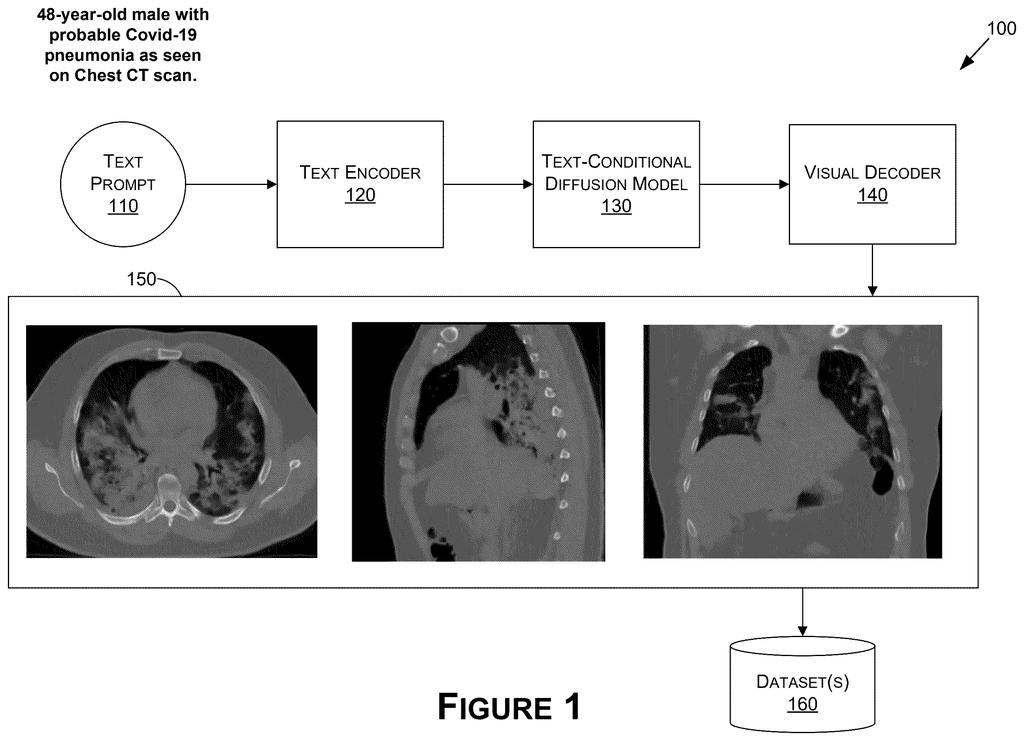
What Nvidia's text-to-CT-scan system actually does
Every time a patient gets a CT scan, the images get filed next to a report written in a stiff, fixed format: age, sex, findings, impression. That is a problem for AI, because a model trained on those reports only understands prompts written the same rigid way.
Nvidia's patent application describes a way around it. A language model (the same kind of AI behind chatbots) rewrites and summarizes existing reports in many different styles, including the one-sentence descriptions a person might actually type. Those varied descriptions get paired with the real scans to teach an image-generating AI to respond to ordinary language.
Once trained, you type a sentence and it produces a brand-new, synthetic 3D scan. The fake scans are meant to pad out datasets used to train other medical AI, especially for rare conditions where real examples are scarce, and to reduce reliance on real patient data.
… generate simulated three-dimensional (3D) image data based at least on applying the latent embedding to a visual decoder of a 3D compression network …
Translation: It creates fake 3D images by running the text through a specialized image decoder.
How Nvidia teaches the AI to read messy prompts
The pipeline has three parts. A text encoder turns your sentence into numbers (an embedding, a numerical fingerprint of its meaning). A diffusion model (an AI that starts with random noise and cleans it up step by step) uses that fingerprint to produce a compact code for a 3D volume. A decoder from a 3D compression network then expands the code into a full scan.
Compression is what makes 3D practical, since full scans eat huge amounts of memory. The filing describes outputs at 512×512×192 voxels (3D pixels) produced directly, without generating a small image and sharpening it afterward. One example pre-trains the compression network on over 55,000 3D medical volumes.
To teach the model plain language, a body-part detector first lists the organs in each existing scan. A language model then gets that list plus pieces of the matching radiology report and writes a short free-form description or rephrases the report's sections (demographics, findings, impressions). During training, the system randomly samples different mixes of those fields, so it learns to handle prompts of many shapes.
… a dataset with 3D medical images and corresponding radiology reports with fixed-format information may be transformed into a diverse set of training data using one or more language models …
Translation: Language models are used to turn standard medical records into varied training data.
Why fake scans could help rare-disease research
The practical pitch is data. Medical AI needs lots of labeled scans, and rare conditions barely show up in existing collections. Expert annotation is slow and expensive, and real patient data comes with privacy rules. Synthetic scans that researchers can order up with a sentence could fill those gaps, so models that spot tumors or outline organs see more variety. The filing offers no test results, so that benefit is a promise for now.
It also fits Nvidia's business of selling the chips and software behind AI training. The claims even mention data center and cloud versions that outside users reach through an API. As a status note, the examiner's first review rejected the claims as filed, which is routine at this stage and usually followed by amendments.
Nvidia's 82nd filing we've tracked in AI simulation since May adds to a run that includes robot hands learning from humans and one photo to 3D head.
The big trade here is realism against trust. A fake scan is only useful if the anatomy is right, and the filing itself admits that synthetic images with glitches can drag down the AI trained on them. Nothing in the text shows how anyone would check that a generated scan is medically sound, so that cost lands on whoever uses the data.
The rewriting step carries its own risk. A language model paraphrases real radiology reports, and a paraphrase can drift from what the radiologist meant. The filing tells the model to make minimal changes and never add information, which is sensible, yet a chatbot can still ignore an instruction.
Squeezing a scan into a compact code also risks losing fine detail, even though the filing says the goal is to keep the important anatomy. The trade looks worth making for filling data gaps, as long as the fake scans supplement real ones.
Get our take in your Top Stories
Liked this breakdown? Add Patentlyze as a preferred source on Google, and our plain-English take shows up more often in your Top Stories the next time Nvidia patent news breaks.
There are more where this came from
We read every patent application Big Tech publishes and send you the ones worth knowing. Plain English, free, every week.
The drawings
9 drawing sheets from US 2026/0360531 A1 · click any drawing to enlarge


Show the other 1 sheets

Want this weekly breakdown for a company we don't cover? Patentlyze Pro →
Be the first to weigh in