
Nvidia Files Patent for Teaching Robot Hands by Watching Human Hands
A human hand and a robot hand are built differently, so copying a human grip move for move often fails. Nvidia's filing teaches the robot to follow the human's intent inside a loose boundary instead.
What Nvidia's robot-hand training patent does
You're watching a video of someone pinching a knife off a table. Your hand does it without thinking. A robot hand has fewer fingers, stiffer joints and a much weaker sense of touch, so copying that exact pinch often fails.
Nvidia's filing describes a two-stage training method. First, a teacher program practices in a computer simulation while watching recordings of human hands handling objects. Instead of demanding that each robot fingertip land exactly where a human fingertip did, it gives the robot a loose zone to stay inside, and it rewards smooth, gentle movement.
Second, a student program learns from the teacher but only gets what a real robot would have: a camera view that shows part of the scene, plus a goal such as a hand path or a plain-language instruction. That student is the version meant to run on an actual machine.
… computing, based on the sequence of actions and the reference states, one or more rewards, wherein the rewards are computed based on a mapping between an anatomy of the human hand and an anatomy of the robot end effector and one or more spatial envelopes for one or more anatomical components of the robot end effector …
Translation: The system scores how well the robot copies human hand movements by mapping human anatomy to the robot's structure.
How a robot hand learns from a human's grip
The patent covers a method for training a robot control policy (the software brain that decides how a robot hand moves) in two stages. Claim 1 requires a first policy trained on a reference demonstration, meaning recorded states of a human hand and an object over time, such as a hand-object motion-capture dataset.
In stage one, the policy proposes a sequence of actions for a robot end effector (the robot's hand or gripper), and reward scores judge each attempt. The rewards rest on an anatomy mapping, which says which robot finger or joint matches which human one, and on spatial envelopes, margins around reference points where the robot can sit without penalty. The filing describes extra pieces:
- Matching reward: compares hand-to-object distances and contact signals that act like a sense of touch.
- Energy reward: penalizes jerky motion.
- Early stopping: an attempt ends if it drifts too far from the reference, and that limit starts loose and tightens during training.
In stage two, the first policy becomes a teacher for a second policy. The student takes partial perception data, such as a single-view depth image turned into a 3D point cloud, and encodes it into a compact internal summary of the skill (a latent representation). A decoder turns that summary into actions. A helper encoder that sees full information guides training and is dropped at run time.
A second policy is trained, using the first policy, to generate robot actions based on perception data.
Translation: The AI trained on human videos then teaches the actual robot how to operate using its own camera vision.
What this means for robots handling real objects
If robots are ever going to sort packages, help in a kitchen or assist someone at home (uses the filing itself names), they have to handle small, awkward objects. Copying human motion onto a robot hand is a big bottleneck because a human grip does not always fit a robot's hand. This method aims to make large libraries of recorded human motion usable for different robot hands.
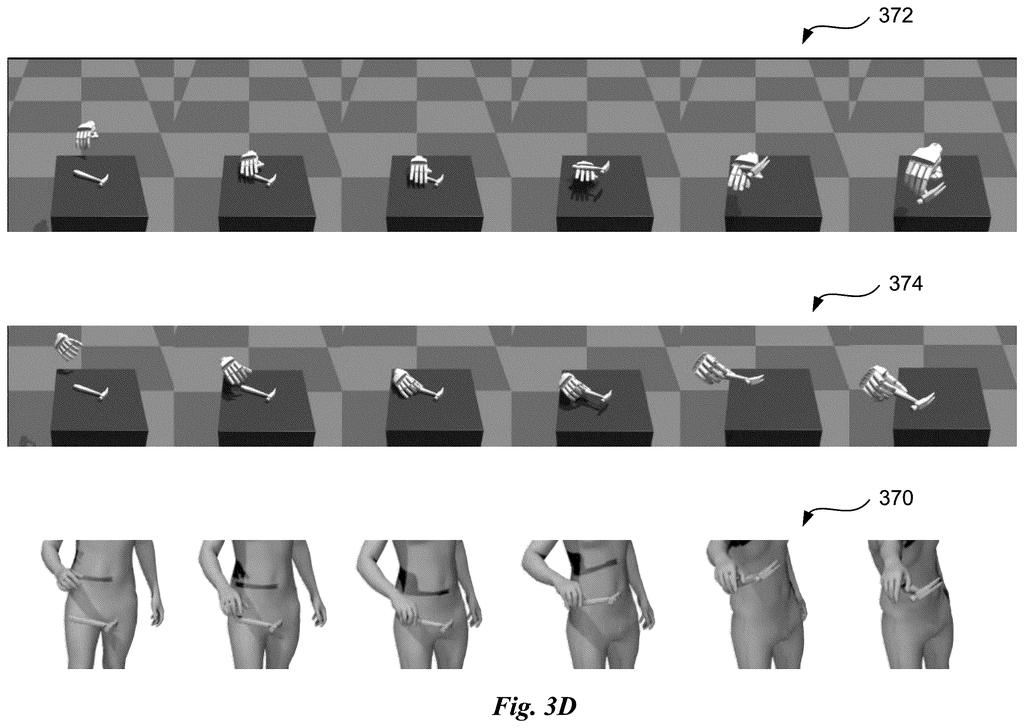
The filing's own simulation comparisons show the trained policy picking up a knife where a baseline model failed, and handling objects it had not seen in training. Those are the company's simulated results, so treat them as promising rather than proven on real hardware. For you, any effect is indirect and a ways off: better training recipes for the robots that handle things in warehouses and homes.
Nvidia's 38th filing we've tracked on teaching robots to grasp and move since May builds on one on replanning when objects shift and maps that update in place.
Claim 1 is broad in an interesting way. It never names a neural network type, a specific robot hand or a camera. It requires three things: a first policy trained on recorded human hand and object motion, rewards built from an anatomy mapping plus spatial envelopes (the loose zones around a human reference point), and a second policy trained using the first from perception data.
Read plainly, a robot hand with any number of fingers could fit, as long as a human-to-robot mapping and those margins feed the scoring. The specifics, like touch signals, the smoothness penalty and the early-stop limit that tightens over time, sit in dependent claims 4 to 6, which are narrower fallbacks.
If granted, the language would reach a lot of two-step robot hand training that scores attempts against human motion with built-in margins. That is a wide net for a research method turned filing, and it says nothing about how well the recipe works on a physical robot. Judge it as a claim on a training recipe, and wait for real-hardware results.
Get our take in your Top Stories
Liked this breakdown? Add Patentlyze as a preferred source on Google, and our plain-English take shows up more often in your Top Stories the next time Nvidia patent news breaks.
There are more where this came from
We read every patent application Big Tech publishes and send you the ones worth knowing. Plain English, free, every week.
The drawings
14 drawing sheets from US 2026/0346435 A1 · click any drawing to enlarge


Show the other 6 sheets


Want this weekly breakdown for a company we don't cover? Patentlyze Pro →
Be the first to weigh in