
Nvidia Files Patent for AI That Fills In the Unseen Sides of Scanned Streets
A laser scanner on a car only sees the side of the world that faces it. Nvidia's patent describes an AI that guesses the hidden backs and far sides, then hands back a complete 3D scene.
What Nvidia's scene-completion AI actually does
You're driving down a crowded street, and your car's laser scanner only catches the sides of parked cars and buildings that face it. The backs, the far sides, anything hidden behind a delivery van: all missing from the picture. But to test a self-driving system, engineers want a full 3D world with every side filled in.
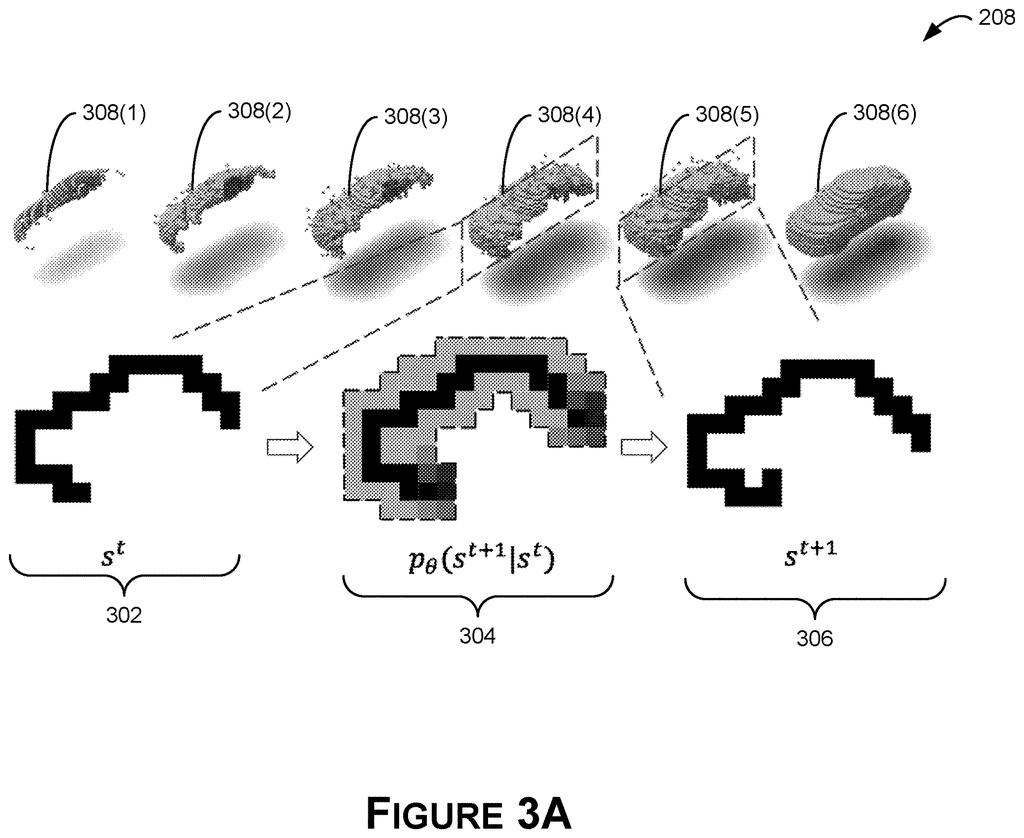
Nvidia's patent describes software that takes that partial scan and fills in the gaps. It starts from the surfaces the scanner did catch and grows them outward in small steps, guessing at each step which nearby bits of space are probably solid. Along the way it sometimes makes a firm yes-or-no call instead of rolling the dice, which clears out stray specks.
The result is a complete 3D model of the street. It could be used in driving simulations, to train other AI systems, or in games and virtual reality, without an artist building every scene by hand.
… generating, using a machine learning model, a first update to the initial representation at a previous time step and a second update to the initial representation at a current time step …
Translation: An AI updates past and present versions of a 3D environment over time.
How the model grows a scan one layer at a time
The filing starts with an initial representation of a 3D scene: a grid of cells (tiny cubes of space, like 3D pixels) where some cells are marked as occupied because a surface sits there. In the description, that starting point comes from a partial LiDAR scan (depth sensing that bounces lasers off objects).
For cells near the occupied ones, the model computes a transition kernel, which is simply a set of probabilities saying how likely each nearby cell is to be occupied. The model can be a sparse convolutional neural network (an AI type suited to grids that are mostly empty). It samples from those probabilities to decide which cells to add, and repeating this over a set number of steps makes the surface grow.
The description adds two cleanup tricks. Every so often, the system applies a cutoff (for example 0.5) so a cell counts as solid only if its probability clears the bar. This alternates with random sampling and cuts down on noisy specks. It also removes any cells that sit on the line between the sensor and a surface it saw, since those would have blocked the view. At the end, the cells are turned into a polygon mesh (a smooth surface made of tiny flat facets) using a standard technique called marching cubes.
Training pairs a sparse scan with a denser one of the same scene, and the model is graded only on cells the scanner could actually see, because hidden cells have no known right answer.
… a technique for performing three-dimensional (3D) scene completion includes determining an initial representation of a first 3D scene …
Translation: The system starts by mapping out whatever parts of the street it can currently see.
Why cheaper test streets matter for self-driving
The practical payoff is cheaper, more varied virtual worlds. The filing's own background says 3D environments for testing driving software are usually modeled by hand or scanned in painstaking detail, which is slow and hard to scale. Software that turns a partial scan into a full scene could let a team feed in real street scans and get back many complete 3D scenes to test against.
The filing also points beyond cars. It lists simulation, training other AI models, game and virtual reality assets, robots and drones as places the same idea could apply. For you, that could mean the simulated streets used to test driver-assist features, or the 3D worlds in games, get built faster. The patent describes a method, not a product, and it gives no accuracy figures.
Nvidia's 109th filing we've tracked since May in the self-driving sensing race adds to work like avoiding double-counting objects and splitting camera work between chips.
Of all the ways a patent can sit far from a product, this one sits close. It is software only. What it needs is a pile of laser scans of real streets and a lot of graphics-chip time for training, and the filing describes training on GPU servers.
The shortest route to something usable is an internal tool: feed in scans from a test car, get back full 3D streets for virtual testing. Nothing in the document calls for a new sensor or a new chip, so no hardware has to exist first.
The open question is quality. The model has to guess the unseen back of a truck, and a wrong guess in a test world could hide a real hazard. The filing relies on training data to make those guesses realistic but gives no accuracy numbers. How trustworthy it is depends on results the document does not show.
Get our take in your Top Stories
Liked this breakdown? Add Patentlyze as a preferred source on Google, and our plain-English take shows up more often in your Top Stories the next time Nvidia patent news breaks.
There are more where this came from
We read every patent application Big Tech publishes and send you the ones worth knowing. Plain English, free, every week.
The drawings
11 drawing sheets from US 2026/0350922 A1 · click any drawing to enlarge


Show the other 3 sheets


Want this weekly breakdown for a company we don't cover? Patentlyze Pro →
Be the first to weigh in