
Nvidia Files Patent for a Web Service That Lets Hospitals Build Their Own Scan-Reading AI
Nvidia has filed a patent for a web service where a hospital can pick AI models and processing steps from a menu, link them together, and run them on its own scans. The goal is scan-reading AI for clinics that can't build the computing setup themselves.
What Nvidia's hospital AI web service does
Imagine you work at a mid-sized hospital. Your CT scanner is a few years old, your IT team is small, and someone wants an AI tool that can outline organs on every scan. Building that from scratch would mean new servers, specialist staff, and months of work.
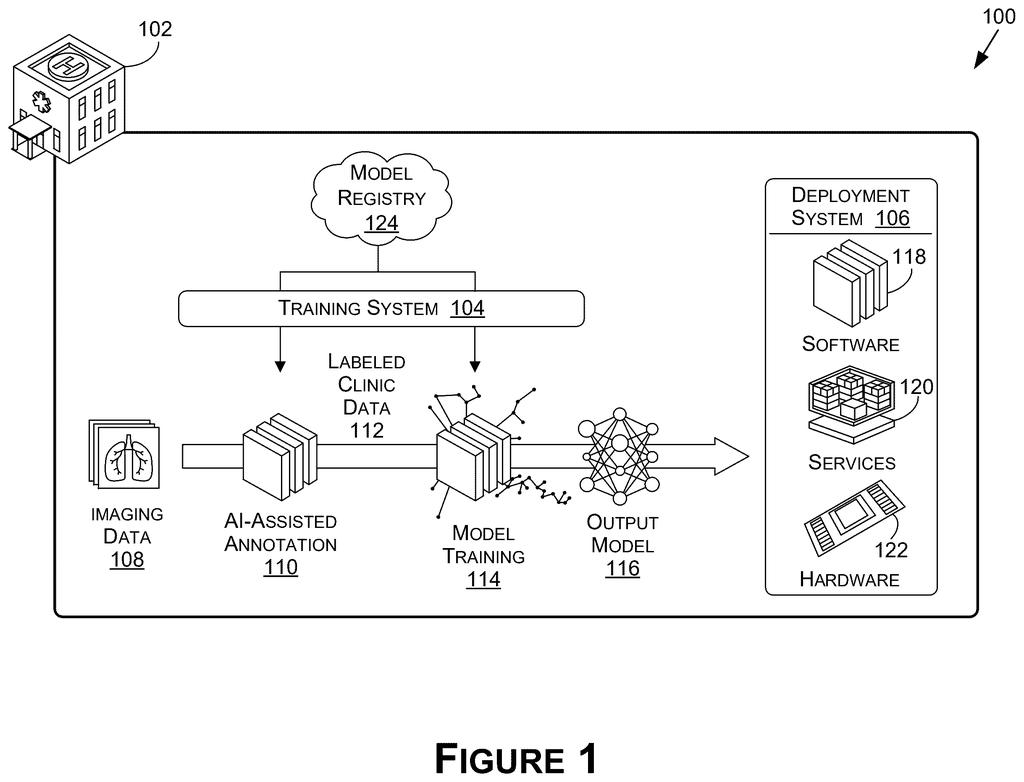
Nvidia's filing describes a web service that skips most of that. On one screen, you pick ready-made software steps (say, rebuilding a raw scan into an image, then outlining the organs) and choose an AI model from a shared library. The service handles the heavy computing, either in the cloud or on equipment near the scanner.
The model can also be retrained on your hospital's own scans, and the filing says patient records can stay on site to protect privacy.
… cause the web-based service to use the selected one or more neural networks to use information generated by the one or more selected neural network data processing programs to implement a sequence of processing operations …
Translation: It connects different AI tools in a specific order to get the job done.
How hospitals chain scan steps into a pipeline
The claim covers a web-based service with a screen where users choose two things: data processing programs (software steps that prepare or handle data) and neural networks (the AI models that do the pattern spotting). The service then runs a sequence of operations using those choices.
That sequence can include any mix of four jobs:
- Training a chosen model on new data
- Running a model to get a result, which engineers call inference
- Preparing data that will be used for training
- Processing what a model produces
The description fills in the picture. Each software step lives in a container (a self-contained package that runs the same way on different computers). A CT scan might pass through one step that rebuilds the raw data into an image, then another that outlines organs.
Models come from a shared model registry (a library of pre-trained models) and can be retrained on a hospital's own scans. The filing also says urgent requests can get a fast lane, with a turnaround target under one minute.
… facilities such as hospitals and clinics may more seamlessly train, deploy, and integrate machine learning models within a production environment for providing informative and actionable medical information to practitioners …
Translation: Hospitals can easily set up and run their own custom medical AI tools.
Why clinics without AI teams should care
If you ever get a scan, the pitch here is that smaller clinics could get the same kind of AI help as big research hospitals. The filing says many hospitals run scanners that are years old and have small IT teams, and that building and running AI on site is complex and expensive. A menu-based service could cut that burden.
For Nvidia, the business logic is easy to see. The filing names its DGX systems, NGC cloud platform and CUDA software as examples of what runs underneath, so a service that makes hospital AI easy to adopt also sells the chips and cloud time behind it. The claim itself never mentions medicine, and the filing lists other uses, such as sensor data and gene sequencing.
Nvidia's 82nd filing in our AI vision coverage since May adds to a run that includes one compressing faces to dots and one reading traffic from cameras.
The cost of this design is that a hospital hands a lot of the work to a shared service. A model trained somewhere else may not fit your patients, and the filing itself says differences in populations and scanner types can make a borrowed model less accurate. That is why the retraining step exists, and it adds back some of the effort the service promised to remove.
For most clinics the trade reads as worth it, since few of them can staff an AI team. Picking from checked, ready-made parts costs far less than starting over. The price is dependence: the whole menu sits on one company's software and graphics chips, and the filing's own examples are Nvidia's.
The single claim is also broad, and nothing in it mentions medicine. It describes a pick-your-models-and-steps web service, which makes it as much a statement about platform ambitions as about hospitals.
Get our take in your Top Stories
Liked this breakdown? Add Patentlyze as a preferred source on Google, and our plain-English take shows up more often in your Top Stories the next time Nvidia patent news breaks.
There are more where this came from
We read every patent application Big Tech publishes and send you the ones worth knowing. Plain English, free, every week.
The drawings
11 drawing sheets from US 2026/0331260 A1 · click any drawing to enlarge


Show the other 3 sheets


Want this weekly breakdown for a company we don't cover? Patentlyze Pro →
Be the first to weigh in