
Nvidia Files Patent for Video Calls That Send Your Face as a Few Dots
Instead of streaming every frame of your video call, Nvidia describes sending one full photo and then only a handful of points that track your face. The other person's computer redraws the video from that.
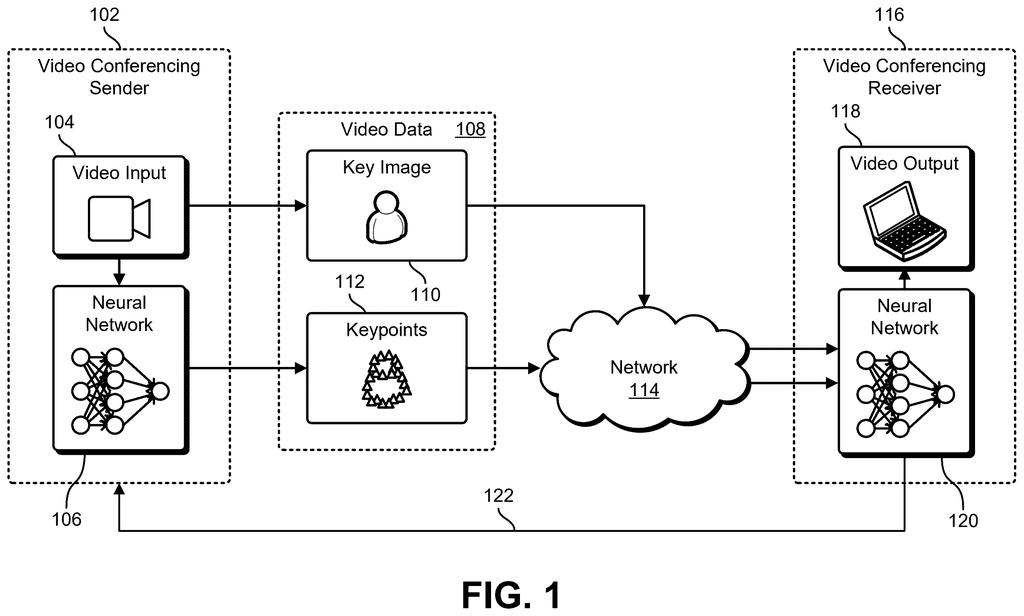
What Nvidia's keypoint video-call idea actually does
A laptop camera watches someone sit through a video meeting from a house with weak Wi-Fi. Every second, it has to push dozens of full pictures of that person through a thin connection, and the call freezes and blurs.
Nvidia's filing describes a different approach. Your device sends one full picture at the start, called a key frame. After that, an AI model sends only a small set of keypoints, such as the positions of your eyes, nose, jaw and mouth as you move. That is far less data than a full image.
On the other end, a second AI model takes the original photo and the stream of points and redraws your face moving. If the points stop making sense, the receiving side can ask for a fresh key frame.
cause one or more images to be compressed based, at least in part, on identifying, using one or more neural networks, one or more features of the one or more images …
Translation: AI scans your video to figure out what parts of the image actually matter.
How the key frame and keypoints rebuild a video
The claims cover a processor setup that compresses images by using a neural network (a software model trained on examples) to pick out features of an image, sends only those features, and has the receiving device rebuild the images from them.
In the description, the features are keypoints: coordinates for points of interest like facial features, hands or arms, and sometimes movement information too. The first frame, the key frame, goes across in full. Later frames are reduced to keypoint sets, which the filing says take up less storage and transfer capacity than the frames they came from.
The receiver runs its own neural network. It uses the key frame as a base image and the keypoints to show how things have changed. The filing says the networks can be trained with a generative adversarial network (two models that train each other, one making fakes and one judging them).
Several claims add detail:
- The receiver can request a new key frame if the keypoints are not usable.
- The sender can pick the key frame based on a request from the receiver.
- Sending the features can be triggered by an API call (a standard way for one program to ask another to do something).
The description also mentions a cloud service doing the rebuilding, and edits like swapping backgrounds, turning a face toward the camera, or adding a hat.
… a sender transmits to a receiver a key frame from video data and one or more keypoints identified by a neural network from said video data …
Translation: Instead of full video, your computer sends just a baseline picture and a few tracking points.
Why shaky video calls are the target here
If it worked in practice, the biggest winner would be anyone on a slow or unstable connection. Remote workers, people on mobile data and rural users could get clearer calls without needing faster internet, since far less data crosses the network.
The filing frames the problem directly: current video compression often saves only marginal bandwidth, sometimes at a cost to picture quality. The same rebuild step also opens the door to features like changing your background or having your gaze appear to meet the camera. The filing also describes using it to create altered or cartoon versions of a person, so trust in what you see on a call could become a question.
Nvidia's 81st filing we've tracked in AI vision since May follows earlier applications like one on reading traffic from cameras and one on AI faces in video.
Bad video calls are an everyday annoyance with a real cost. Remote work made them routine, and anyone who has watched a colleague turn into a frozen, pixelated blur knows the problem is not rare. Ordinary compression has trimmed the data load but has hit diminishing returns, which is the gap this filing goes after.
The approach fits the size of the problem well. A talking head is a very predictable subject, so sending a photo once and then just tracking movement throws away a lot of repeated information. The request for a fresh key frame is a sensible safety valve for when the guess goes wrong.
The open question is quality. A face redrawn by an AI can look slightly off, and the filing says little about how often or how badly. Still, it is a clear, practical attack on a widespread frustration.
Get our take in your Top Stories
Liked this breakdown? Add Patentlyze as a preferred source on Google, and our plain-English take shows up more often in your Top Stories the next time Nvidia patent news breaks.
There are more where this came from
We read every patent application Big Tech publishes and send you the ones worth knowing. Plain English, free, every week.
The drawings
57 drawing sheets from US 2026/0332790 A1 · click any drawing to enlarge


Show the other 49 sheets


Want this weekly breakdown for a company we don't cover? Patentlyze Pro →
Be the first to weigh in