
OpenAI Patents a Way to Teach Its AI Your Company's Internal Code Names
Every company has its own language, and until now AI assistants have been oblivious to it. OpenAI has filed a patent for a system that lets its AI understand internal code names, project nicknames, and organization-specific terms without leaking those secrets to people who aren't supposed to know them.
What OpenAI's company-aware AI actually does for you
Most companies run on shorthand. A project might be called "Falcon" internally, but that word means something completely different in a dictionary or on the public internet. When employees ask a general-purpose AI assistant about "Falcon," the AI has no idea they mean the company's upcoming product launch.
OpenAI's patent describes a system that fixes this. When your company's AI assistant receives a question, it checks whether the word you used is a known code name inside your organization, and if it is, it answers based on that meaning rather than the ordinary one. So asking "what's the status of Falcon?" would get you a real, useful answer tied to your actual project.
Critically, the system also enforces access rules. If you don't have permission to know about a particular project or document, the AI won't surface that information to you, even if you ask directly. Your company's secrets stay secret, even when employees use the AI freely.
receiving, by a generative response engine, a prompt from a user account referencing a term that is a code name within an organization and the term has a different meaning outside of the organization other than the code name …
Translation: The system recognizes when an employee uses an internal company code word that means something else to the general public.
How the engine maps code names to internal meaning
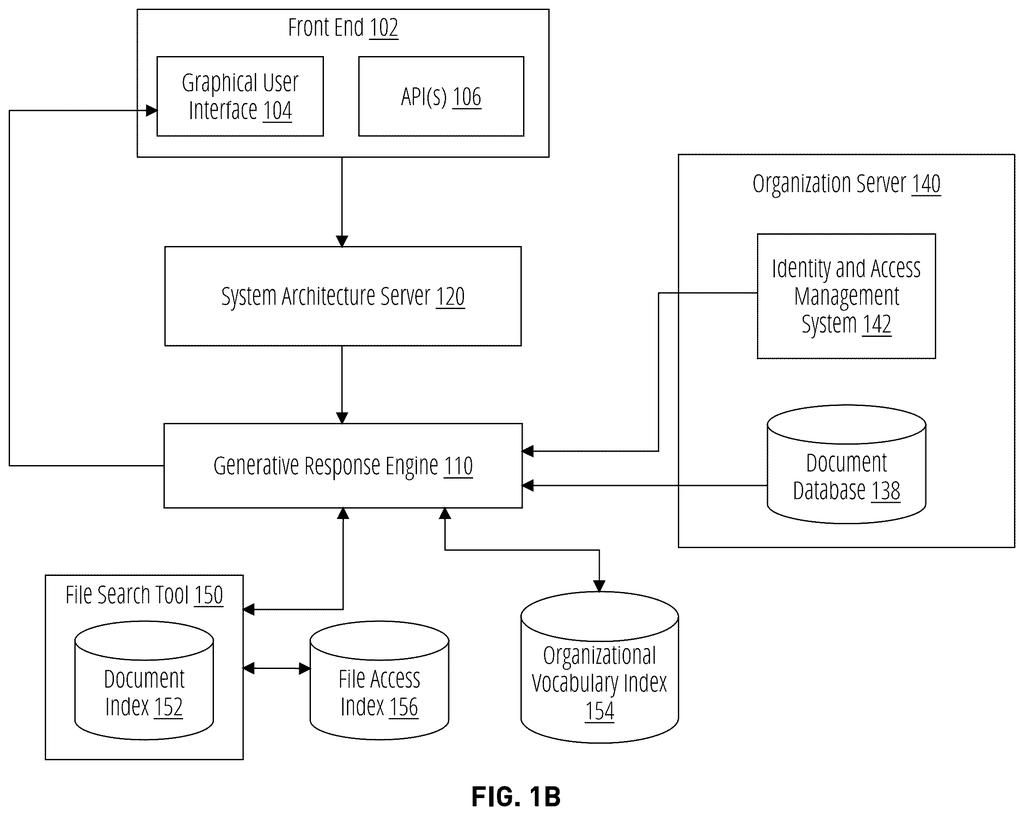
The patent describes a generative response engine (an AI that produces conversational answers, like ChatGPT) that is wired into an organization's internal knowledge base and permission system.
When a user sends a prompt, the engine does two things before answering:
- It checks whether any terms in the prompt are registered code names or organization-specific vocabulary, and if so, it retrieves the internal meaning rather than defaulting to the common definition.
- It checks the user's access privileges (essentially, what they're allowed to read inside the company) and filters the response so it only draws on information the user is authorized to see.
The first independent claim is deliberately narrow: it focuses on a scenario where a user asks about a project by its code name, and the system returns an answer that reflects the code name's internal meaning. That specificity is important because code names are a real, daily friction point for enterprise AI tools.
The access-control layer is where the engineering gets interesting. The system has to resolve terminology and enforce permissions in the same pass, so an employee in marketing asking about an engineering code name won't accidentally get briefed on confidential technical specs they're not cleared for.
… respects access privileges of the organization so that the generative response engine does not leak information within the organization to unauthorized members of the organization …
Translation: It enforces security rules so workers only see internal project details they are actually allowed to access.
What this means for businesses using AI chat tools
For any company that has started rolling out AI chat tools internally, this addresses a real and immediate problem. Right now, asking an AI about an internal project name either returns useless generic information or, worse, confidently wrong information. A system that understands your company's own vocabulary would make AI assistants far more useful for day-to-day work.
The access-control angle matters just as much as the jargon-mapping. One of the biggest concerns IT teams have about deploying AI internally is the risk that the AI becomes an accidental leak machine, letting one employee pull up information they were never supposed to see just by phrasing a question cleverly. This patent is OpenAI's answer to that concern, and it signals the company is building toward a version of its tools designed to operate inside corporate security boundaries.
That makes this OpenAI's second filing we've tracked since August in our chatbots that remember you, following their patent on detecting topic shifts.
The design trade here is straightforward: you get a much more useful AI assistant in exchange for tying the system deeply into your organization's identity and permissions infrastructure. That integration is not free. Someone has to maintain the registry of code names, keep it current as projects rename or conclude, and audit what the AI is actually drawing on when it answers.
There is also a subtler cost. A permissions-filtered AI will, by design, give different answers to different employees asking the same question. That is the point, but it can erode trust in the tool: if a manager and a junior employee both ask about a project and get noticeably different responses, people will start wondering what they're not being told.
The patent reads as a genuine engineering attempt to solve a real enterprise problem, not a defensive filing. But the hard work here is organizational, not technical. The AI can only be as useful as the internal knowledge and permission structures it plugs into, and most companies' internal data is messier than any clean patent diagram suggests.
There are more where this came from
We read every patent application Big Tech publishes and send you the ones worth knowing. Plain English, free, every week.
The drawings
19 drawing sheets from US 2026/0278246 A1 · click any drawing to enlarge


Want this weekly breakdown for a company we don't cover? Patentlyze Pro →
Be the first to weigh in