Samsung
Samsung · Robotics · Filed Oct 14, 2025 · USPTO published May 14, 2026 · May 14 release
Samsung Patents a Robot That Finds and Cleans Up Liquid Spills Autonomously
Spilled a glass of water at 2am? Samsung is patenting a robot that can spot liquid on the floor, figure out whether it's safe to drive over, and then clean it up — all without you lifting a finger.
- Publication number
- US 2026/0131455 A1(US20260131455A1)
- Applicant
- Samsung Electronics Co., Ltd.
- Filed · Published
- Oct 14, 2025 · May 14, 2026
- Inventors
- Injoo KIM
- Status when we published
- Waiting for an examiner
- Document
- 20 claims
- US classification
- 700/245
- Parent application
- Continuation of PCT/KR2025/012179 (filed Aug 12, 2025)(PCTKR2025012179)
What Samsung's liquid-detecting cleaning robot actually does
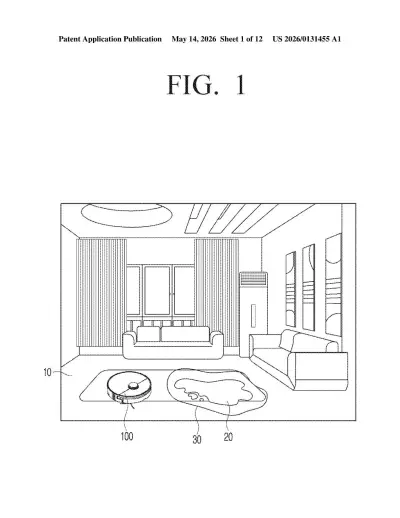
Imagine your robotic vacuum detects a puddle of spilled juice in the kitchen. Right now, most robots either ignore it, smear it around, or get stuck. Samsung's patent describes a smarter approach: a robot that actively identifies liquid contaminants using its onboard sensors, then decides what to do about them.
The key step is a two-stage safety check. First, the robot consults a space map — a stored layout of your home — to confirm the wet area is physically safe to enter. Then, as it moves in, it gathers fresh sensor data to verify the surface is actually cleanable before plotting a specific cleaning path. It won't just barrel through.
Only after passing both checks does the robot commit to a cleaning route and start working. It's essentially adding a "look before you leap" decision loop to a robot's existing navigation and cleaning routines.
How the robot maps, checks, and cleans a spill zone
The patent describes a multi-step decision pipeline that activates when a liquid contaminant is detected. Here's the flow:
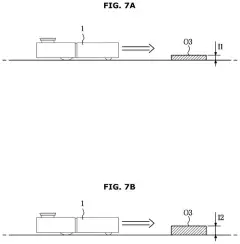
- Detection: One or more sensors (likely a camera, floor sensor, or moisture detector) flag a liquid on the floor and define a cleaning area around it.
- Travelability check: The robot cross-references the flagged area against a stored space map — essentially a floor plan with known obstacle zones — to confirm it can physically navigate to and through the wet area without getting trapped or damaged.
- Cleanability check: The robot moves into the area and gathers real-time sensing data. This second pass accounts for dynamic conditions a static map wouldn't capture — think a puddle near chair legs or on a rug vs. tile.
- Path planning and execution: Only if both checks pass does the robot calculate a cleaning path and begin cleaning.
The two-stage verification (map-based, then sensor-based) is the core invention here. It separates "can I go there?" from "should I clean there?" — a meaningful distinction for liquid messes, which present risks static maps can't always anticipate.
What this means for Samsung's home and commercial robots
For Samsung, which makes the Jet Bot line of robotic vacuums, this patent signals an intent to push beyond dry debris into active liquid spill response — a capability that competing robots largely avoid. Liquid detection and cleaning is genuinely harder than vacuuming: you risk spreading the mess, shorting sensors, or slipping on a wet surface.
For you as a user, this would mean a robot that doesn't just vacuum on a schedule but actually responds to accidents as they happen. Whether that shows up in a consumer product or in Samsung's commercial cleaning robots (like those deployed in retail and hospitality spaces) isn't clear yet — but the dual-check architecture suggests they're thinking carefully about real-world safety, not just a marketing feature.
Source: US 2026/0131455 A1 at the USPTO (PDF). Full patent text and figures are in the official publication.
Get our take in your Top Stories
Liked this breakdown? Add Patentlyze as a preferred source on Google, and our plain-English take shows up more often in your Top Stories the next time Samsung patent news breaks.
Add Patentlyze on Google
One click.
There are more where this came from
We read the new patents from Big Tech, carmakers and more and send you the ones worth knowing. Plain English, free, every week.
More from Samsung
All 1,662 Samsung patents →
More in Hardware
All 2,375 Hardware patents →
Samsung
Samsung Patents a Robot Vacuum That Picks Up Objects in Its Path
Samsung
Samsung Patents a Projector That Drives Itself to Your Location and Sets Up Automatically
Samsung
Samsung Patents a Guide Robot That Switches Alerts Based on Your Eyesight
Samsung