
AMD Patents a Runtime GPU Shader Scheduler That Learns From Past Frames
AMD is filing a patent for a GPU scheduling system that watches how your games actually run — across multiple frames — and quietly rewrites its own task-distribution policy on the fly, no driver update needed.
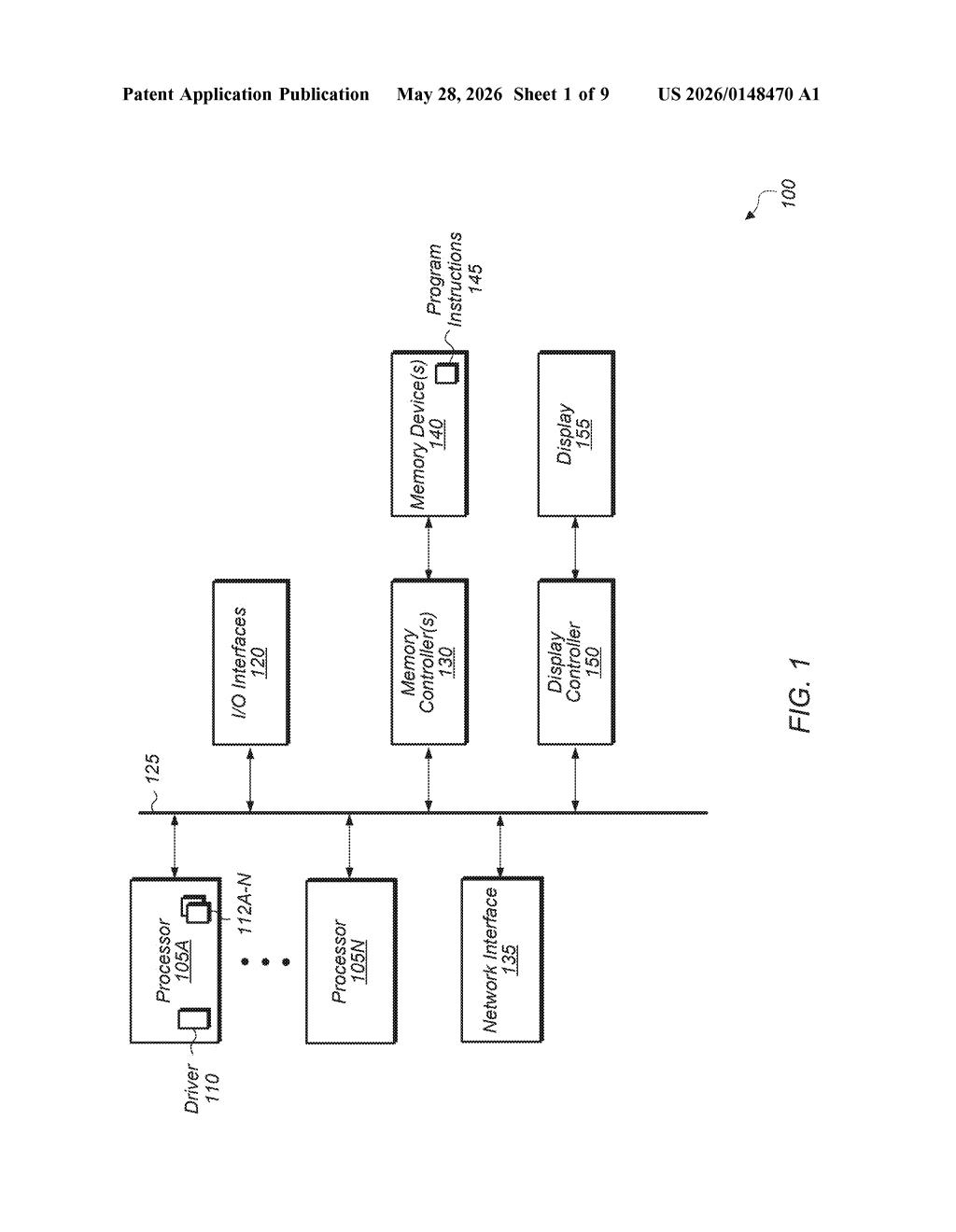
What AMD's self-updating GPU scheduler actually does
Imagine your GPU as a busy kitchen with multiple prep stations, each handling different cooking tasks. Normally, a fixed recipe (the scheduling policy) tells each station what to do — and that recipe only changes when the chef rewrites it in a full kitchen overhaul (a driver update). AMD's patent describes a smarter arrangement: a background server watches how each station is performing across many meals (frames), then quietly hands the kitchen a better recipe mid-service.
The key twist is the time scale. Instead of just looking at the last dish served, the system tracks performance across many previous frames and adjusts the workload distribution accordingly. This lets the GPU balance tasks more evenly across its different processing engines.
Because the policy updates happen at runtime — and can be tuned per game, per application, even per user — AMD can push better scheduling behavior without waiting for a full driver release cycle.
How the server analyzes telemetry to rewrite scheduling policy
The patent describes a client-server architecture for GPU task scheduling. The client is the local GPU driver, which executes shader workloads and collects telemetry (timing data, resource utilization stats) about each processing engine. The server sits at a higher level — likely a background service or cloud component — and ingests that telemetry.
The core innovation is the server's analysis window. Traditional schedulers make decisions based on the immediately preceding frame — a very short feedback loop. This system analyzes execution times and resource utilization across multiple previous frames, giving it a broader statistical picture of how a workload actually behaves over time.
From that analysis, the server derives an updated scheduling policy — essentially a set of rules about how to distribute tasks across the GPU's various processing engines and their individual task queues. That policy gets pushed back to the client and takes effect at runtime, without requiring a driver reinstall or system reboot.
The patent also emphasizes per-application and per-user customization. Because the server can maintain separate policy profiles, it can tune scheduling behavior differently for, say, a ray-tracing-heavy AAA title versus a compute-bound machine learning workload — all from the same infrastructure.
Why per-game GPU tuning without driver updates matters
Driver updates are slow, risky, and one-size-fits-all. Game studios frequently complain that performance regressions slip in with new driver releases, and users sometimes stay on old drivers for months. A system that can tune scheduling policy at runtime — per app, per user, without touching the driver binary — sidesteps that entire pain point. You could theoretically get better GPU utilization on your specific game library just by the system learning your patterns over time.
For AMD specifically, this is also a competitive angle against Nvidia's well-established driver optimization pipeline. If AMD can deliver per-game GPU tuning faster and more granularly through runtime policy updates, it narrows the gap on a dimension where Nvidia has long held a perception advantage.
This is genuinely interesting infrastructure work, not a flashy feature patent. The multi-frame telemetry window is a real engineering insight — single-frame scheduling feedback is notoriously noisy, and smoothing over longer windows is a straightforward improvement that's surprisingly rare in published GPU scheduling literature. The 'no driver update required' angle is the practical payoff that makes this worth watching.
There are more where this came from
We read every patent application Big Tech publishes and send you the ones worth knowing. Plain English, free, every week.
Want this weekly breakdown for a company we don't cover? Patentlyze Pro →