
Samsung Files Patent to Squeeze Better Video Out of Phone Chips Without More Power
Your phone shrinks video using a deliberately rough shortcut, and Samsung's filing patches that shortcut's blind spots with a cheat sheet prepared ahead of time.
What Samsung's video-shrinking correction does
Imagine you're recording a long video of your kid's soccer game on your phone. Your phone has to shrink that footage on the fly, and it has to do it without draining the battery or getting hot in your hand.
To pull that off, phones use a quick-and-rough method to decide how to shrink each little patch of the picture. It's fast, but it makes slightly worse choices than the slow, careful method that big servers use. Samsung's filing adds a correction to the rough method: a small adjustment, looked up from a table prepared ahead of time, that nudges the quick estimate closer to what the careful method would have said.
The goal is better-looking, smaller video files from the same phone chip, without making it work harder.
… determining prediction mode candidates for the coding tree unit by applying a first low complexity rate-distortion optimization (LC-RDO), the first LC-RDO comprising applying a first correction value to correct at least one of a rate, a distortion, or a rate-distortion cost …
Translation: The chip uses a lightweight mathematical shortcut to quickly guess the best ways to compress parts of the video.
How the lookup table nudges each coding decision
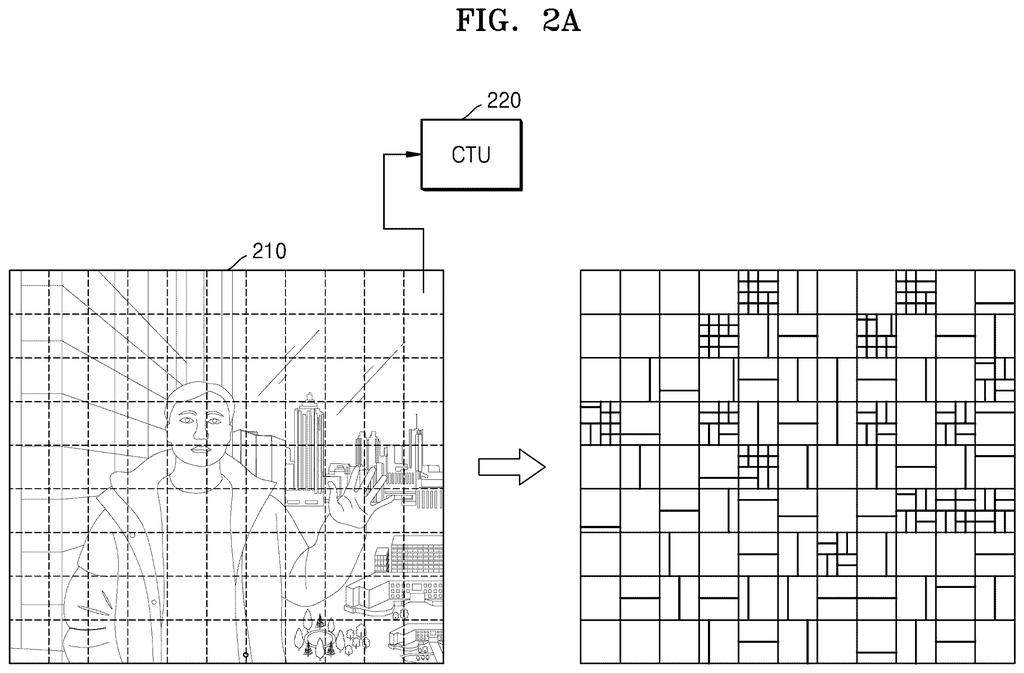
Video encoding starts by chopping each frame into square blocks called coding tree units. Each block can be split into smaller pieces, again and again, until the encoder finds the cheapest way to describe it. For every piece, the encoder picks a prediction mode, which is a recipe for guessing the block's contents from nearby pixels or from the previous frame.
To choose, encoders score each option on rate (how many bits it costs) and distortion (how much picture quality is lost). The careful scoring method is slow, so phones use low complexity rate-distortion optimization (LC-RDO), which swaps in simpler math such as Golomb coding and a Hadamard transform (two cheap shortcuts for estimating bits and error). The price is slightly worse choices.
The patent adds correction values at each decision step:
- A first stage builds a shortlist of candidate modes, with a first correction applied to the rate, the distortion, or the combined score.
- A second stage picks the final mode from that shortlist, using its own second correction.
- The filing also describes a third correction for deciding whether to split a block further, and a fourth for the clean-up filter step.
The corrections come from a pre-calculated lookup table, built from the gap between the careful method's scores and the quick method's scores on the same encoding job. The values depend on the block type and mode. The filing says some of that data could come from an outside server, and that a reinforcement learning program (software that learns by trial and reward) could help find good values.
What this means for Samsung phone video
Video is one of the hungriest things your phone does. Recording, screen mirroring and live streaming all need compression that runs fast and sips power. If a small correction lets the quick method make choices closer to the careful one, you could get smaller files or sharper footage from the same chip, with no extra battery cost.
The filing lists smartphones, laptops, digital cameras, smart TVs and game consoles as possible devices, so the idea is not tied to one product. Samsung sells several of those, and the filing points to quality gains from a lookup table with no bigger chip required. It gives no measured results, so how much gain you would see is unknown.
Samsung's 155th filing we've tracked since May in our camera sensor work watchlist follows earlier applications like a battery-saving camera fix and one model for all sensors.
Every shortcut costs something, and this one pays in preparation. The lookup table has to be built ahead of time by running the slow, careful method and the quick one side by side. Someone has to do that homework for each type of block and mode.
A fixed table also gives average corrections. If your footage is unusual, say a dim concert or fast sports, an average nudge could miss in either direction. The filing offers no measured gains, so the size of the benefit is an open question.
The price at run time is small, though: a lookup and a small addition per decision costs far less than the full careful math. If the gains hold up, trading some prep work for better video at the same battery cost looks worth it.
Get our take in your Top Stories
Liked this breakdown? Add Patentlyze as a preferred source on Google, and our plain-English take shows up more often in your Top Stories the next time Samsung patent news breaks.
There are more where this came from
We read every patent application Big Tech publishes and send you the ones worth knowing. Plain English, free, every week.
The drawings
13 drawing sheets from US 2026/0332750 A1 · click any drawing to enlarge


Show the other 5 sheets


Want this weekly breakdown for a company we don't cover? Patentlyze Pro →
Be the first to weigh in