
Samsung Patents a Camera Lock That Lets You Reframe a Shot Without Moving the Lens
Samsung is working on a way to let you change what you see in a camera preview without actually moving or refocusing the camera's field of view. It's a subtle but meaningful split: the lens stays put, but the framing can shift.
What Samsung's camera angle-lock actually does for you
When you zoom in on your phone camera today, the camera physically adjusts what it captures. The whole field of view shrinks to match the zoom level. You can't then nudge the framing a little without that adjustment cascading back through everything.
Samsung's patent describes a mode where the camera's field of view gets locked in place at a specific zoom level. Once locked, you can still shift the preview to a different framing inside that locked view. Think of it like freezing a wide photo and then sliding a crop window around inside it. The camera doesn't chase your adjustments; it just shows you a different slice of what it already captured.
This matters most when you're trying to hold a consistent angle, say for a social media photo series or a time-lapse, and you want to fine-tune composition without losing that fixed perspective. The lock keeps the big picture stable while giving you small adjustments.
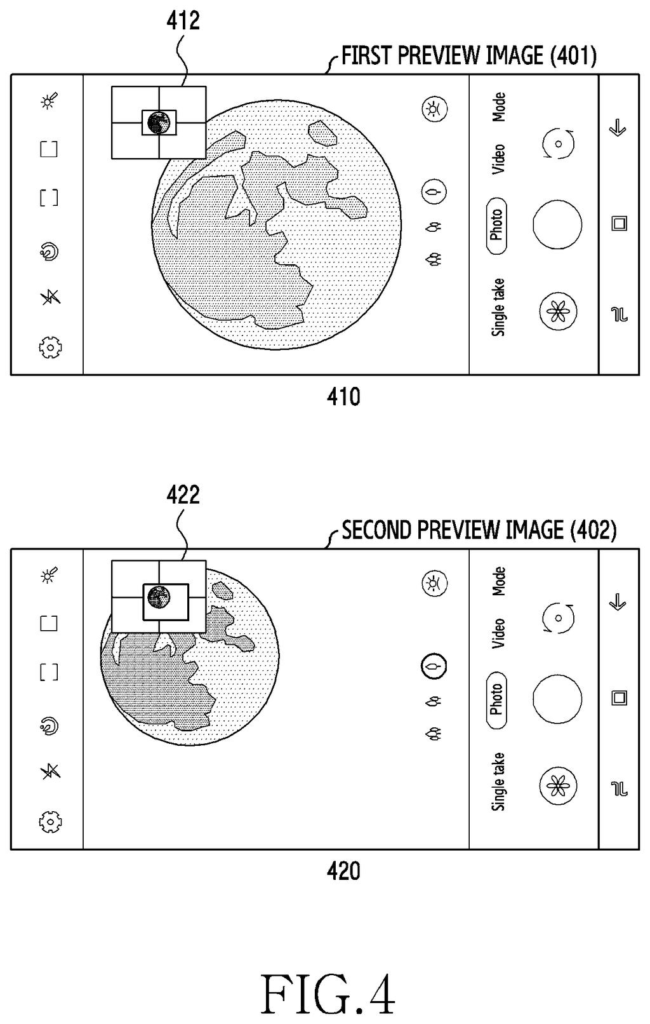
… activate an angle-of-view fixing function for fixing the angle of view of the camera to a first angle of view corresponding to the first preview image, obtain a user input for changing from the first angle of view to a second angle of view while the angle-of-view fixing function is activated …
Translation: It locks your current frame in place so you can pan around the larger photo without moving the actual lens.
How the angle-of-view fix separates crop from field of view
The patent describes a two-phase camera system. In the first phase, the device displays a first preview image cropped from the camera's full capture, at a magnification at or above a set reference level. This is what you see on screen before you do anything unusual.
In the second phase, the processor activates an angle-of-view fixing function. This locks the camera to a specific field of view (called the first angle of view in the patent) and holds it there regardless of other inputs. The camera stops reacting to zoom gestures the way it normally would.
Once the lock is active, the user can input a command to shift to a second angle of view. Here's the key detail: instead of physically redirecting the camera or changing its optical zoom, the processor pulls the new framing from within the image data it already has. The display then switches to a second preview image corresponding to that second angle, derived from the same underlying capture.
- Camera: holds a fixed field of view
- Processor: handles the angle-of-view lock and detects user input for reframing
- Display: shows whichever cropped preview the user selects, without the camera moving
What this means for Samsung's phone camera controls
For anyone who shoots repeated photos at the same zoom level (product photographers, content creators running a consistent visual style, or just someone taking a burst of family shots), constantly losing your locked angle when you try to reframe is a real annoyance. A lock mode that separates field of view from on-screen crop could make that workflow much less fiddly.
Samsung has been building out its camera software toolset across Galaxy devices, and a feature like this fits neatly into that pattern. It's a control-layer improvement rather than a hardware one, which means it could appear on existing sensor setups. Camera UX patents are a growing part of the latest Big Tech patents as phone makers compete less on megapixels and more on how much creative control the software hands back to the user.
Samsung's 92nd application we've tracked since May on our camera sensor work list builds on the color-sorting lens chip and the voice-stripping camera with yet another imaging idea.
The engineering trade here is real: decoupling the displayed crop from the actual camera field of view means the user is always working with a subset of captured data, not the full sensor output. At wide angles that's fine, but if the locked view is already tight, there may not be much room left to reframe without hitting the edges of the captured image and degrading quality. Samsung is betting that the gain in compositional control outweighs that ceiling, and for most everyday use cases that trade probably holds up. Where it breaks is in low-light shooting, where cropping inside a fixed frame amplifies noise, so the feature's practical value shrinks exactly when phone cameras are already under stress.
There are more where this came from
We read every patent application Big Tech publishes and send you the ones worth knowing. Plain English, free, every week.
The drawings
13 drawing sheets from US 2026/0247027 A1 · click any drawing to enlarge


Want this weekly breakdown for a company we don't cover? Patentlyze Pro →
Be the first to weigh in