
Samsung Patents a System for Moving AI Learning Data Efficiently Across Wireless Networks
Moving AI models around inside a phone network sounds like plumbing work, but getting it wrong means every AI-driven call, speed boost, or beam adjustment breaks down. Samsung is patenting a way to make that movement structured and rule-based.
What Samsung's wireless AI data transfer actually does
Today, if a mobile network wants to use AI to improve your calls or data speeds, the AI software and the data it needs have to move between different parts of the network. There is no agreed-upon, standardized way to do that cleanly, which means network engineers have to patch things together manually.
Samsung's patent describes a dedicated function inside the network whose only job is moving AI-related data, whether that is a trained model, updates to a model, or the results it produces. That function follows a set of rules or policies to decide how and where to send the data, either through the channel normally used for regular traffic (the "user plane") or the channel used for network management instructions (the "control plane").
The idea is to give AI a proper lane inside the network rather than forcing it to borrow space from channels built for other purposes. Think of it like adding a dedicated freight elevator to a building that previously had everyone, packages included, sharing the same lift.
… control the first AI/ML data transfer function to coordinate communicating AI/ML data with the network over user plane (UP) or control plane (CP) based on at least one rule or policy …
Translation: It manages how artificial intelligence data moves across different wireless network paths according to set rules.
How the AI transfer function picks its path across the network
The patent describes a first network entity (think: a server or node inside a carrier's infrastructure) that hosts a dedicated AI/ML data transfer function. This function's job is to establish a connection with equivalent AI/ML transfer functions living in other network entities, then coordinate the movement of AI-related data between them.
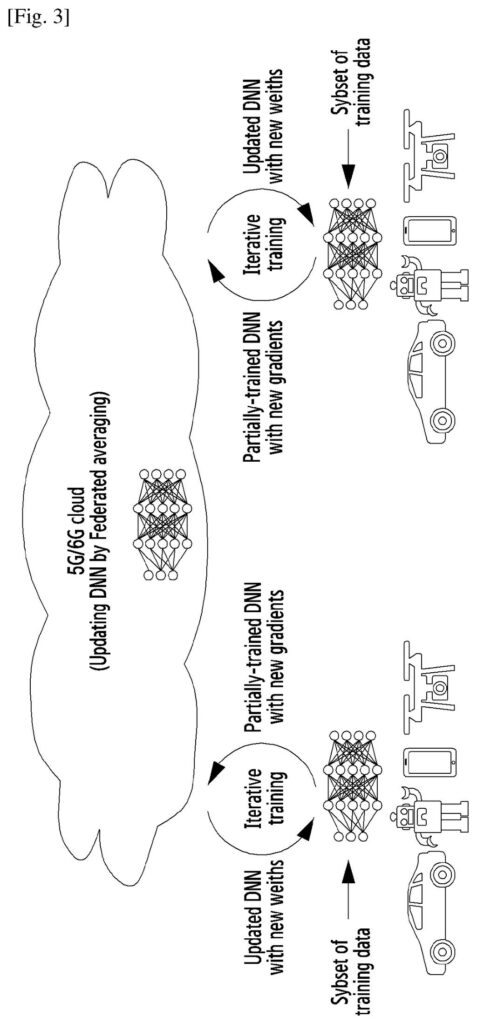
AI/ML data here refers broadly to anything an AI operation needs: model weights (the numerical parameters that define how an AI behaves), inference results, or training updates. None of that is ordinary user data, so stuffing it through standard pipes without a coordination layer causes conflicts over priority and routing.
The function chooses between two paths:
- User plane (UP): the fast lane normally used for moving your actual data (video, web pages, calls).
- Control plane (CP): the management lane used for signaling instructions between network components.
Which path gets used depends on rules or policies set by the operator. This policy-driven approach means a carrier can decide, for example, that large model files go over the user plane during off-peak hours and that lightweight updates go over the control plane in real time. The two-function handshake between entities is described as a "first connection," implying the architecture can scale to multiple nodes exchanging AI data simultaneously.
The disclosure relates to a 5G or 6G communication system for supporting a higher data transmission rate.
Translation: The technology improves fast data transfer in advanced mobile networks.
What this means for AI running inside mobile networks
Mobile networks are adding AI everywhere: to predict interference, manage antennas, allocate spectrum, and optimize handoffs between towers. Right now, Samsung's run of 5G and 6G AI-infrastructure filings points to a company betting that the plumbing for AI in networks will matter as much as the AI itself. Without a standard way to move model data around, each carrier ends up with a bespoke mess that is expensive to maintain and hard to upgrade.
For everyday users, a cleaner AI data pipeline means the network can update its own intelligence faster and more reliably. That translates to fewer dropped calls, faster speed adjustments when you move between areas, and better overall network behavior, especially as 6G starts to lean even more heavily on AI for core operations.
Samsung's 77th filing we've tracked since May in our 5G and network push builds on work like the dual-signal antenna and borrowed GPS for offline phones.
Moving AI software across a live cellular network without a dedicated system for doing so is roughly like shipping freight through a city with no roads, only parking lots. Every carrier building toward next-generation networks faces this cost today, and it compounds as AI becomes more central to how those networks actually run.
Samsung's answer is to create a dedicated coordination layer with rules governing when and how that software moves. The architecture is straightforward, which is appropriate: the underlying logistics problem scales fast, and a clean framework beats a clever one when dozens of network nodes may need updated AI models at the same time.
Whether the policies that govern this system can keep pace with real network complexity is the open question. The framework described here is sound; the difficulty lives in whatever fills the policy engine once a network goes live.
There are more where this came from
We read every patent application Big Tech publishes and send you the ones worth knowing. Plain English, free, every week.
The drawings
8 drawing sheets from US 2026/0291826 A1 · click any drawing to enlarge


Want this weekly breakdown for a company we don't cover? Patentlyze Pro →
Be the first to weigh in