
Samsung Patents an Image Sensor That Captures Bright and Dark Areas at the Same Time
Shooting a photo into a bright window and losing all the shadow detail is one of the oldest frustrations in photography. Samsung's latest patent describes a pixel-level approach to capturing both extremes at once, without stitching together multiple exposures.
How Samsung's dual-gain pixel handles harsh lighting
Imagine taking a photo of someone standing in front of a sunny window. Your camera has to pick: expose for the person (and blow out the bright sky) or expose for the sky (and turn the person into a silhouette). High dynamic range, or HDR, is the attempt to capture both at once.
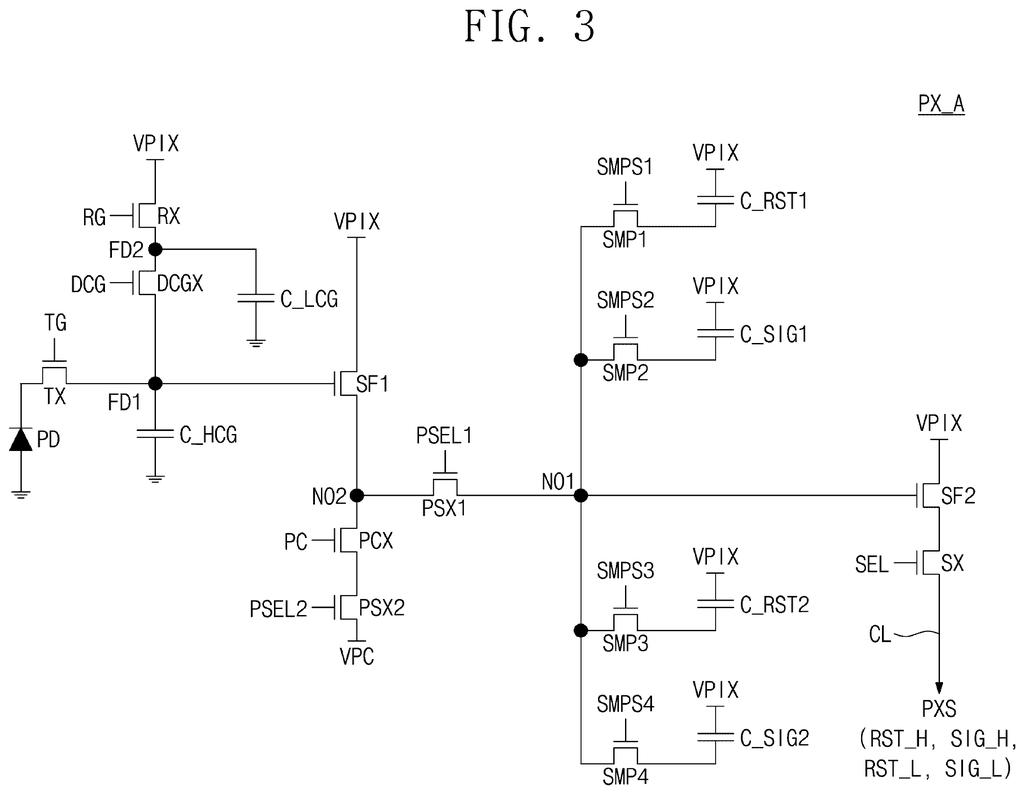
Samsung's patent describes an image sensor where each individual pixel can operate in two modes at the same time: one that is very sensitive to light (good for shadows) and one that is less sensitive (good for bright areas). Each pixel stores four separate voltage readings using four tiny capacitors, giving the chip enough raw data to reconstruct a full range of brightness in one shot.
Critically, this design also uses a global shutter, meaning every pixel records light at exactly the same instant rather than scanning row by row. That eliminates the "jelly" distortion you sometimes see when photographing fast-moving objects with cheaper camera sensors.
An image sensor according to some example embodiments of the present inventive concepts may operate in a global shutter mode, and each pixel circuit may support a high conversion gain (HCG) mode and a low conversion gain (LCG) mode so as to have high dynamic range (HDR).
Translation: The sensor shoots everything at once and handles both extreme bright and dark spots.
Inside the four-capacitor pixel readout circuit
The patent describes an image sensor built around a concept called dual conversion gain. Each pixel contains a photodiode (the light-collecting element) connected to two storage nodes called floating diffusion nodes. Think of them as two differently sized buckets for holding electrical charge.
When the second node is disconnected, the pixel operates in high conversion gain (HCG) mode: the small bucket fills up quickly, making the sensor very sensitive to faint light. When the second node is connected, the total storage capacity doubles, producing low conversion gain (LCG) mode, which prevents bright areas from overloading the pixel.
To capture both readings in a single frame, each pixel also contains four capacitors that store four separate voltage samples:
- A reset voltage in HCG mode (baseline for the sensitive reading)
- A signal voltage in HCG mode (actual light captured in sensitive mode)
- A reset voltage in LCG mode (baseline for the tolerant reading)
- A signal voltage in LCG mode (actual light captured in tolerant mode)
A dedicated reset transistor clears the system between captures. The difference between each signal and its corresponding reset voltage (a technique called correlated double sampling, which cancels out electronic noise) is then combined to produce a single wide-dynamic-range output per pixel.
… a first floating diffusion node configured to store the charge generated by the photodiode; a second floating diffusion node selectively connected to the first floating diffusion node and configured to store the charge generated by the photodiode; …
Translation: It uses two linked storage zones to hold the light data.
What this means for Samsung cameras and image quality
Most smartphone cameras achieve HDR by taking two or more photos at different exposure settings and blending them together in software. That works reasonably well for still subjects, but it introduces artifacts whenever anything moves between frames. A sensor that collects HDR data in a single exposure at the pixel level sidesteps that problem entirely.
Paired with a global shutter (which freezes motion across the entire sensor at once), this design is particularly relevant for video, sports photography, and automotive or industrial cameras where both high speed and wide dynamic range are needed. Samsung's image sensor division supplies chips to a wide range of phone makers and device manufacturers, so improvements at this level can ripple across many products.
This is a solid, technically detailed patent covering a meaningful engineering problem. Dual-gain global shutter sensors exist in professional and industrial cameras already, but bringing that combination into a compact, consumer-grade pixel design is genuinely difficult. Samsung filing this suggests ongoing work to push its ISOCELL sensor line further into high-speed and HDR territory, which matters for both its own Galaxy devices and the broader market it supplies.
There are more where this came from
We read every patent application Big Tech publishes and send you the ones worth knowing. Plain English, free, every week.
The drawings
24 drawing sheets from US 2026/0230723 A1 · click any drawing to enlarge


Want this weekly breakdown for a company we don't cover? Patentlyze Pro →
Be the first to weigh in