
Samsung Patents a Scroll Bar That Moves to Match Where Your Thumb Is
A scroll bar that chases your thumb sounds trivial until you've tried to read a long article one-handed on a big phone and realized the position indicator is hiding behind your palm the whole time.
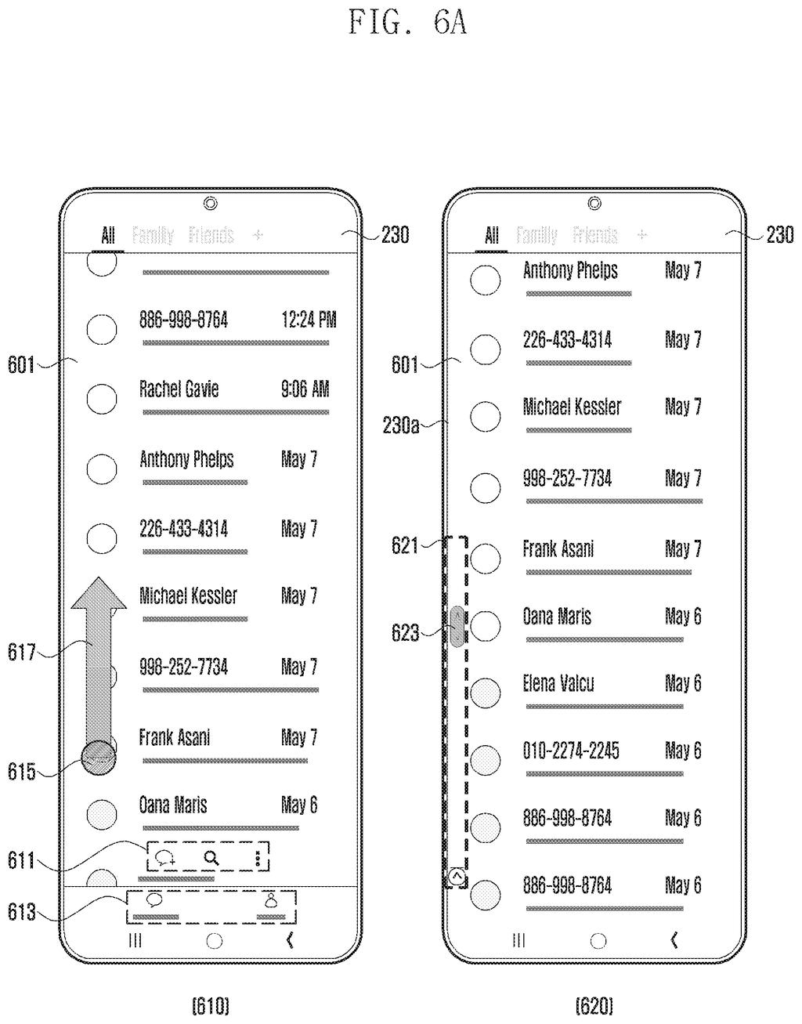
What Samsung's thumb-tracking scroll bar actually does
You're scrolling through a long article on your phone, holding it in your left hand, and the scroll bar is stubbornly parked on the right edge where you can't see it. Samsung's new patent wants to fix exactly that.
The idea is to split your screen into zones. If your touch input comes from the left side of the display, the scroll bar pops up on the left edge. Touch from the right, and it moves to the right edge. Touch somewhere in the middle, and the phone falls back to a sensible default position.
It sounds like a small quality-of-life tweak, but on the large-screened Galaxy phones Samsung sells, one-handed scrolling is a real daily friction point. Putting the scroll bar where your thumb already is means you can see your position in a document without rearranging your grip.
… identify, when a scroll input based on a touch input is detected, an area on which the touch input is detected from among a first area, a second area, and a third area of the display …
Translation: The device figures out where your thumb is touching the screen.
How the display picks which edge gets the scroll bar
The patent describes a display system that monitors not just that a scroll gesture is happening, but where on the screen the finger first touches down.
The display is divided into three regions: a first area (left zone), a second area (right zone), and a third area (middle zone). When a scroll gesture is detected, the device checks which zone the touch landed in, then renders the scroll bar on the corresponding side edge of the screen. The middle zone has a pre-set default side it falls back to, which Samsung calls the "default area."
The scroll bar itself is shown only in a partial area of the chosen side surface, not the full edge length. That keeps it proportional to the visible content slice and consistent with how scroll bars normally behave.
Key components the patent identifies:
- A touch-input detection layer that classifies the contact zone
- Logic that maps each zone to a specific screen edge
- A fallback default for ambiguous center-screen input
… displaying, when it is identified that the touch input is detected in the first area of the display, a scroll b34-ar in a partial area of a first side surface of the display corresponding to the first area …
Translation: It pops up the scroll bar on the side matching your touch location.
What this means for large-screen phone usability
For most users on compact phones, scroll bar position is barely a concern. On a 6.8-inch Galaxy Ultra held one-handed, though, a right-edge scroll bar is simply out of reach for a left-handed grip, and it can sit directly under the thumb for right-handed users who then can't read it anyway.
This patent addresses a friction point that grows as phone screens get taller and wider. If Samsung ships this in a future One UI update, it would be one of those changes you notice only because something stopped annoying you, which is often the best kind of UX improvement. It also has clear relevance to foldable devices, where the usable display area shifts depending on fold angle and which hand is doing the work.
Samsung's 1344th filing we've tracked since May in our Samsung coverage follows work like the context-aware keyboard and the dual-AI object trainer.
Dividing the screen into three fixed zones is a reasonable shortcut, but it costs flexibility. A user whose thumb drifts across a zone boundary mid-scroll gets the wrong scroll bar position, with no correction.
That cost is probably acceptable for a first version. A fixed zone map gives users a learnable rule, and predictability matters more than perfection when a feature is this subtle.
The real risk is invisibility. Scroll bars are background furniture, and the people who would benefit most from this change are the least likely to notice it happened without a clear prompt from Samsung during setup.
There are more where this came from
We read every patent application Big Tech publishes and send you the ones worth knowing. Plain English, free, every week.
The drawings
36 drawing sheets from US 2026/0288324 A1 · click any drawing to enlarge


Want this weekly breakdown for a company we don't cover? Patentlyze Pro →
Be the first to weigh in