
Sony Patents a System That Fills In Missing Color Data From Basic Light Sensors
Most camera sensors only capture a handful of color channels, throwing away most of the light information that actually hit them. Sony has filed a patent for a system that trains a custom algorithm to reconstruct the missing spectral detail after the fact.
What Sony's wavelength-filling color sensor system actually does
Every time a camera or color sensor reads a scene, it collapses the full rainbow of light into just a few broad buckets, red, green, blue, or maybe a few more bands if it's a fancier sensor. A lot of precise color information gets lost in that collapse, and that matters in places where color accuracy is critical, like medical imaging, quality control on a factory floor, or high-end photography.
Sony's patent describes a system that trains a specialized calculation to recover that lost detail. The system first simulates what a real sensor would output when pointed at a known object under a known light source, then it finds the best math to "stretch" those limited sensor readings back into a much richer color profile, one that covers far more wavelengths.
The key idea is that the algorithm is tuned to minimize the gap between what it reconstructs and what the object's color actually looks like. You end up with a sensor that captures relatively little, but whose output gets expanded into something far more detailed by software trained specifically for that task.
a sensor output estimation processing unit that estimates, on a basis of spectral reflectance information of a target subject and spectral information of a target light source, a sensor output that is output spectral information of a spectral sensor in a case where the spectral sensor has sensed the target subject irradiated with light from the target light source; …
Translation: It calculates what a basic sensor would record based on how an object reflects light and the lighting conditions.
How Sony's algorithm learns to expand sparse sensor readings
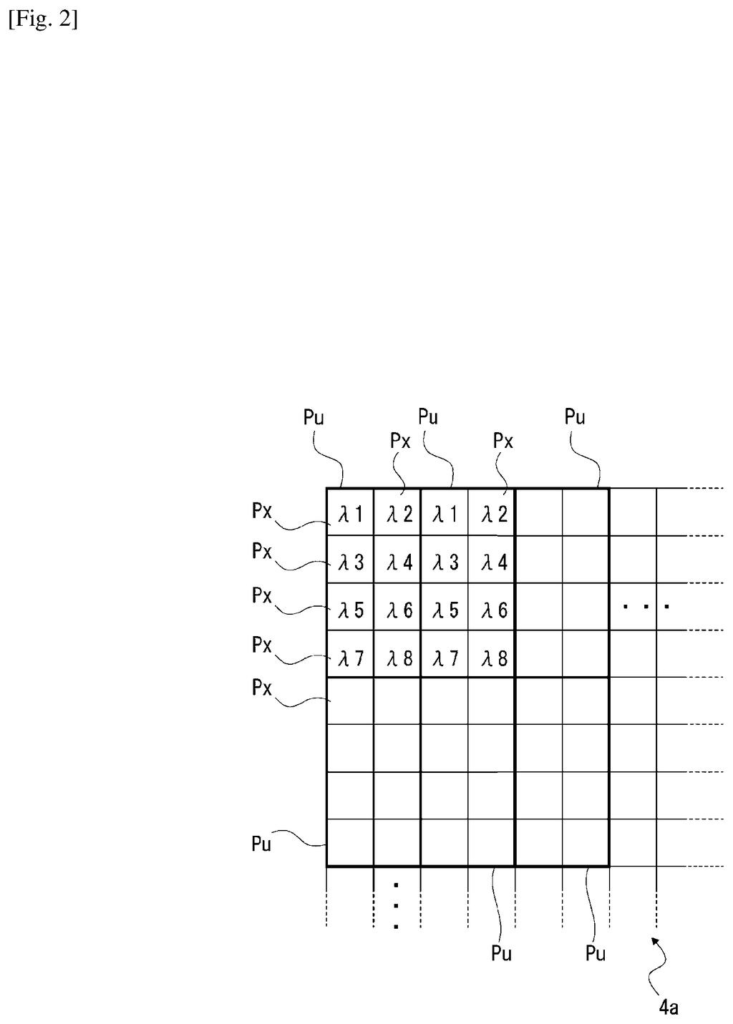
A spectral sensor measures light broken into specific wavelength bands, but most affordable sensors only output a small number of those bands. That limits how precisely you can describe the color or reflectance of a surface.
Sony's patent covers two linked components. First, a sensor output estimation unit takes two inputs: the spectral reflectance of a target object (essentially a precise description of how that surface reflects different wavelengths of light) and information about the light source illuminating it. From those inputs, it simulates what a real sensor would actually output. This simulation step means you can train the system without needing mountains of real-world sensor captures.
Second, a derivation processing unit uses that simulated output to find the best band-narrowing algorithm. "Band-narrowing" here is slightly counterintuitive: despite the name, it refers to the process of estimating a larger number of finer wavelength channels from a smaller number of broad sensor outputs (think of it as sharpening a blurry color reading into a precise spectrum). The system searches for the version of that algorithm that minimizes the error between its reconstructed spectrum and the known ground-truth reflectance.
The output is a tuned computation that can be deployed on the sensor's processing pipeline to upgrade sparse spectral readings into richer, more accurate color data in real time.
… a computation algorithm that minimizes an error between a wavelength characteristic indicated by post-band-narrowing spectral information obtained by executing the band-narrowing processing based on the sensor output and a wavelength characteristic indicated by the spectral reflectance information of the target subject.
Translation: It creates a math formula to reduce the difference between the filled in color data and the actual object colors.
What richer spectral data means for cameras and color-sensing devices
For consumer cameras, this kind of processing could mean more accurate colors under tricky lighting without requiring physically better sensors. Better spectral reconstruction also matters in industrial and scientific settings, where knowing exactly how a surface reflects light can indicate material composition or product defects.
The practical appeal is cost: if software can recover spectral detail that hardware would otherwise miss, manufacturers can use simpler, cheaper sensors while still hitting accuracy targets. That trade-off between sensor complexity and post-processing sophistication is a recurring theme in modern imaging, and Sony's approach leans firmly toward doing more in software.
This is the 65th Sony filing in our Camera patents coverage since May, adding to work like a self-adjusting distance camera and a touch-and-distance sensing robot that we've tracked.
The engineering trade Sony is making here is clear: instead of building sensors with more physical channels, it bets on simulation-trained software to fill the gap. That bet has a real cost attached.
The algorithm is only as good as the simulated training data. If the modeled light sources and reference objects don't match real-world conditions closely enough, the reconstructed spectrum will drift from reality in ways that are hard to detect. A sensor that confidently reports wrong color data can be worse than one that admits it doesn't know.
That said, the simulation-first approach does solve a genuine data problem: you can't easily collect ground-truth spectral reflectance paired with sensor readings at scale in the real world. Using physics-based simulation to generate training cases is a reasonable answer to that constraint. Whether the accuracy holds outside controlled conditions is the open question this patent doesn't resolve.
Get our take in your Top Stories
Liked this breakdown? Add Patentlyze as a preferred source on Google, and our plain-English take shows up more often in your Top Stories the next time Sony patent news breaks.
There are more where this came from
We read every patent application Big Tech publishes and send you the ones worth knowing. Plain English, free, every week.
The drawings
15 drawing sheets from US 2026/0281561 A1 · click any drawing to enlarge


Show the other 7 sheets


Want this weekly breakdown for a company we don't cover? Patentlyze Pro →
Be the first to weigh in