
Microsoft Patents a System That Runs Robot Missions in Simulation Before the Real Thing
Before a robot does something dangerous or complicated, what if you could watch a digital twin of it run the whole mission first, with an AI and a human in the room? That's the core idea in Microsoft's latest patent.
What Microsoft's robot rehearsal system actually does
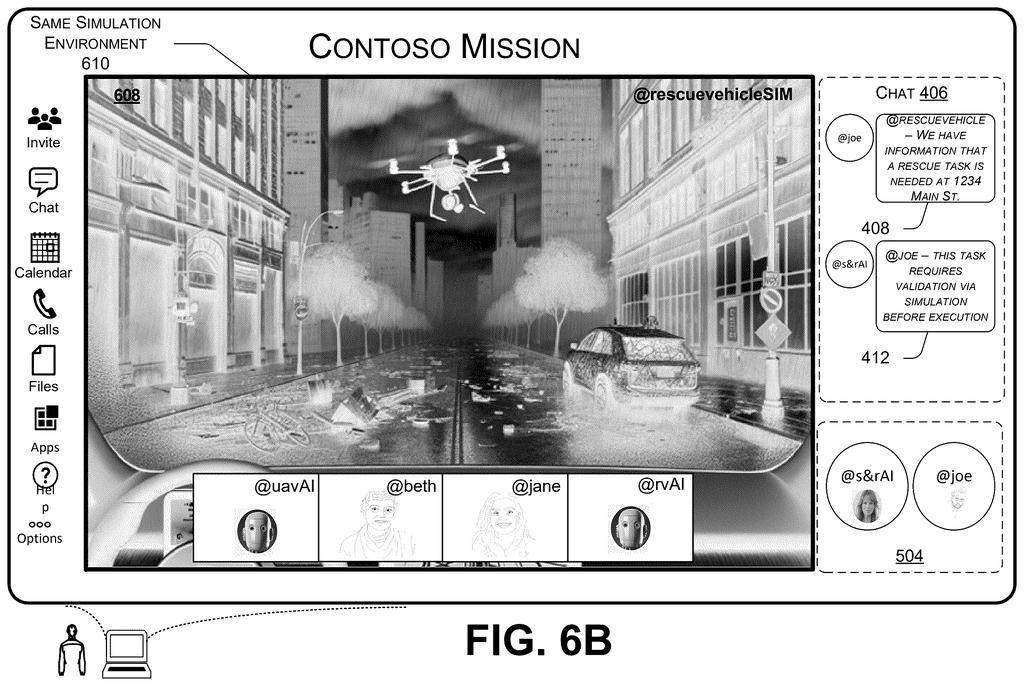
Imagine a rescue robot is about to enter a collapsed building to search for survivors. Before it takes a single step inside, a virtual copy of that robot runs the exact same path in a simulated version of the building, letting a human operator and an AI watch for anything that could go wrong.
That's the scenario Microsoft is designing for. The patent describes a system where humans, AI agents, and robots all join a shared digital workspace to plan and carry out a mission. When the robot is assigned a task, the system first spins up a virtual copy of the robot and a virtual version of the location, so the team can see the plan play out safely before any real hardware moves.
If the simulated run looks good, the actual robot gets its instructions. If something looks off, the team can adjust without anyone, or anything, getting hurt.
… before transmitting instructions for the robotic device participant to execute the task in the part of the geographical environment, causing the simulation environment to be displayed in the interaction environment; and causing a simulated version of the robotic device participant to execute the task in the simulation environment.
Translation: The system runs a trial run in a virtual world before sending any actual commands to the robot.
How the simulation fits inside the collaboration session
The patent describes a three-way collaboration session involving a human participant, at least one robotic device, and an AI agent, all working together toward a shared mission inside a defined geographic area.
When a task is assigned to the robot, the system does something important before sending any instructions to the physical hardware: it builds a simulation environment that mirrors the real-world location where the task will happen. Inside that simulation, a virtual copy of the robot attempts the task, and the results are shown inside the collaboration interface that the human operator sees.
- If the task is dangerous (entering a hazardous zone, for example), simulation lets the team confirm it's safe before committing the real robot.
- If the task is complex (a multi-step sequence with lots of moving parts), simulation lets the team confirm it's actually achievable and efficient.
- Only after the simulated run is validated does the system transmit real instructions to the physical robot.
The AI agent participant appears to play a role alongside the human in reviewing and guiding the session, though the patent focuses more on the simulation pipeline than on how the AI reasons internally.
For instance, a dangerous task to be executed by the actual robotic device may be simulated before actual execution to ensure the safety of the task is validated. Or, a complex task to be executed by the actual robotic device may be simulated before actual execution to ensure the effectiveness and/or efficiency of the task is validated.
Translation: Testing risky or complicated jobs ahead of time helps guarantee the robot will act safely and effectively.
What this means for AI-and-robot teamwork in the field
The practical upside here is about reducing the cost of mistakes in environments where mistakes are expensive or irreversible. Industrial inspection drones, disaster-response robots, military reconnaissance units, and logistics robots in warehouses all operate in situations where a failed command can damage equipment, endanger people, or waste significant time. A built-in rehearsal layer before execution is a direct answer to that risk.
Microsoft has been pushing into AI-driven enterprise and industrial tools for several years, and this filing sits at the intersection of robotics, AI coordination, and digital twins, an area that the latest Big Tech patents in robotics show companies competing on hard right now. Whether this ends up in an Azure robotics platform, a defense-sector product, or something else entirely, the architecture it describes, where AI, humans, and robots share a workspace and simulation gates real action, is one of the more concrete attempts to make human-robot teams less accident-prone.
This is the sixth Microsoft filing we've tracked since July in our agents that act for you watchlist, following one on plain English telecom commands and one on AI-written chart code.
The problem this patent attacks is real and underappreciated. Robots fail in the field for reasons that are often predictable in advance: a path that looked fine on a map turns out to be blocked, a task sequence that seemed logical skips a step, or a maneuver that works in testing doesn't account for a slightly different terrain. Those failures cost money, time, and sometimes lives, and they happen because there's usually no easy way to do a dry run in context before deployment.
The simulation-before-execution idea is not new in robotics research, but baking it directly into a shared collaboration session, where a human, an AI, and the robot itself are all present and the sim runs automatically before instructions are sent, is a tighter integration than most deployed systems manage today. The approach matches the size of the problem because it doesn't just alert you that something might go wrong; it shows you what going wrong looks like before it happens.
The open question is whether the simulation environment can be generated fast enough and accurately enough to be useful in fast-moving, real-world situations. A simulation that takes ten minutes to set up and diverges from reality by 20 percent helps less than it sounds. That's the engineering problem this patent raises but doesn't fully answer.
Get our take in your Top Stories
Liked this breakdown? Add Patentlyze as a preferred source on Google, and our plain-English take shows up more often in your Top Stories the next time Microsoft patent news breaks.
There are more where this came from
We read every patent application Big Tech publishes and send you the ones worth knowing. Plain English, free, every week.
The drawings
14 drawing sheets from US 2026/0254864 A1 · click any drawing to enlarge


Want this weekly breakdown for a company we don't cover? Patentlyze Pro →
Be the first to weigh in