Adobe
Adobe · AI / ML · Filed Feb 25, 2025 · USPTO published Aug 27, 2026 · Aug 27 release
Adobe Patents an AI System That Compresses 3D Scenes for Faster Editing
Adobe is patenting a way to take a full three-dimensional scene, squeeze it into a compact internal form using AI, and then rebuild it on demand. It's a foundational move that could change how 3D content gets edited, generated, or manipulated inside future Adobe tools.
- Publication number
- US 2026/0253311 A1(US20260253311A1)
- Applicant
- Adobe Inc.
- Filed · Published
- Feb 25, 2025 · Aug 27, 2026
- Inventors
- Jae shin Yoon, Yangtuanfeng Wang, Quankai Gao, Krishna Kumar Singh, Iliyan Atanasov Georgiev
- Status when we published
- Approved; patent expected soon
- Document
- 20 claims
- US classification
- 345/426
- Examiner
- CHEN, FRANK S (Art Unit 2611)
What Adobe's 3D scene compression actually does
Working with 3D scenes today is slow and memory-hungry because your computer has to keep track of every surface, depth layer, and spatial relationship all at once. Adobe wants to change that by teaching an AI to create a kind of shorthand for a 3D scene.
The idea is to feed a 3D representation of a scene into a machine learning model. The model encodes it into something called a latent space, which you can think of as a compressed sketch that captures the scene's essential information in far fewer numbers. When you need the actual 3D data back, the same model decodes it from that sketch.
This encode-then-decode approach is the same general strategy that powers modern AI image generators, just applied to full 3D environments instead of flat pictures. For Adobe's customers, the practical goal is making it easier for software to understand, edit, or generate 3D content without needing to wrangle raw geometry every step of the way.
… encoding, by the processing device, a tokenized three-dimensional representation based on the three-dimensional representation of the scene into a latent space using a machine learning model …
Translation: The system turns complex 3D scene data into a compact digital format that an AI can easily process and store.
How the model encodes and rebuilds a 3D scene
The patent describes a system that takes a three-dimensional representation of a scene (think geometry, depth, spatial structure) and first converts it into a tokenized form. Tokenization here means breaking the scene down into discrete chunks, similar to how a language model breaks a sentence into individual words before processing it.
Those tokens are then fed through a machine learning model that compresses them into a latent space (a lower-dimensional mathematical representation that retains the scene's meaningful structure without carrying every raw data point). The model learns which aspects of the scene matter most and encodes them efficiently.
The same model then runs in reverse, decoding three-dimensional information back out of that latent space. The output can be 3D geometry, depth maps, or other spatial data depending on what the system needs.
Key components the patent outlines:
- A pipeline that accepts a 3D scene as input
- A tokenization step that converts spatial data into model-digestible chunks
- A shared machine learning model handling both encoding and decoding
- A latent space as the intermediate compressed form
This architecture mirrors how variational autoencoders work in 2D image AI, extended to three-dimensional data.
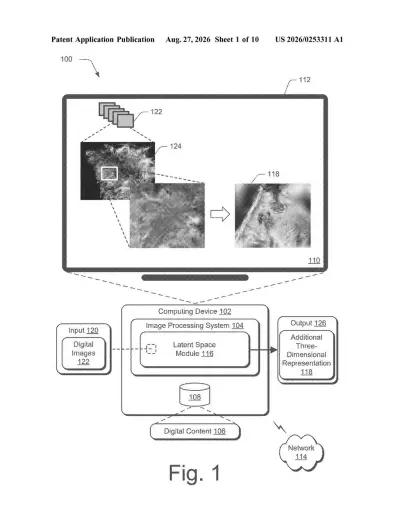
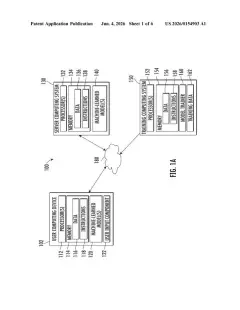
In implementation of techniques for generating a latent space for a three-dimensional scene, a computing device implements a latent space system to receive a three-dimensional representation of a scene.
Translation: Adobe is building a specialized system designed to ingest and manage detailed 3D environments.
What this means for AI-powered 3D creative tools
For anyone making 3D content, whether for games, film, or product visualization, the bottleneck has always been raw data volume. A latent space approach means AI tools could analyze, edit, or generate 3D scenes by operating on the compressed form rather than the full geometry, which is faster and opens the door to the same kind of prompt-based generation that already works for flat images.
Adobe's broader strategy has been to fold generative AI into every creative product it owns, and a solid 3D latent-space system is the kind of infrastructure that would sit underneath many future features rather than becoming one itself. This filing sits alongside the latest Big Tech patents in the 3D AI space, where companies are racing to build the encoding foundations that make generative 3D tools possible.
This is the 27th Adobe filing we've tracked in our AI photo editing race since May, following one-click material selection and filling 3D holes with text.
Source: US 2026/0253311 A1 at the USPTO (PDF). Full patent text and figures are in the official publication.
Get our take in your Top Stories
Liked this breakdown? Add Patentlyze as a preferred source on Google, and our plain-English take shows up more often in your Top Stories the next time Adobe patent news breaks.
Add Patentlyze on Google
One click.
There are more where this came from
We read the new patents from Big Tech, carmakers and more and send you the ones worth knowing. Plain English, free, every week.
The drawings · 10 sheets
10 drawing sheets from US 2026/0253311 A1 · click any drawing to enlarge


Show the other 2 sheets


More from Adobe
All 270 Adobe patents →
More in AI simulation
All 193 AI simulation patents →
Sony
Sony Patents Tech That Rebuilds 3D Scenes From Ordinary Video Footage
Google
Google Patents an AI That Reconstructs 3D Objects From One Photo — and Admits When It's Guessing
Google
Google Patents an AI That Builds a 3D Model of Your Specific Object From a Few Photos
Nvidia