Waymo (Google)
Waymo (Google) · Automotive · Filed Apr 10, 2026 · USPTO published Aug 27, 2026 · Aug 27 release
Waymo Patents System That Predicts How Long Drivers Take To React
Waymo is building a system that doesn't just track what other drivers do, it estimates how long they'll take to even notice something has gone wrong. That gap between surprise and response is exactly where accidents happen.
- Publication number
- US 2026/0249885 A1(US20260249885A1)
- Applicant
- Waymo LLC
- Filed · Published
- Apr 10, 2026 · Aug 27, 2026
- Inventors
- Johan Engstrom, Shuyuan Liu, Azadeh Dinparastdjadid, Camelia Valentina Simoiu
- Status when we published
- Waiting for an examiner
- Document
- 20 claims
- US classification
- 701/1
- Parent application
- Division of 18/233,696 (filed Aug 14, 2023)(18233696)
How Waymo measures a driver's reaction time to surprises
Ever been so focused on something that you didn't see a car drift into your lane until it was nearly too late? That delay between something unexpected happening and your brain registering it as a problem is what Waymo is trying to measure and predict.
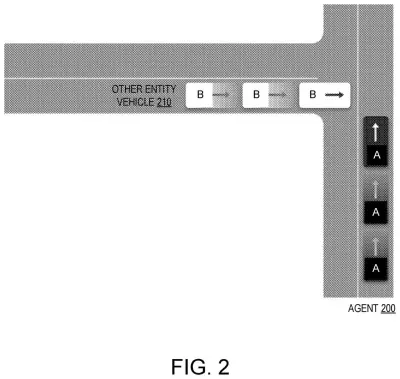
Waymo's patent describes a method for estimating how quickly a person in a traffic scene (a driver, cyclist, or pedestrian) will respond to something that caught them off guard. The system watches how a nearby vehicle or person is moving, compares that movement to what was expected, and tallies up how surprising that behavior is over time. Once the surprise reaches a certain level, the system predicts the moment when the human would likely begin to react.
For Waymo's self-driving cars, knowing that a distracted driver nearby probably hasn't noticed a problem yet gives the robot car a window to act first. It's a way of modeling not just what humans do, but when they do it.
… continually updating, at each time step of a plurality of time steps, an accumulated measure of surprise for the agent due to the movements of another entity in the traffic environment …
Translation: The system constantly tracks how surprised a driver gets over time based on what other cars do.
How surprise accumulates until a response threshold is crossed
The patent describes a step-by-step process for producing a predicted response time for any agent (a human driver, pedestrian, or cyclist) in a traffic scene.
At each tiny slice of time, the system:
- Uses a generative model (a type of AI that produces a range of plausible future paths) to build a picture of where a nearby entity was expected to go.
- Compares where that entity actually ended up against those expectations, calculating a measure of surprise for that moment.
- Adds that surprise value to a running total, the accumulated surprise.
When the running total crosses a set threshold, the system declares that the human agent has now experienced enough unexpected stimulus to trigger a reaction. The moment of crossing becomes the predicted response time.
The underlying logic borrows from cognitive science: humans don't react instantly to change. They react once something has been surprising enough, for long enough, to break through their current mental model of the world. This patent turns that psychological idea into a computable number.
The system is designed to run continuously and in parallel for multiple agents in the same scene, giving Waymo's software a real-time picture of who has noticed what and who probably hasn't yet.
If the accumulated measure of surprise crosses a threshold at a particular point in time, a predicted response time for the agent is generated based on the particular point in time that the accumulated measure of surprise crosses the threshold.
Translation: Once that surprise builds up past a certain point, the system calculates exactly how long the driver takes to react.
What this means for how Waymo plans around human behavior
For a self-driving car, the most dangerous moment is often not the collision itself but the seconds before it, when a human nearby still hasn't registered that something is wrong. If Waymo's car can estimate that a driver beside it is still oblivious to an obstacle ahead, it can start braking or steering earlier than it would if it assumed everyone around it was paying full attention.
This kind of human-behavior modeling sits at the frontier of autonomous vehicle research, and it shows up across new Big Tech patents in the self-driving space as companies race to handle the unpredictable human element rather than just the physics of the road. Getting the timing right matters enormously: predict the response too early and the car acts on a false alarm; predict it too late and the safety margin vanishes.
This is the 51st Google filing we've tracked since May in the self-driving sensing race, building on blind spot navigation and redundant braking.
Source: US 2026/0249885 A1 at the USPTO (PDF). Full patent text and figures are in the official publication.
Get our take in your Top Stories
Liked this breakdown? Add Patentlyze as a preferred source on Google, and our plain-English take shows up more often in your Top Stories the next time Google patent news breaks.
Add Patentlyze on Google
One click.
There are more where this came from
We read the new patents from Big Tech, carmakers and more and send you the ones worth knowing. Plain English, free, every week.
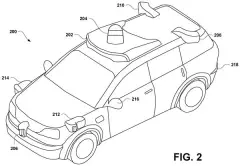
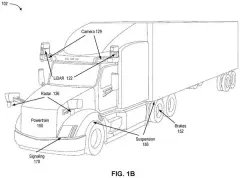
The drawings · 8 sheets
8 drawing sheets from US 2026/0249885 A1 · click any drawing to enlarge


More from Google
All 1,127 Google patents →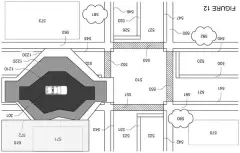
More in Automotive
All 432 Automotive patents →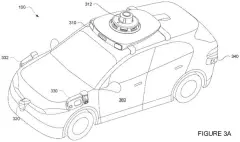
Waymo (Google)
Google Patent Reveals Robotaxi Sensors That Self-Diagnose Vision Loss in Bad Weather
Waymo (Google)
Waymo Patents a Way to Stop Its Robotaxis From Drowning Out Each Other's Radar
Waymo (Google)
Waymo Patents a Dual-Brain Fallback System for When Its Robotaxis Break Mid-Drive
Waymo (Google)