
Sony Patents a System That Reads Your Mood Mid-Game to Keep You Playing
Sony is working on a system that reads how you're feeling while you play and sends you a personalized nudge right before you're likely to quit or disengage. It's less a game mechanic and more a behavioral early-warning system built into the game itself.
What Sony's in-game mood detector actually does
Ever hit a rough patch in a game and just... stopped? Sony is working on tech that tries to catch you at that exact moment.
The idea is to run a background tool that picks up signals about your emotional state while you're playing. The game tracks certain progress milestones, and when you're getting close to one, the system checks how you're feeling. If the signals suggest you're frustrated, bored, or about to give up, it sends you a notification before you reach that milestone, not after.
The goal seems to be keeping you invested at moments when players are most likely to walk away. Think of it as the game reading the room and offering a well-timed word of encouragement or reward before you decide it's not worth continuing.
… launching the sentiment analyzer in the game; gathering, via the sentiment analyzer, one or more inputs associated with the user; extracting, by the sentiment analyzer, sentiment information from the one or more inputs …
Translation: It turns on a mood tracker to collect data and figure out how the player is feeling.
How the sentiment analyzer times its nudges
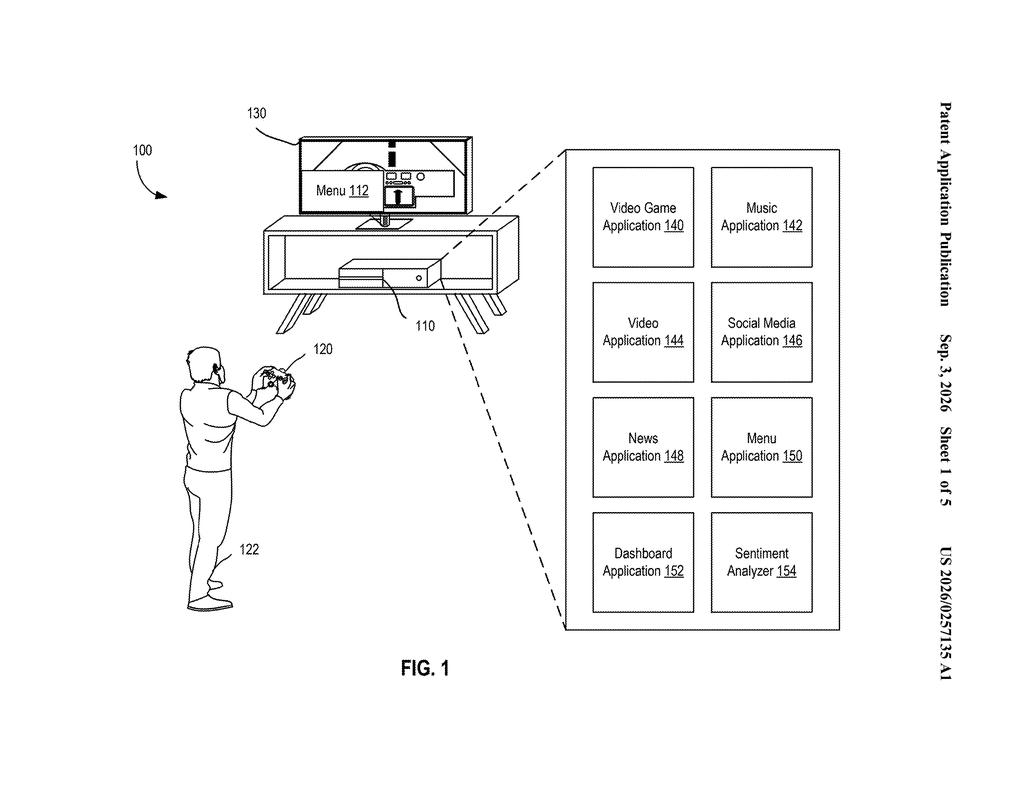
The patent describes a sentiment analyzer that runs inside a game while you're playing. It collects one or more inputs from the user (the patent doesn't lock in a specific signal type, leaving room for audio, facial expression, controller behavior, or other data) and extracts what it calls sentiment information from those inputs.
Separately, the game holds a list of benchmarks, structured checkpoints or milestones in the gameplay. The system continuously monitors two things at once: how close you are to one of those benchmarks, and what your sentiment signals look like.
When the system detects that you're approaching a benchmark, it fires up the sentiment analyzer if it isn't already running. If the extracted sentiment suggests negative engagement (frustration, disengagement, declining interest), the system outputs a notification to you before you actually reach that benchmark.
The timing is the central claim here. The notification fires proactively, not reactively. Rather than waiting until you quit or fail, the system tries to intervene while you still have momentum, using your own emotional signals as the trigger.
… outputting, prior to the user reaching the at least one of the plurality of benchmarks, a notification to the user based at least in part on the sentiment information.
Translation: It sends an alert to the player based on their mood before they hit a specific point in the game.
What mood-aware games could mean for players
For players, this could change the texture of how games handle difficulty spikes and drop-off points. A well-timed in-game message, bonus reward, or hint, delivered right when you're struggling but haven't given up yet, is genuinely different from a generic pop-up after you've already failed three times.
Sony's run of player-engagement filings suggests the company sees behavioral data as a long-term layer in game design. That said, a system that reads your emotional state in real time also raises fair questions about how that data is stored, who sees it, and what happens to it after the session ends. Those questions aren't answered in this document.
Sony's fourth AI recommendation filing we've tracked since May follows work on in-store movement ads and play-history game trailers.
Most games lose players at predictable moments: a brutal difficulty spike, a puzzle with no clear path forward, a stretch where nothing seems to happen. This system is designed to catch you at exactly that moment, before you close the game and don't come back.
The part players will never see is the part that matters most. The game is reading your inputs, drawing conclusions about your mood, and deciding whether to intervene, all before you've consciously decided you're frustrated.
That invisible quality is both the strength and the risk. Players who feel rescued will probably never know why. Players who feel watched, if they find out at all, will want to know what was collected and where it went, and this filing has no answer for that.
Get our take in your Top Stories
Liked this breakdown? Add Patentlyze as a preferred source on Google, and our plain-English take shows up more often in your Top Stories the next time Sony patent news breaks.
There are more where this came from
We read every patent application Big Tech publishes and send you the ones worth knowing. Plain English, free, every week.
The drawings
5 drawing sheets from US 2026/0257135 A1 · click any drawing to enlarge


Want this weekly breakdown for a company we don't cover? Patentlyze Pro →
Be the first to weigh in