
Sony Patents a Way to Shrink Huge Game Assets Into AI Thumbnails for Cloud Play
Cloud gaming's dirty secret is data size: a single high-fidelity 3D building or vehicle can be enormous, and sending it over the internet in real time is a real problem. Sony's new patent describes a way to let an AI encode that object into a fraction of its original size before it ever leaves the server.
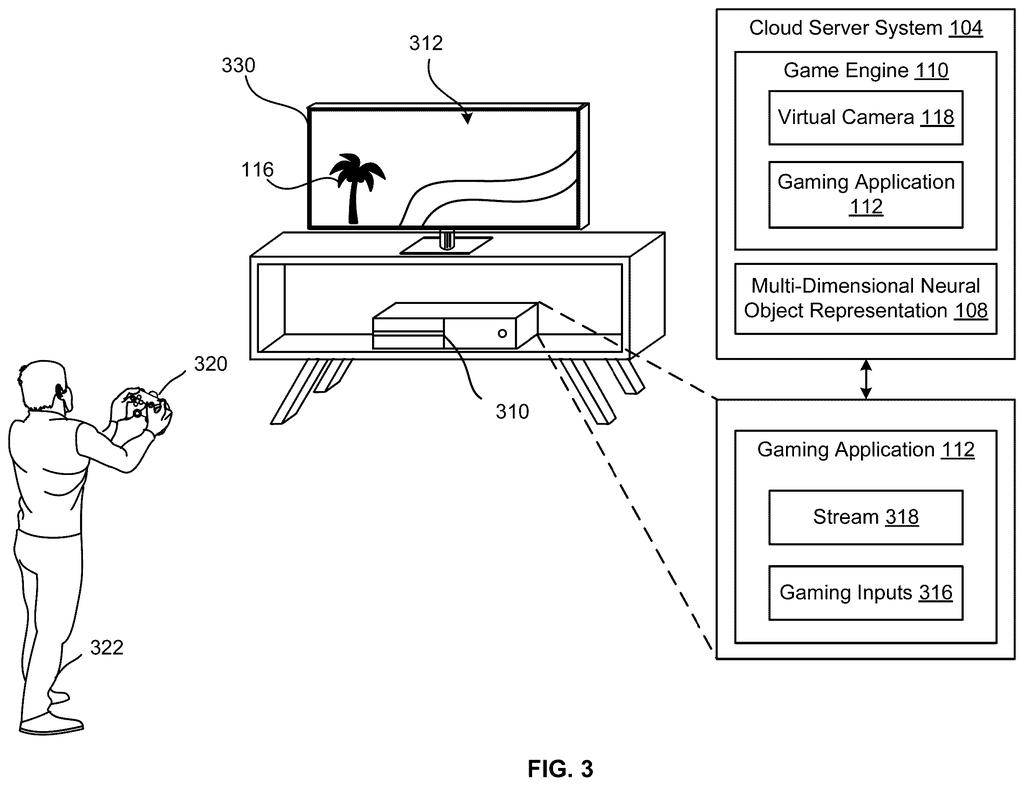
How Sony's AI stand-ins keep cloud games running
Ever tried to load a huge file over a slow connection and watched the spinner just keep going? That same problem haunts cloud gaming, where the server has to push fully detailed 3D objects to your device fast enough that the game still feels smooth.
Sony's patent describes a system where a game server essentially photographs a 3D asset (a building, a vehicle, a landscape chunk) from multiple angles using a virtual camera inside the game engine. Those images are then fed into a neural network, which compresses the object into a much smaller data package called a neural object representation. Instead of shipping the full, heavy asset to your device, the server ships this compact AI-generated stand-in.
Your device's own rendering engine receives that smaller package and uses it to reconstruct what the object looks like on screen. The idea is that you get something that looks close to the original without the server having to blast gigabytes of geometry at you every time a new part of the game world appears.
… generating, based at least in part on the one or more video frames, a multi-dimensional neural object representation of the asset, wherein a first data size of the asset is larger than a second data size of the multi-dimensional neural object representation; …
Translation: The cloud server turns video frames of a heavy game asset into a much smaller neural AI model.
How the server films, compresses, and ships the neural object
The system works in two distinct phases: asset preparation on the server and asset delivery to the client.
On the server side, a game engine renders a high-fidelity version of an asset, and a virtual camera captures video frames of that rendering from whatever angles are needed. Those frames go into a neural network that produces a multi-dimensional neural object representation (think of it as an AI-compressed blueprint) whose file size is explicitly smaller than the original asset. The patent doesn't specify which neural representation format is used, but the category typically includes techniques like Neural Radiance Fields or similar view-synthesis approaches that encode how an object looks from any angle into a compact set of numbers.
On the client side, when a player's device requests an asset, the server sends the compressed neural version instead of the raw geometry. The client's own rendering engine takes that neural object as an input and reconstructs a displayable image from it locally.
- Server films the 3D asset with a virtual camera
- A neural network compresses the footage into a small representation
- The client receives the compressed version on demand
- The client's renderer uses it to display the asset in the game
The patent positions this specifically for large-scale assets in cloud gaming, where bandwidth and streaming latency (the delay between server and screen) make sending full assets impractical in real time.
Multi-dimensional neural object representations can be generated to use as placeholders for large-scale assets in cloud gaming development.
Translation: AI models replace huge game files during the development of cloud games to save space.
What smaller game assets mean for cloud gaming quality
Cloud gaming has always bumped into a ceiling: the more detailed a game's world, the more data has to travel between server and player, and that data has to arrive fast enough that the game doesn't stutter. Compressing individual objects using neural encoding is a way to attack that problem at the asset level rather than relying entirely on video-stream compression (which blurs the whole picture) or forcing players onto faster connections.
For you as a player, the practical hope is that visually complex game worlds become more feasible over ordinary home internet speeds. For Sony specifically, this matters because its PlayStation Network and cloud gaming ambitions depend on making high-end games feel playable on devices that can't run a full game engine locally, from phones to thin clients to future hardware.
Sony's 17th filing in the AI simulation space we've tracked since May adds to a run that includes one on 3D game world mapping and one on learning object angles for streaming.
Claim 1 as written is broad in a way that could cause real headaches for competitors. It covers any cloud server that renders an asset, captures frames with a virtual camera, generates a neural representation that is smaller than the source, and then serves that representation to a client. That's a wide net. It doesn't restrict the type of neural representation, the rendering technique, the compression ratio, or the game genre.
That breadth is a double-edged sword for Sony. A broad claim is easier to argue covers a competitor's system, but it's also easier for a patent examiner or a later challenger to find prior art that knocks it down. Neural radiance fields and similar compressed scene representations have been a very active research area since at least 2020, so Sony will need to show its application is meaningfully distinct from what academics and other companies have already published.
If it holds, the claim could touch any cloud gaming platform that uses neural compression at the per-object level, which is a meaningful slice of where the industry is heading. Whether Sony can maintain a claim this wide through examination is the real question.
There are more where this came from
We read every patent application Big Tech publishes and send you the ones worth knowing. Plain English, free, every week.
The drawings
6 drawing sheets from US 2026/0273416 A1 · click any drawing to enlarge


Want this weekly breakdown for a company we don't cover? Patentlyze Pro →