
Sony Patents a Dual-Coil Speaker Driver That Squeezes More Sound from a Small Magnet
Sony has filed a patent for a speaker driver that runs two coils simultaneously through a redesigned magnetic gap, a mechanical trick that could push more force through a smaller, thinner speaker without sacrificing audio quality.
What Sony's dual-coil speaker design actually does
Imagine holding a pair of headphones up to your ear and hearing bass that sounds too full and deep for how light and thin they are. That gap between size and sound quality is one of the hardest problems in speaker engineering, and Sony just patented a specific approach to closing it.
Inside every speaker or pair of headphones is a tiny coil of wire that vibrates back and forth inside a magnetic field to produce sound. Sony's patent describes a way to fit two coils instead of one into that magnetic zone, by reshaping the metal plate that sits on top of the magnet. The plate now has a downward-pointing lip, and both coils sit right next to that lip where the magnetic pull is strongest.
The practical upside is that you get double the pushing force on the cone or diaphragm that actually moves air and creates sound, which can mean louder or more controlled audio without physically enlarging the speaker. That matters a lot in headphones, soundbars, and any device where physical space is at a premium.
… the magnetic circuit unit includes a top plate portion that constitutes a part of the yoke and has a top surface portion located above the magnet and extending in a direction substantially perpendicular to a movable direction of the movable unit, the top plate portion has a protrusion portion that protrudes downward from an inner edge or an outer edge of the top surface portion …
Translation: The metal plate above the magnet features a lip that bends downward to shape the magnetic field.
How the protruding top plate puts both coils to work
A conventional speaker driver has one coil (called a voice coil) that hangs inside a gap in a magnetic circuit. When electrical audio signals flow through the coil, the magnet pushes and pulls it, moving the diaphragm and producing sound. The amount of force you can generate is largely set by how much coil wire sits inside the strongest part of the magnetic field.
Sony's patent rethinks the shape of the top plate, the metal yoke component that sits directly above the magnet. Instead of a flat plate, the design adds a protrusion, a downward-pointing lip along the inner or outer edge. This lip creates a second vertical surface inside the magnetic circuit, and Sony positions a first coil and a second coil so that both of their winding sections face that side surface simultaneously.
The result is that both coils sit in a region of high magnetic flux (high magnetic force), not just one. Key components at a glance:
- Top plate with protrusion: the reshaped yoke that creates two usable magnetic surfaces instead of one
- First coil and second coil: two separate voice coils, each positioned to gain drive force from the same magnetic gap
- Diaphragm: the cone or membrane that both coils connect to, which vibrates to produce sound
By doubling the active coil area in the magnetic field, the driver can apply more linear force to the diaphragm across a wider range of movement, which is a common route to both higher output and lower distortion.
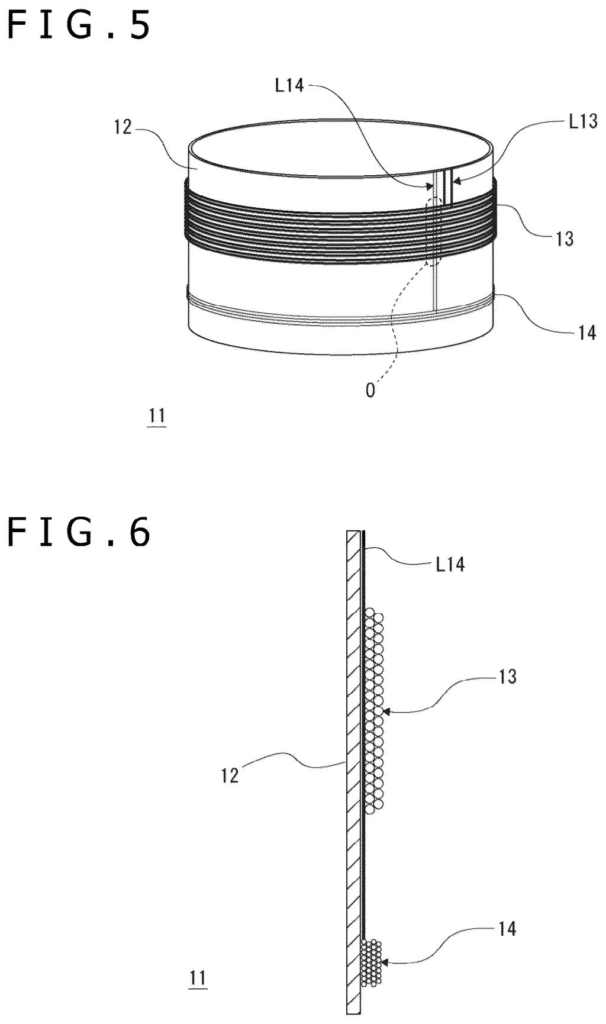
The movable unit has a first coil and a second coil each constituting the coil. Winding portions of the first coil and the second coil of the movable unit face a protruding side surface that is a side surface of the top plate portion on a side where the protrusion portion is formed.
Translation: Two separate wire coils sit right alongside that downward-bending lip to drive the speaker.
What this means for your next Sony headphones or speaker
For you as a listener, the most direct payoff is the possibility of smaller devices that sound bigger, or existing-size devices that sound cleaner at higher volumes. Speaker drivers are often the binding constraint in headphone and portable speaker design: engineers want more output, but adding a larger magnet or a longer coil assembly means the product gets heavier and thicker. Sony's approach tries to extract more performance from the same physical footprint by putting two coils where one used to go.
Sony makes some of the most popular consumer audio products in the world, from the WH-1000XM series noise-canceling headphones to soundbars and earbuds, so a mechanical improvement at the driver level could eventually show up across a wide product range. Audio hardware patents tend to be incremental by nature, but this specific geometry change is the sort of low-level fix that compounds across an entire lineup, and it sits alongside a steady stream of new Big Tech patents in acoustics and signal processing that are reshaping how consumer audio hardware is built.
That makes this Sony's 13th filing we've tracked in our Audio coverage since May, a run that includes applications like sending sound layers per ear and fixing muffled controller speakers.
If you care about headphones or portable speakers, this patent targets the one thing that most directly limits how good a small speaker can sound: the force the driver can apply to move air. The redesign lives entirely in the physical hardware, which means the benefit would show up whether the device is playing music, a podcast, or a film.
You would notice it as a speaker that stays clean and controlled when you push the volume up, rather than getting harsh or distorted at the moment you most want clarity. The change itself is modest: a small lip added to a metal plate, plus a second coil fitted alongside the first.
That narrowness makes it credible. The most durable improvements in audio history have usually arrived as small mechanical refinements exactly like this one.
Get our take in your Top Stories
Liked this breakdown? Add Patentlyze as a preferred source on Google, and our plain-English take shows up more often in your Top Stories the next time Sony patent news breaks.
There are more where this came from
We read every patent application Big Tech publishes and send you the ones worth knowing. Plain English, free, every week.
The drawings
16 drawing sheets from US 2026/0255116 A1 · click any drawing to enlarge


Want this weekly breakdown for a company we don't cover? Patentlyze Pro →
Be the first to weigh in