
Tesla Patents a Dashboard Display Showing How Hard Each Wheel Is Pulling
Tesla is working on a system that shows drivers — in plain, visual terms — exactly how hard each wheel is working and how close it is to breaking something. Think of it like a fuel gauge, but for mechanical stress.
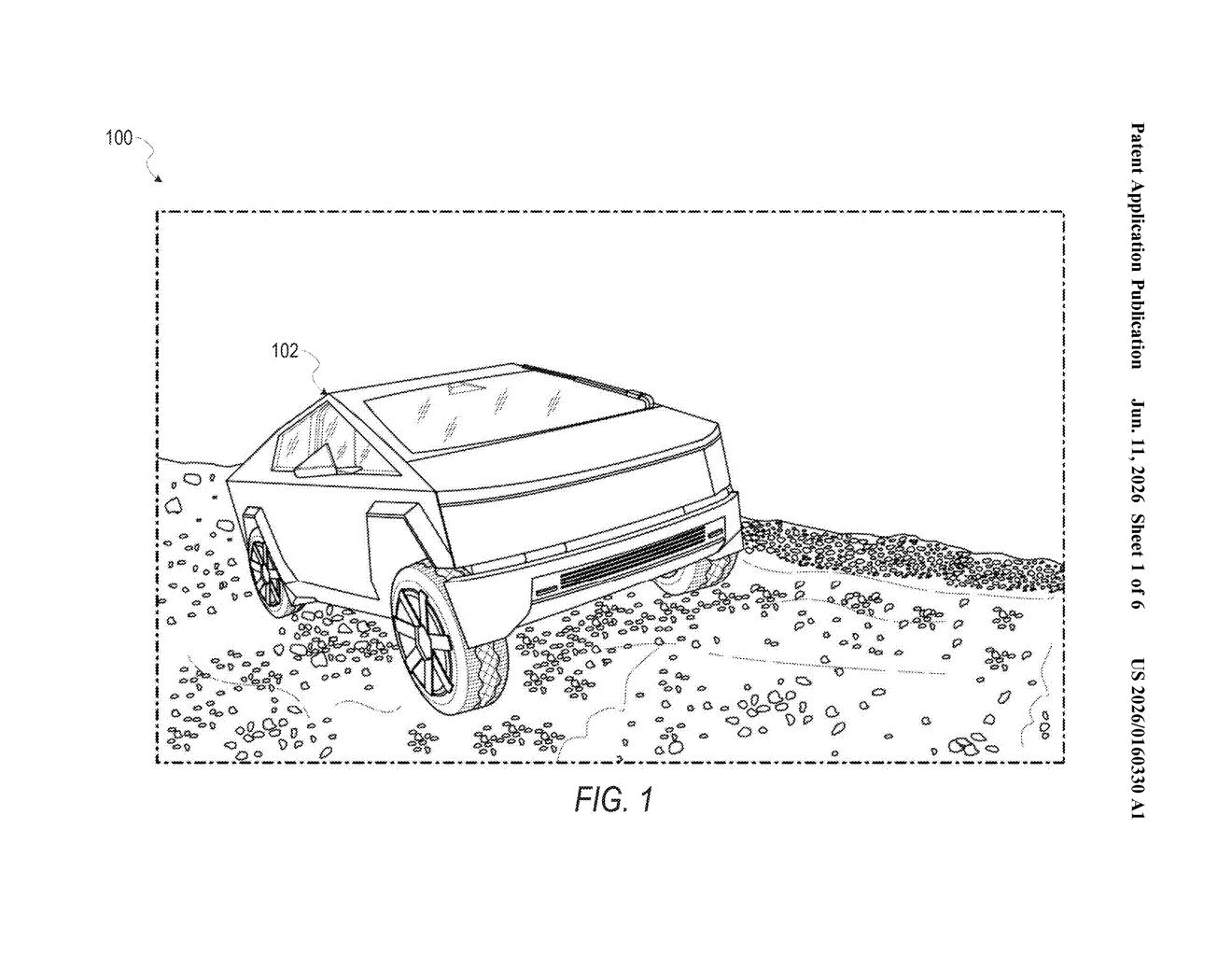
What Tesla's per-wheel torque display actually does
Imagine you're crawling a steep, rocky trail in a truck. One wheel is spinning faster than the others, and the axle connecting them is under enormous strain — but you have no idea how much. Push too hard, and something snaps. Pull back too early, and you leave capability on the table.
Tesla's patent describes a system that solves this by showing you, right on the dashboard, a live bar for each wheel — how much torque is being applied right now, and how much that wheel can safely take. When you get close to the limit, the system can warn you or even dial things back automatically.
The thresholds aren't fixed numbers. They shift dynamically based on your steering angle and how much the vehicle is flexing over terrain — because a sharp turn or a twisted frame changes how much stress a driveshaft can handle. It's a safety net that adapts to what you're actually doing.
How Tesla calculates torque limits from wheel-spin data
The system continuously pulls data from wheel-speed sensors and other vehicle sensors. It calculates the wheel rotation delta — essentially, how differently the left and right wheels on an axle are spinning. That difference is a reliable proxy for how much torque is being transmitted through each halfshaft (the metal shaft connecting a wheel to the central differential).
That calculated torque value is then checked against a lookup table — a pre-built reference chart that maps safe torque limits to specific driving conditions, particularly the vehicle's articulation angle (how much the body is twisting over uneven ground) and steering angle. A halfshaft under a tight steering lock can handle less stress than one pointed straight, so the threshold changes accordingly.
The comparison between live torque and the safe threshold is then rendered as a visual bar element on the interior display — one bar per wheel, showing current load versus max capacity. If the ratio gets dangerous:
- The driver receives a visual or audio alert
- The system can automatically cap torque output to prevent component failure
This is designed specifically for vehicles with differential lockers (a mechanism that forces both wheels on an axle to spin at the same speed, useful off-road) and/or individual corner motors — each wheel driven by its own electric motor, as on a Cybertruck.
What this means for Tesla's off-road ambitions
Off-road driving has always involved a lot of guesswork. Experienced drivers develop a feel for how hard they can push, but that knowledge takes years to build and still can't account for hidden variables like a pre-stressed driveshaft or an unusual suspension angle. A real-time visual readout removes the guesswork and lets any driver — not just experts — use the vehicle's full capability without wrecking it.
For Tesla specifically, this fits squarely into the Cybertruck's positioning as a serious off-road vehicle. The Cybertruck already has rear and front motor setups with locking differentials. A system like this would make those features genuinely accessible to everyday owners who wouldn't otherwise know when they're about to over-torque a halfshaft.
This is a genuinely practical idea. Off-road torque management has historically been tribal knowledge — passed between enthusiasts, not displayed on a screen. Tesla making it visual and automatic is exactly the kind of feature that could separate a Cybertruck owner who confidently clears a tough trail from one who snaps a driveshaft trying. It's not flashy engineering, but it's the kind of thing that makes a capable vehicle actually usable.
There are more where this came from
We read every patent application Big Tech publishes and send you the ones worth knowing. Plain English, free, every week.
Want this weekly breakdown for a company we don't cover? Patentlyze Pro →